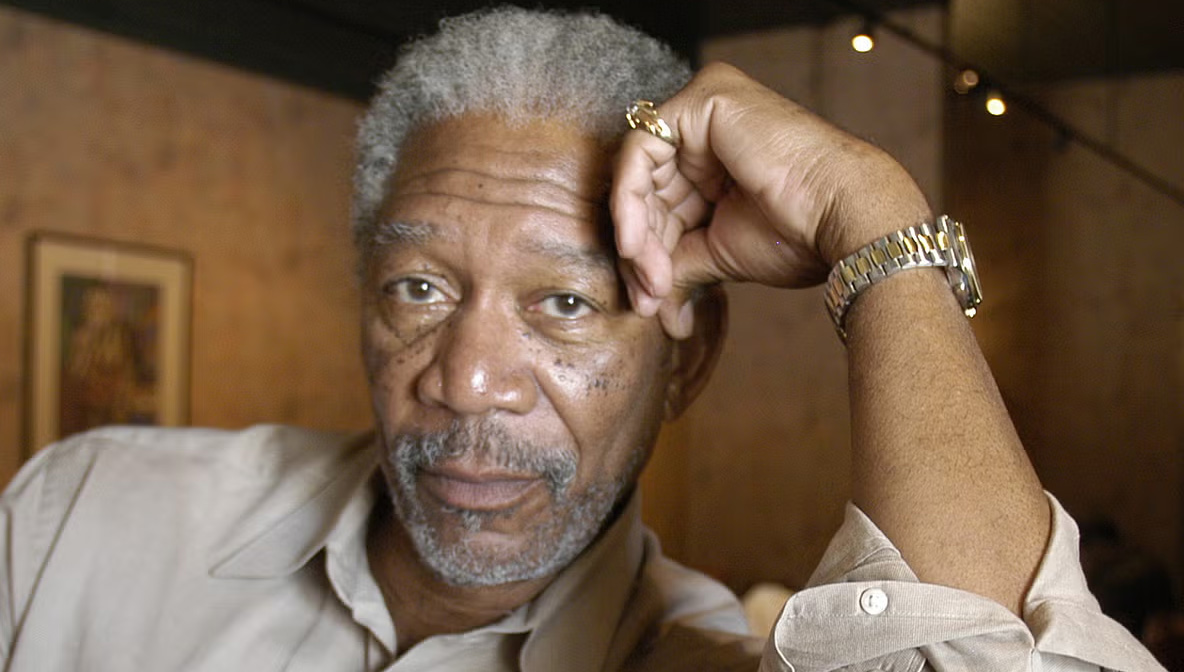

Close your eyes and imagine a voice. It’s a voice that doesn’t just speak words; it carries them on a river of deep, resonant calm. It’s a voice that can narrate the dawn of creation, the wisdom of a convicted murderer, the fury of a president, or the hope of a boxer. That voice belongs to Morgan Freeman, but to define him by that voice alone is to miss the profound journey of the man himself. He is not an overnight sensation. His story is one of the great slow-burn triumphs in American cultural history.
Morgan Freeman is more than an actor; he is an American archetype. He embodies dignity, patience, and a hard-won wisdom that seems to emanate from a deep well of lived experience. For decades, he was the best-kept secret of the American theater, a craftsman honing his art far from the glare of Hollywood. Then, in his fifties, an age when many actors see their careers winding down, his exploded into a stratosphere of fame and respect that few ever achieve. His journey from a Mississippi childhood to becoming the literal voice of God in film is a testament to talent, timing, and an unshakable belief in his own ability. This is the story of a man who waited for the world to catch up to him, and in doing so, became the narrator of our collective conscience.
Early Life & Background: The Mississippi Roots of a Storyteller
Morgan Freeman was born on June 1, 1937, in Memphis, Tennessee, but his soul was forged in the crucible of the Mississippi Delta. He was the youngest of five children born to Mayme Edna, a teacher, and Morgan Porterfield Freeman, a barber who died of cirrhosis in 1961. His parents’ troubled marriage meant that Morgan spent much of his childhood shuttling between them, but his most formative years were spent in the care of his maternal grandmother in Charleston, Mississippi.
Life in the segregated South was strict and structured. His grandmother was a devout Baptist, and the church was the center of their community. It was here, in the pews of the black church, that Freeman first discovered performance. The call-and-response, the rhythmic oration of the preachers, the raw emotion of the gospel music—it was a masterclass in drama and storytelling. He found another outlet at school, where a teacher made him stand on a desk and recite a poem to the class. The resulting applause was a revelation; he was hooked.
A pivotal moment came when he was nine years old. He had earned a small part in a school play. The moment he stepped on stage, a feeling of absolute belonging washed over him. He later described it as “falling in love with the idea of being someone else.” This epiphany set his course. At 12, he won a statewide drama competition, and his confidence in his path solidified.
After high school, he turned down a partial drama scholarship from Jackson State University, viewing it as a dead end in the segregated South. Instead, he sought a different kind of education: he joined the United States Air Force in 1955, serving as a mechanic and radar technician. The military was his ticket out of Mississippi, a chance to see the world and escape the rigid constraints of Jim Crow. He was honorably discharged in 1959, having decided that his future was not in the Air Force, but on the stage. He moved to Los Angeles to pursue acting, taking classes at the Pasadena Playhouse and supporting himself with low-wage jobs as a transcript clerk at Los Angeles City College and a dancer at the 1964 New York World’s Fair. The long apprenticeship had begun.
Career & Achievements: The Long Road to Stardom
Morgan Freeman’s career is a masterclass in patience. For the first twenty-five years of his professional life, he was a working actor, not a star. He paid his dues in the most demanding arenas.
The Theater Years (1960s-1970s)
Freeman’s first real break came not in film, but on the stage. He moved to New York City in the early 1960s, immersing himself in the Off-Off-Broadway scene. He was a member of the prestigious Negro Ensemble Company, a groundbreaking theater group dedicated to producing works about the Black experience. Here, he honed his craft in classics and new works, developing the technical precision and emotional depth that would become his trademark.
His big Broadway break came in 1967, in an all-black version of the musical Hello, Dolly! starring Pearl Bailey. While it was a supporting role, it put him on the map. The 1970s were a period of steady work and critical respect. He won a Drama Desk Award and a Clarence Derwent Award for his role in The Mighty Gents in 1978 and snagged a Tony Award nomination for his performance in The Gospel at Colonus. He was a respected and known entity in the theater world, a king in a small but significant kingdom.
Television and Early Film: The Character Actor (1970s-1980s)
To a national audience, Freeman first became a familiar face through television. For six years, from 1971 to 1977, he played the charming, intellectual Easy Reader on the beloved children’s show The Electric Company. It was a job that paid the bills and made him a hero to a generation of kids, but it was a world away from the complex dramatic roles he craved.
His film career began in earnest in the early 1970s with small parts, but his first significant role came in 1987. He played the fast-talking, ruthless pimp, Fast Black, in the gritty drama Street Smart. The performance was a thunderclap. Critics were stunned by his ferocity and menace, a stark contrast to the gentle Easy Reader. He received his first Academy Award nomination for Best Supporting Actor. Suddenly, Hollywood saw him in a new light. He was no longer just a reliable presence; he was a force.
The Leading Man: A Star is Born (1989-2000)
The floodgates opened. In 1989, he delivered two of the most iconic performances of his career. First, he played the patient, dignified chauffeur Hoke Colburn in Driving Miss Daisy. His chemistry with Jessica Tandy was magical; he conveyed a universe of history, pain, and quiet dignity with a mere glance. The film won the Academy Award for Best Picture, and Freeman was nominated for Best Actor.
That same year, he embodied the archetype that would define his persona for decades: the wise, moral guide. In Glory, he played Sergeant Major John Rawlins, a gravedigger who becomes the moral center for the first all-Black regiment in the Civil War. His speech to the frightened soldiers around the campfire is a masterpiece of quiet authority.
The 1990s cemented his status as a beloved American icon. He was the unflappable, world-weary police detective in Se7en (1995). He was the voice of calm and reason as President Tom Beck in the blockbuster Deep Impact (1998). And, of course, he was Ellis Boyd “Red” Redding in The Shawshank Redemption (1994). As Red, the man who can “get things,” Freeman delivered the film’s soulful, hopeful narration. His line, “Get busy livin’, or get busy dyin’,” became a cultural touchstone. Though not a huge box-office hit initially, the film grew into one of the most beloved of all time, and Freeman’s performance is its enduring heart.
The Elder Statesman and the Voice of God (2000-Present)
Entering his sixties, Freeman didn’t slow down; he ascended to a new plateau. He played God in Bruce Almighty (2003) and its sequel, a piece of casting that felt less like acting and more like a public confirmation of his persona. He won the Academy Award for Best Supporting Actor for his role in Million Dollar Baby (2004), where he played the wise, seen-it-all former boxer, Scrap Iron Dupris.
He became the narrator for some of the most prestigious documentaries of our time, including the Emmy-winning series The Story of God with Morgan Freeman and the landmark March of the Penguins. His voice, now instantly recognizable to billions, lent gravity and warmth to any project it touched. He continued to headline major films like the Dark Knight trilogy as Lucius Fox, the moral conscience of Wayne Enterprises, and Invictus (2009), where he delivered an uncanny portrayal of Nelson Mandela, earning another Oscar nomination.
Personal Life: The Man Behind the Voice
Freeman’s personal life has been marked by the same complexity as the characters he plays. He has been married twice: first to Jeanette Adair Bradshaw from 1967 to 1979, and then to Myrna Colley-Lee from 1984 to 2010. He has four children from previous relationships and his marriages.
He is known to be a private man who values his freedom. He is an avid sailor, a passion that reflects his love for solitude and the open horizon. For decades, he owned and piloted his own private aircraft, holding several licenses. These hobbies speak to a man who, despite his fame, craves control and independence.
In 2008, he was involved in a serious car accident near his home in Mississippi, which left him with significant injuries and fueled tabloid speculation about his relationship with a passenger. The incident was a rare and jarring public intrusion into his carefully guarded private life.
More recently, in 2018, he faced allegations of sexual harassment and inappropriate behavior by multiple women, which he partially acknowledged while also stating, “I did not create unsafe work environments. I did not assault women.” The allegations prompted a period of public reckoning and led to the suspension of some of his projects, creating a complicated layer to his otherwise pristine public image. It was a stark reminder that the wise, godlike persona on screen is a performance, and the man himself is as human and fallible as any other.
Legacy & Impact: The Sound of Dignity
Morgan Freeman’s impact on culture is immeasurable. He is more than an actor; he is an institution.
-
Redefining the Black Leading Man: Before Freeman’s ascent, leading roles for Black men over 50 were scarce and often stereotyped. He shattered that ceiling. He brought a new kind of Black masculinity to the screen—one that was intellectual, patient, authoritative, and gentle. He wasn’t defined by rage or athleticism, but by wisdom and quiet power. He paved the way for actors like Denzel Washington and Samuel L. Jackson by proving that audiences of all races would embrace a Black man as a figure of universal authority and morality.
-
The Narrator of America: His voice has become the soundtrack for our national consciousness. When a documentary needs gravitas, when a film needs a wise guide, when a moment in history needs to feel monumental, Morgan Freeman is the voice we trust. He has become, in a very real sense, America’s storyteller.
-
A Master of His Craft: His legacy for actors is one of disciplined craft. He is not a method actor who loses himself in a role; he is a technical master who builds a character from the outside in, focusing on voice, posture, and rhythm. His performances are lessons in economy and control.
-
The Triumph of Patience: In an industry obsessed with youth, his career is a powerful testament to the value of experience. He is the ultimate example of a career built not on a single burst of fame, but on a lifetime of dedicated work. He proves that greatness can be a slow, steady burn that eventually produces the brightest light.
Final Thoughts, and What We Learn
The story of Morgan Freeman is a profound lesson in the art of becoming. It is a rejection of the myth of overnight success and a celebration of the long, patient journey.
What We Learn from His Life:
-
Your Time Will Come, If You Are Ready: Freeman spent decades preparing for the fame that found him in his fifties. He didn’t languish; he trained. He was a master craftsman long before the world knew his name. His story teaches us to focus on honing our skills, trusting that readiness meeting opportunity is the true formula for success.
-
Dignity is a Powerful Choice: In a world that often rewards loudness, Freeman built a career on quiet strength. He demonstrates that power doesn’t always have to shout; sometimes, its most potent form is a calm, steady whisper. His characters, and the man himself, remind us that dignity is an internal compass, not an external reward.
-
The Voice is an Instrument: Freeman treats his voice like a Stradivarius. He understands its rhythm, its tone, its power to comfort and command. He teaches us to be mindful of how we use our own voice, both literally and metaphorically, in our communication with the world.
-
Complexity is Human: The allegations against him serve as a crucial lesson in separating the art from the artist. They remind us that our heroes are human, capable of great artistry and profound flaws. It complicates his legacy, forcing us to hold two truths at once: the brilliance of his work and the troubling nature of the accusations.
-
It’s Never Too Late: Morgan Freeman’s most iconic achievements came after most people consider mid-life. He is a walking, talking embodiment of the idea that your greatest chapters can be written long after you think the story is set. His life is a permission slip to keep dreaming, working, and growing, no matter your age.
Morgan Freeman found his timeless rhythm not in a frantic chase for fame, but in the patient, daily practice of his art. He waited, he worked, and when his moment finally arrived, he was ready. He didn’t just become a star; he became a part of our cultural firmament, the deep, resonant voice in the ear of America, reminding us of our capacity for wisdom, hope, and redemption.