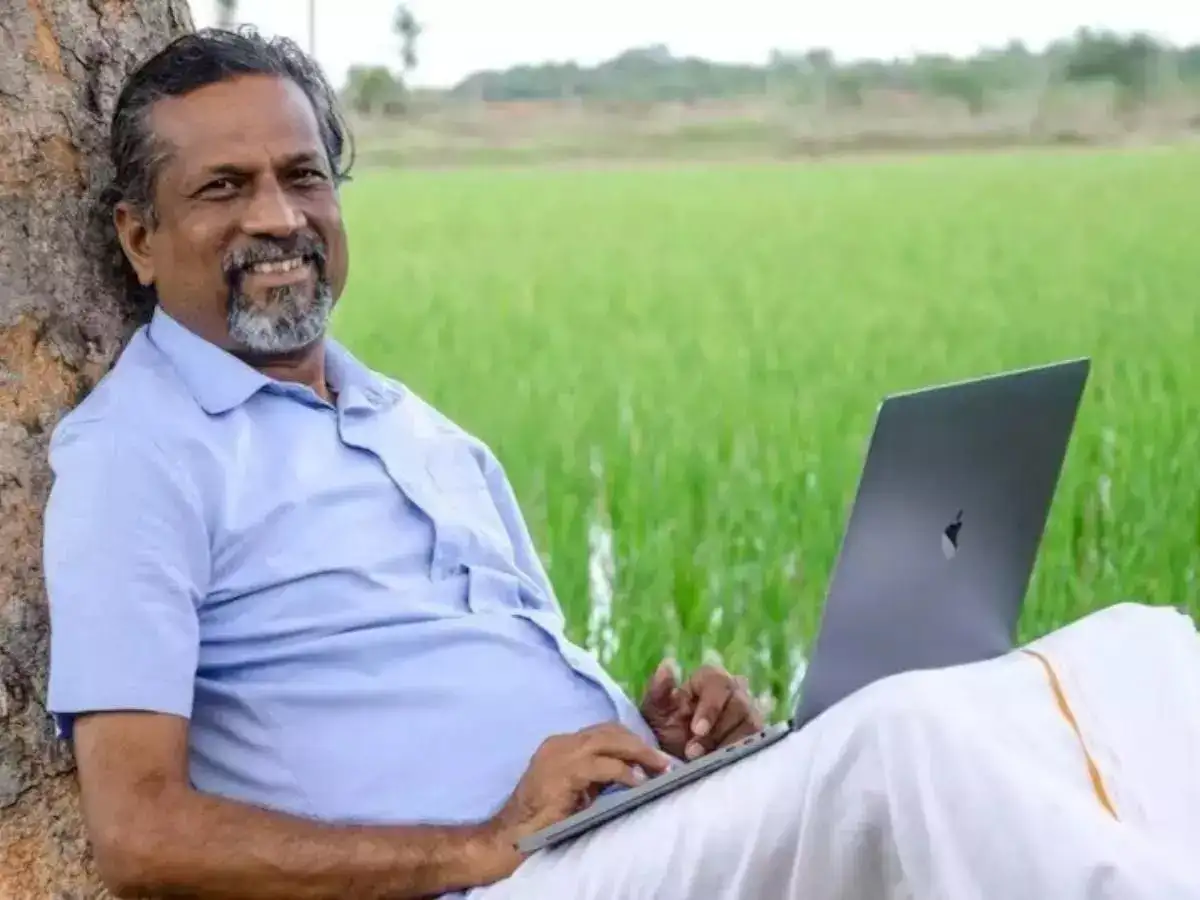

In a world where success is often measured by the gloss of a corporate skyscraper address and the frequency of one’s appearances on global news channels, the story of Sridhar Vembu stands in quiet, defiant contrast. He is a billionaire who gave up the bustling silicon valleys of America for the tranquil, dusty lanes of a remote Indian village. He is the CEO of a multi-billion dollar tech giant, Zoho Corporation, who is more likely to be found discussing crop patterns with local farmers than attending a high-profile tech summit.
Sridhar Vembu is not just a successful entrepreneur; he is a philosopher of business, a quiet revolutionary who is challenging the very foundations of how we think about work, community, and progress. His journey from a humble background in Tamil Nadu to the pinnacle of global software, and then his conscious decision to “reverse-migrate” to rural India, is more than an inspiring rags-to-riches tale. It is a masterclass in building a sustainable, humane, and fiercely independent enterprise that thrives on its own terms. This is the story of the man who is building the future, not in a futuristic city, but in the heart of India’s villages.
Early Life & Background: The Seeds of Simplicity and Scholarship
Sridhar Vembu was born in 1968 in a small village near Chennai, Tamil Nadu, into a middle-class family. His father was a judge, and his mother was a homemaker. This detail is crucial—it was a family that valued discipline, integrity, and, above all, education. However, this was not an upbringing of luxury. It was one rooted in simplicity and a deep connection to his cultural roots.
From a very young age, Sridhar was an exceptional student. He possessed a sharp, inquisitive mind that excelled in mathematics and the sciences. He attended the prestigious Indian Institute of Technology (IIT) Madras, the hallowed engineering institution that has been the launchpad for countless Indian tech luminaries. He graduated with a Bachelor’s degree in Electrical Engineering in 1989.
But his academic journey was far from over. Like many of his brightest contemporaries, he looked westward for higher studies. He moved to the United States and enrolled at Princeton University, one of the world’s leading Ivy League institutions. In 1994, he earned his Ph.D. in Electrical Engineering. On paper, he was the perfect candidate for a stellar career in the American corporate world or academia. The script was written: a brilliant Indian student makes good in the land of opportunity.
However, the seeds of a different vision had already been sown. His upbringing in India, with its stark contrasts of urban ambition and rural resilience, had given him a perspective that was uniquely his own. While he appreciated the opportunities America provided, he was not entirely seduced by the “American Dream” template. He carried with him a latent question: Was there another way?
Career & Achievements: Building an Empire, The Zoho Way
Sridhar Vembu’s career did not begin with a eureka moment in a garage, but with a pragmatic decision in a network of friends and family. In 1996, alongside his siblings and a friend, he founded AdventNet Inc. in Pleasanton, California. The company’s initial focus was on network management software, a niche but essential field in the burgeoning internet era.
The early days were a grind. They operated out of a small apartment in Chennai with just a handful of employees. There was no venture capital, no lavish funding rounds. This lack of external funding, which seemed like a disadvantage at the time, would become the cornerstone of Zoho’s philosophy. It forced them to be frugal, to focus on generating revenue from customers from day one, and to build products that people were actually willing to pay for. It was a bootstrap mentality that bred resilience and financial discipline.
The Pivot to Zoho and the SaaS Revolution
In the early 2000s, the company saw the seismic shift towards cloud computing and Software-as-a-Service (SaaS). While giants like Salesforce were emerging, Vembu and his team recognized an opportunity to create a suite of web-based business applications that were powerful yet affordable, especially for small and medium-sized businesses.
This led to the birth of Zoho in 2005. The name was chosen for its global appeal and ease of pronunciation. The vision was audacious: to take on Microsoft and Google in the productivity software space. While others focused on a single “killer app,” Zoho’s strategy was to build an entire ecosystem—a “suite” that included everything from word processing (Zoho Writer) and spreadsheets (Zoho Sheet) to customer relationship management (Zoho CRM), email, and project management tools.
The Unorthodox Business Model: Fierce Independence
What truly sets Zoho apart in the tech world is its radical business model.
-
No Venture Capital: To this day, Zoho remains privately held and profitable, funded entirely by its own revenue. This gives Vembu and his team unparalleled freedom. They don’t have to chase quarterly results to please investors. They can make long-term bets, invest in research, and stay true to their vision without external pressure. In a world obsessed with “burn rates” and “valuation,” Zoho’s profitability is a quiet act of rebellion.
-
The “Transnational” Model: This is perhaps Vembu’s most groundbreaking contribution to global business strategy. Instead of concentrating all his operations in expensive urban hubs like Bangalore or San Francisco, he deliberately set up offices in smaller towns and rural areas across India. The flagship development center is in Estancia Vallam, a campus on the outskirts of Chennai, but Zoho has a significant presence in smaller towns like Tenkasi and Renigunta.
-
Investing in People: Zoho University, started in 2005, is a testament to Vembu’s belief in potential over pedigree. Recognizing that the formal education system often leaves students unprepared for the workforce, he created his own in-house training program. They recruit talented students from local villages, often from non-engineering backgrounds, and train them in software development. This not only solves the talent crunch but also provides life-changing opportunities to those who would otherwise be left behind. It is a powerful model of corporate-led social upliftment that is also brilliant for business.
Achievements and Recognition
Under Vembu’s leadership, Zoho has grown into a global behemoth with over 100 million users worldwide, more than 55 applications in its suite, and a reputation for robust, cost-effective software. Its success has not gone unnoticed.
-
In 2021, Sridhar Vembu was awarded India’s fourth-highest civilian honor, the Padma Shri, by the Government of India for his contributions to trade and industry.
-
He has consistently featured in the Forbes list of billionaires, a rare feat for a bootstrapped entrepreneur.
-
Perhaps the most significant recognition of his unique model came when he was appointed to the National Security Advisory Board (NSAB) of India in 2022, signaling that his ideas on rural development and self-reliance have national strategic importance.
Personal Life: The Philosopher-CEO in a Village
If Sridhar Vembu’s professional life is unorthodox, his personal life is a direct embodiment of his philosophy. Around 2019, he made a life-altering decision. He moved from the comfortable suburbs of California to a village called Mathalamparai in the Tenkasi district of Tamil Nadu.
This was not a vacation home or a retreat. It was a permanent move. He lives there in a modest home, with a routine that is a world away from that of a typical corporate CEO. His day might start with a walk through the village, conversations with local farmers, or tending to his garden. He is deeply involved in the community, funding local schools, improving infrastructure, and understanding the grassroots challenges of rural life.
He is married to Pramila Vembu, who is a director at Zoho and plays a key role in the company’s operations. Together, they are living the experiment of “reverse migration.” Vembu is often seen in simple, traditional attire, his lifestyle a conscious rejection of the trappings of extreme wealth. He is a man who finds more satisfaction in solving a local water problem than in closing a multi-million dollar deal.
His public persona is that of a thoughtful, articulate individual who shuns the spotlight. His interviews and Twitter feed are not filled with corporate jargon, but with insightful musings on economics, education, Indian civilization, and the importance of building from the ground up. He is, in every sense, a philosopher-king who has chosen his kingdom to be a small village, from where he quietly oversees a global empire.
Legacy & Impact: Beyond Software, A Blueprint for the Future
Sridhar Vembu’s legacy is multi-layered and still being written.
1. The “Zoho Model” of Rural Development: His most profound impact may well be the blueprint he is creating for rural economic revitalization. He has proven, with data and profitability, that world-class technology and innovation do not have to be concentrated in overcrowded, expensive megacities. By setting up offices in rural areas, Zoho is curbing urban migration, creating local ecosystems, and proving that distributed work is not just a pandemic-era trend but a sustainable economic model. Governments and businesses across the developing world are now looking at the “Zoho model” as a viable template.
2. A Challenge to Venture Capital Dogma: In an era where “disruption” is funded by billions in VC money, Zoho stands as a towering counter-narrative. Vembu has shown that it is possible to build a world-class, globally competitive tech company without ever taking a dollar of external funding. This empowers a generation of entrepreneurs to believe in bootstrapping, in profitability, and in maintaining control of their vision.
3. Redefining Corporate Social Responsibility (CSR): For most companies, CSR is a separate department that donates a portion of profits to charity. For Vembu, social good is integrated directly into the business model. Zoho University is not charity; it is a strategic talent pipeline that also transforms lives. Investing in rural offices is not philanthropy; it is a smart business decision that also develops the region. He has blurred the line between profit and purpose, showing that they can be two sides of the same coin.
4. An Intellectual Contribution: Vembu is sparking a crucial conversation about the nature of progress. He argues that blindly aping Western models of urbanization and consumerism is not the only path for a country like India. He champions the idea of “rooted modernism”—embracing technology and progress while staying firmly rooted in one’s cultural and community values. He is a vocal advocate for strengthening rural economies as the true foundation of a nation’s resilience.
What We Learn: The Vembu Playbook for Life and Work
The story of Sridhar Vembu is not just to be admired; it is to be learned from. Here are the key takeaways from his life and philosophy:
-
Potential Over Pedigree: Your background or the brand of your college does not define your potential. By investing in raw talent from villages, Vembu has shown that given the right training and opportunity, human potential can flourish anywhere.
-
Freedom Through Profitability: Building a business that generates its own revenue is the ultimate freedom. It liberates you from the demands of investors and allows you to pursue a long-term vision with integrity.
-
Think Long-Term: In a world of quarterly reports and sprint cycles, have the courage to think in decades. Zoho’s success was not built overnight; it was the result of patient, persistent effort on a vision they believed in.
-
Embrace Frugality as a Superpower: Scarcity breeds innovation. Not having lavish funding forces you to be creative, resourceful, and deeply connected to what your customers truly need.
-
You Can Be Successful and Humble: Success does not have to come with arrogance or ostentation. Vembu’s simple lifestyle is a powerful reminder that true fulfillment comes from purpose, not from possessions.
-
Build Where You Are Planted: You don’t have to move to a global hub to make a global impact. Vembu’s most radical act was to take the global to the local. You can build something that changes the world from your own village, town, or community.
-
Question the Default Path: The standard script—great education, high-paying job in a big city, climb the corporate ladder—is not the only one. Vembu’s life is a testament to the power of writing your own script, even if it seems illogical to others.
Conclusion
Sridhar Vembu is more than a billionaire or a CEO. He is a visionary who is living his vision, day by day, in a small Indian village. He has not only built one of the world’s most respected software companies but has also provided a hopeful, humane, and practical alternative to the often-soulless machinery of global capitalism. His story is a beacon, showing us that it is possible to be globally successful while being locally rooted, to be fiercely profitable while being deeply humane. In the story of Sridhar Vembu, we don’t just find inspiration for building better businesses; we find a blueprint for building a better, more balanced life.