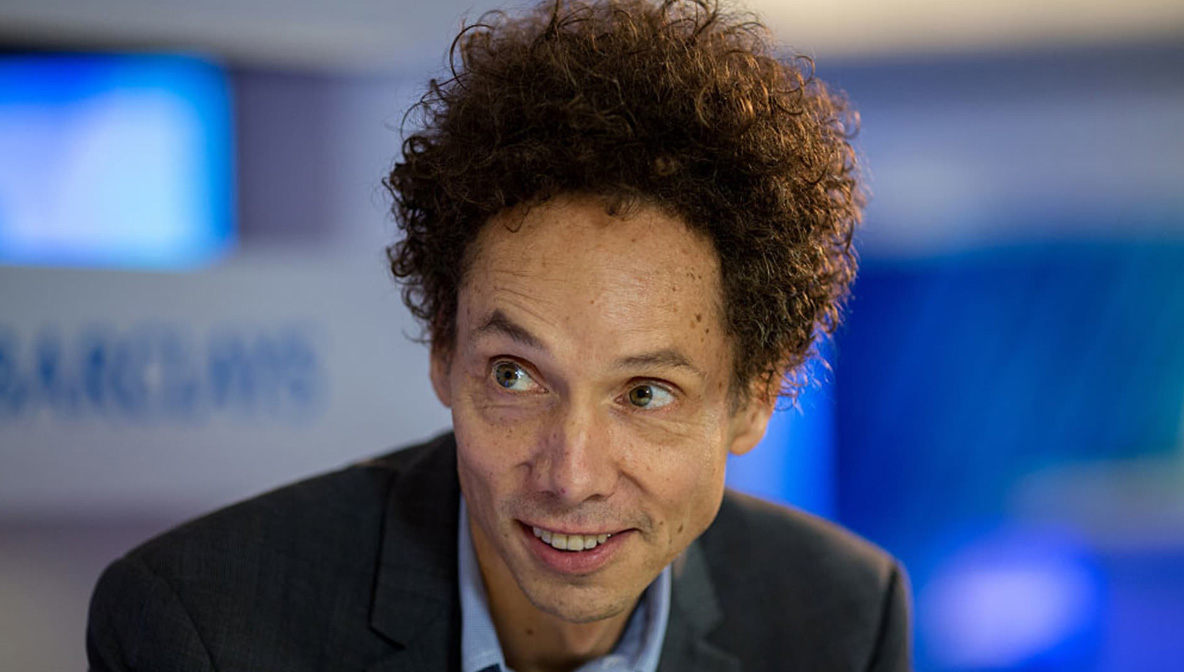

If you’ve ever heard that it takes 10,000 hours to become an expert, or used the term “tipping point” to describe a cultural shift, or wondered about the hidden factors behind success, you’ve been touched by the work of Malcolm Gladwell. He isn’t a traditional academic or a self-help guru. He is something far more unique: a master storyteller who uses the tools of sociology, psychology, and history to answer the simple, profound questions we all ask. Why do some ideas succeed and others fail? What truly separates the extraordinary from the ordinary? Is our intuition as reliable as we think?
Gladwell took complex academic research and turned it into a series of “aha!” moments for millions of readers. He became the intellectual gateway drug for an entire generation, making the science of human behavior feel less like homework and more like a thrilling detective story. With his famous afro and a knack for a perfect phrase, he challenged our deepest assumptions about merit, justice, and destiny. This is the story of how a curious kid from Canada became one of the most influential public intellectuals of our time, not by discovering new facts, but by connecting the dots in a way no one else had.
Introduction: The Master of the “Aha!” Moment
Before Malcolm Gladwell, pop social science was often dry, dense, and inaccessible. He revolutionized the genre. His books don’t feel like lectures; they feel like conversations with a brilliantly insightful friend who keeps saying, “Wait, have you heard this story? It’s incredible, and it explains everything.”
His core talent lies in what he calls “the Gladwellian sensibility”—the ability to take a seemingly mundane or isolated phenomenon (like the sudden popularity of Hush Puppies shoes, or the reduction of crime in New York City) and connect it to a much larger, more profound idea about how the world works. He is a master of the counterintuitive argument. He thrives on turning our common sense on its head.
Is success purely a matter of talent and hard work? Gladwell says not exactly—it’s also about hidden advantages, cultural legacies, and being in the right place at the right time. Are we rational decision-makers? Gladwell argues our snap judgments can be both brilliantly accurate and tragically flawed, often in predictable ways.
His work has been phenomenally successful. All five of his major books—The Tipping Point, Blink, Outliers, What the Dog Saw, and David and Goliath—have been number one New York Times bestsellers. He’s been a staff writer for The New Yorker for decades and his podcast, Revisionist History, is a constant in the top charts, re-examining overlooked or misunderstood events from the past.
But his influence goes beyond sales figures. He has given us a new vocabulary to understand our lives and our society. He is both celebrated and criticized, but never ignored. He makes us think, and in an age of distraction, that might be his greatest achievement of all.
Early Life & Background: The Roots of a Storyteller
Malcolm Gladwell was born on September 3, 1963, in Fareham, Hampshire, England. His story begins not in North America, but with a rich multicultural heritage that would later inform his global perspective. His mother, Joyce Gladwell, was a Jamaican-born psychotherapist. His father, Graham Gladwell, was a mathematics professor from England.
When Malcolm was six, the family moved to Canada, settling in Elmira, a small town in Ontario. This experience of being an outsider—an English-born boy with a mixed-race heritage in a predominantly Mennonite community—undoubtedly shaped his observational skills. He has described himself as a “socially awkward” child, more comfortable observing the social rituals of his peers than participating in them. This is a classic origin story for a writer: the quiet observer on the periphery, trying to decipher the rules of the game.
His family was a crucible of intellectual curiosity. Dinner table conversations were not about trivialities; they were vigorous debates about ideas. His mother, in particular, encouraged his intellectual pursuits. In a telling anecdote, when a young Malcolm expressed a desire to become a lawyer, she replied, “Don’t be a lawyer. That’s a trade. Be an intellectual.” She defined an intellectual as someone who finds a problem that interests them and spends their life trying to understand it. This single piece of advice became a north star for his entire career.
He was also a gifted middle-distance runner. His dedication to track and field was intense, and he achieved significant success as a teenager, even holding his high school’s record for the 1500 meters for many years. This experience with athletics would later surface in his writing, not as a nostalgic memory, but as a rich source of material on talent, practice, and the psychology of competition.
After high school, Gladwell attended the University of Toronto, where he studied history. He has said he chose history not because he wanted to be a historian, but because he saw it as the study of everything. It was the perfect training ground for a future connector of dots. He graduated in 1984 and, after a brief, unsuccessful attempt at a career in advertising (he was rejected by every agency he applied to), he found his calling almost by accident.
Career & Achievements: From Fact-Checker to Cultural Phenomenon
Gladwell’s career began not with a bang, but with the meticulous, unglamorous work of a journalism apprentice. In 1987, he was hired as a fact-checker for The American Spectator, a conservative magazine. This role, while often tedious, was a form of boot camp. It taught him rigor, the importance of getting every detail right, and how to deconstruct an argument piece by piece.
He then moved to The Washington Post in 1987, where he worked for nine years, first as a science writer and then as the New York City bureau chief. The Post was where he honed his voice and learned how to find the compelling human story buried within complex topics. He wasn’t just reporting on science; he was telling stories about the people behind the science.
The turning point came in 1996 when he was hired as a staff writer for The New Yorker. Under the legendary editor Tina Brown, and later David Remnick, The New Yorker provided the perfect platform for his unique talents. It was a magazine that valued deep reporting, elegant prose, and intellectual curiosity—all Gladwell hallmarks.
It was at The New Yorker that he wrote the articles that would become the foundation for his first book. He was exploring ideas about social epidemics, the power of context, and the personalities who spread ideas. In 2000, he published The Tipping Point: How Little Things Can Make a Big Difference.
The book was an instant smash hit. It introduced a powerful new metaphor into the cultural lexicon. The “Tipping Point” is that magic moment when an idea, trend, or social behavior crosses a threshold, tips, and spreads like wildfire. He populated the book with memorable archetypes: Connectors (people who know everyone), Mavens (information specialists), and Salesmen (persuaders). He used case studies from the sudden revival of Hush Puppies to the dramatic drop in New York City’s crime rate to illustrate his points. The public and business world were captivated. Suddenly, everyone was talking about how to make their product or idea “tip.”
He had established his formula: a catchy, central theory, supported by a tapestry of riveting stories from diverse fields, all woven together with accessible prose.
He followed it up in 2005 with Blink: The Power of Thinking Without Thinking. This book explored the power and peril of our rapid cognition—the split-second decisions and first impressions we make in the “blink” of an eye. He explained “thin-slicing,” our ability to find patterns in situations based on very narrow slices of experience. He showed how experts can make astonishingly accurate snap judgments, but also how our unconscious biases can lead us tragically astray. Blink sparked conversations in boardrooms, police departments, and living rooms about the power of intuition.
Then, in 2008, he published what is perhaps his most influential and debated book: Outliers: The Story of Success. This was Gladwell’s direct challenge to the myth of the self-made man. He argued that we pay too much attention to what successful people are like, and not enough to where they are from—their culture, their family, their generation, and the idiosyncratic opportunities they were given.
He introduced two concepts that have become part of modern folklore:
-
The 10,000-Hour Rule: The idea that achieving true mastery in any complex field requires at least 10,000 hours of dedicated practice.
-
The Role of Luck and Legacy: He used stories of Bill Gates, The Beatles, and Canadian hockey players to show how success is never solely about individual merit. It’s a gift shaped by hidden advantages, cultural legacies (like the “rice-paddy” work ethic), and being born at the exact right time to seize a unique opportunity.
Outliers was a phenomenon. It was both inspiring and unsettling. It suggested that untapped potential was everywhere, stifled not by a lack of will, but by a lack of opportunity.
His subsequent books, What the Dog Saw (a collection of his best New Yorker essays) and David and Goliath (which examined our misperceptions about underdogs and advantages), continued his streak of bestsellers.
In 2016, he launched his podcast, Revisionist History. The podcast is pure Gladwell: each season, he re-examines an event, person, or idea from the past and asks whether we got the story right. It allows him to apply his connective thinking to audio, with deep dives into everything from the true story of a forgotten soul music genius to the ethical dilemmas of philanthropy. It has been a massive success, consistently ranking among the most popular podcasts and proving that his brand of storytelling is perfectly suited for the modern era.
Personal Life: The Private Intellectual
Compared to his very public intellectual life, Malcolm Gladwell keeps his personal life decidedly private. He has never been married and has no children, a fact he has occasionally referenced in the context of having the freedom to immerse himself in his work. He is a dedicated runner, still hitting the pavement almost every day, a discipline that clearly mirrors the rigorous structure of his intellectual process.
He lives in New York City, the perfect laboratory for a man fascinated by human behavior and social trends. By all accounts, he is intensely curious in his personal interactions, known for asking probing questions and truly listening to the answers. He seems to live the life of the mind he always envisioned, treating the world as a series of fascinating problems to be understood.
While he is a charismatic and sought-after speaker, he maintains a sense of humility about his role. He doesn’t present himself as a genius who has all the answers, but as a curious guide who is sharing his journey of discovery with his audience. This lack of pretension is a key part of his appeal.
Legacy & Impact: The Great Popularizer
Malcolm Gladwell’s impact is immense, but it is also the source of the greatest criticism against him. His legacy is that of the “Great Popularizer.”
-
He Made Academic Research Accessible: He took dense, peer-reviewed studies from sociology and psychology and translated them into compelling narratives for a mass audience. He got people who never set foot in a university library excited about the work of sociologists like Mark Granovetter or psychologists like Daniel Kahneman.
-
He Changed the Conversation: He introduced powerful new concepts and phrases into our everyday language. “The Tipping Point,” “Thin-Slicing,” “The 10,000-Hour Rule,” “Outliers”—these are Gladwellian contributions that shape how business leaders, marketers, educators, and policymakers frame their problems and solutions.
-
He Inspired a Generation of Storytellers: His success spawned a whole new genre of pop social science writing. Authors like Susan Cain (Quiet), Daniel Pink (Drive), and Charles Duhigg (The Power of Habit) walk a path that Gladwell helped pave. He proved there was a massive, hungry audience for smart, story-driven non-fiction.
-
He Sparked Debate: Perhaps his most important function has been as a provocateur. Academics frequently criticize him for oversimplifying complex research, cherry-picking data to fit his narratives, and pushing theories beyond what the evidence can support. The “10,000-Hour Rule,” for example, has been heavily debated and nuanced by researchers who point out that the type and quality of practice, and innate talent, matter just as much as the raw quantity.
This criticism, however, is often a mirror image of his strength. Gladwell is not a scientist; he is a journalist and a storyteller. His goal is not to publish a definitive, iron-clad academic thesis. His goal is to provoke thought, to offer a new lens, to start a conversation. By simplifying and storytelling, he inevitably sacrifices some academic precision. But in return, he delivers something arguably just as valuable: he gets millions of people to engage with big ideas they would otherwise never encounter.
What We Learn: The Enduring Lessons from Malcolm Gladwell
You don’t have to agree with every one of Gladwell’s theories to learn from his approach to the world. The real takeaways are in the mindset he embodies.
-
Challenge “Common Sense”: Our intuition about why things happen is often wrong. Gladwell teaches us to be skeptical of simple explanations for complex outcomes. Success isn’t just hard work; crime reduction isn’t just better policing. Look deeper.
-
The Power of Context: Human behavior is exquisitely sensitive to environment and circumstance. The “Power of Context” from The Tipping Point teaches us that small, seemingly insignificant details in our surroundings can have an enormous impact on our actions. To change behavior, sometimes you need to change the context.
-
Success is a Ecosystem, Not a Solo Act: The lesson of Outliers is profoundly democratic. It asks us to look beyond the individual hero narrative and recognize the systems, opportunities, and historical accidents that create success. This should make us more humble about our own achievements and more ambitious about creating opportunities for others.
-
Our Unconscious Mind is a Powerful Force: Blink teaches us to respect the power of our adaptive unconscious—the part of our brain that works rapidly and automatically. It can be a source of astonishing expertise, but it can also be a hiding place for deep-seated biases. The key is to understand when to trust our instincts and when to question them.
-
The World is Full of Stories Waiting to Be Connected: Gladwell’s greatest lesson is about curiosity. He looks at a failed rock band, a billionaire software magnate, and a Korean airline crash and sees a common thread. He teaches us that the world is not a collection of disconnected events, but a web of fascinating, hidden relationships. The most interesting insights often live in the spaces between disciplines.
Malcolm Gladwell gave us permission to be curious about everything. He showed that a history degree could be a toolkit for understanding the modern world, that a story about ketchup could reveal profound truths about choice and happiness, and that the most powerful ideas are often the ones that help us see the familiar in a completely new way. In a world drowning in information, his true legacy is teaching us how to find the signal in the noise.