
🖋️ Introduction
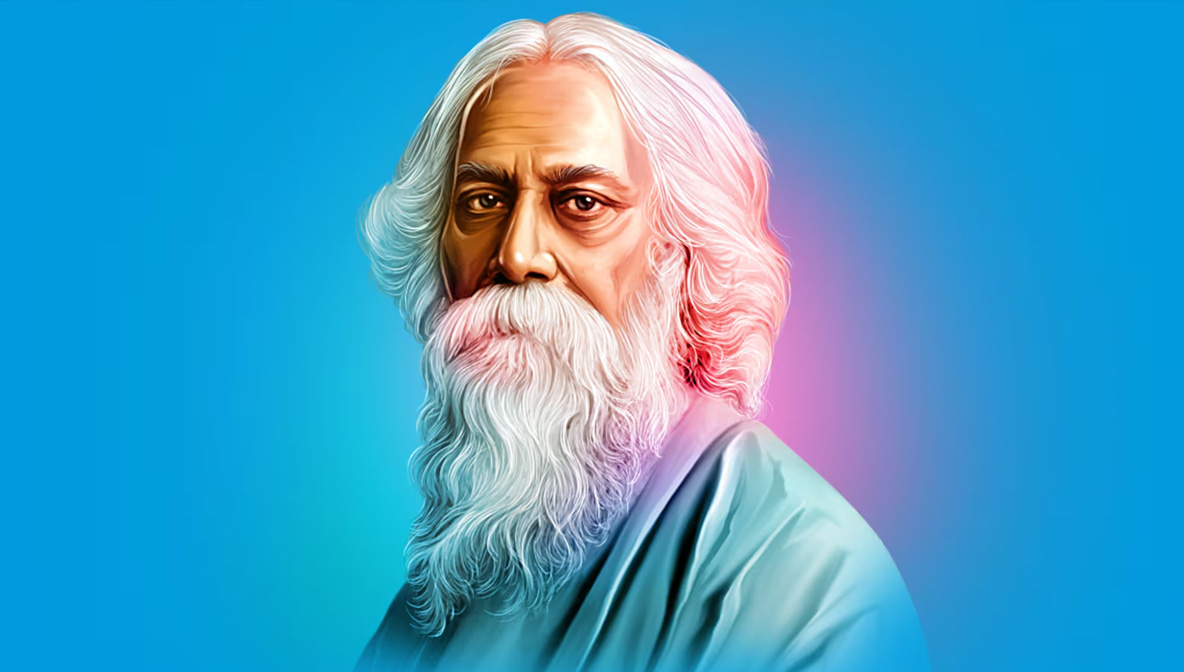
Rabindranath Tagore (1861–1941) was a Bengali poet, writer, composer, philosopher, social reformer, and Nobel laureate whose influence extended far beyond India. Known as “Gurudev”, he reshaped Bengali literature and music in the late 19th and early 20th centuries. His creative works and humanistic ideals continue to inspire generations.
📅 Early Life and Education
-
Born: May 7, 1861, in Jorasanko, Kolkata (then Calcutta), India
-
Family: The Tagore family was a prominent and cultured Bengali Brahmin family. His father, Debendranath Tagore, was a philosopher and religious reformer.
-
Education: Tagore was mostly educated at home under tutors. He briefly attended University College London but left to pursue writing.
From an early age, Tagore displayed immense literary talent. His first poem was published at age eight, and by sixteen, he had started writing under the pseudonym Bhanusimha.
✍️ Literary Career
Rabindranath Tagore was a prolific writer who contributed significantly to poetry, short stories, plays, songs, novels, and essays. He wrote in both Bengali and English.
Notable Works:
| Genre | Famous Works |
|---|---|
| Poetry | Gitanjali, Sonar Tari, Balaka |
| Short Stories | Kabuliwala, The Postmaster |
| Novels | Gora, Ghare-Baire, Chokher Bali |
| Songs | Composed over 2,000 songs, now known as Rabindra Sangeet |
| Plays | Dak Ghar, Raktakarabi |
His writing often explored humanism, spirituality, patriotism, and nature.
🏆 Achievements and Awards
🥇 Nobel Prize in Literature (1913)
-
Tagore was the first non-European to win the Nobel Prize in Literature, awarded for his poetry collection Gitanjali (Song Offerings).
🇮🇳 National Contributions:
-
Wrote the national anthem of India – Jana Gana Mana
-
Composed the national anthem of Bangladesh – Amar Shonar Bangla
-
Influenced Sri Lanka’s anthem as well
🎓 Founder of Visva-Bharati University:
-
In 1921, Tagore founded Visva-Bharati University in Santiniketan to promote education combining Eastern and Western philosophies.
🕊️ Global Impact:
-
Traveled extensively across Europe, the Americas, and East Asia
-
Met with luminaries like Albert Einstein, Mahatma Gandhi, and W.B. Yeats
-
Advocated for global peace, cultural unity, and freedom of thought
🧠 Ideology and Philosophy
Tagore’s philosophy centered around:
-
Universal humanism
-
Self-expression
-
Harmony between man and nature
-
Opposition to nationalism and blind patriotism
He was a visionary thinker who criticized the mechanical education system and colonial rule, yet always promoted non-violence and spiritual awakening.
🧑🏫 What We Learn from Rabindranath Tagore
1. Pursue Your Passion
Tagore followed his creative instincts instead of a traditional path, showing us the importance of authenticity.
2. Value Education
His founding of Visva-Bharati shows his lifelong commitment to meaningful, holistic education.
3. Be a Global Citizen
Tagore believed in unity across cultures and religions, a message highly relevant today.
4. Embrace Nature
Many of his works reflect deep love and respect for the natural world.
5. Use Art as a Tool for Change
He used literature, music, and art to inspire social reform and emotional awakening.
🕊️ Death and Legacy
-
Died: August 7, 1941, in Kolkata, India
-
His death marked the end of an era, but his legacy continues to live through his works, songs, educational contributions, and timeless philosophy.
🙏 Conclusion
Rabindranath Tagore was more than a writer; he was a pioneer of cultural renaissance, a global humanist, and an eternal source of inspiration. His life teaches us to embrace creativity, compassion, and courage in the face of conformity.
“You can’t cross the sea merely by standing and staring at the water.” – Rabindranath Tagore