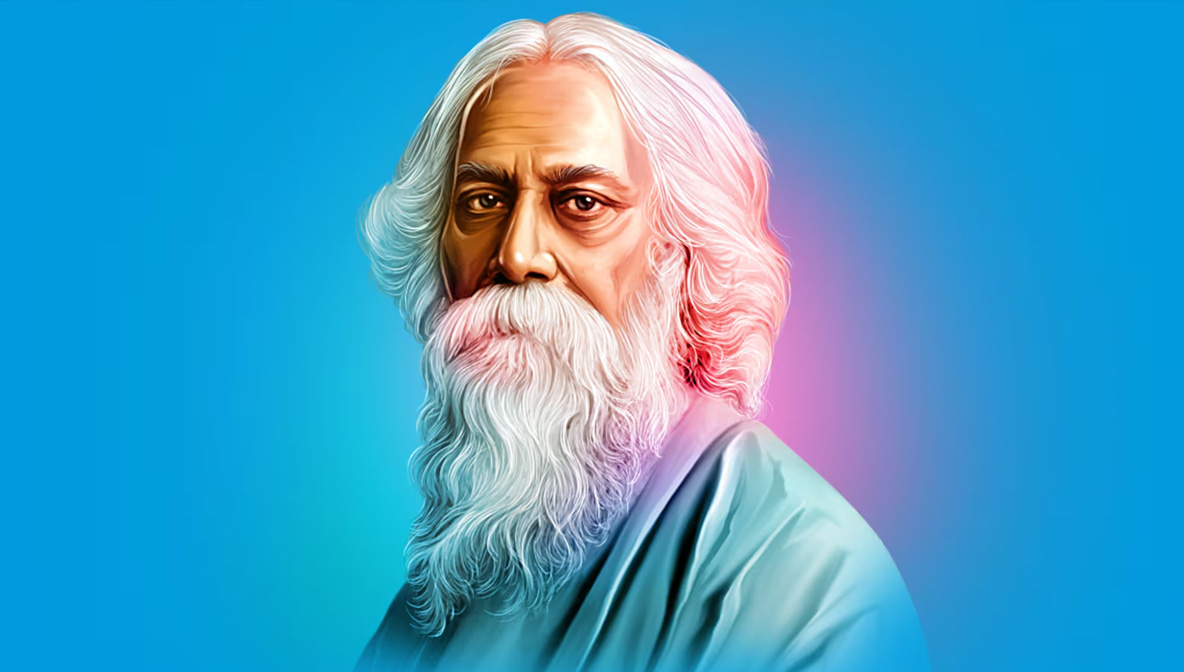

🎓 Introduction
Rabindranath Tagore (7 May 1861 – 7 August 1941) was a Bengali poet, writer, philosopher, composer, playwright, painter, and social reformer. In 1913, he became the first non-European to win the Nobel Prize in Literature for his profoundly spiritual and lyrical work Gitanjali (Song Offerings). He reshaped Indian literature and music, introduced new prose and verse forms, and advocated for education and internationalism.
👶 Early Life and Background (1861–1880)
-
Born into the Tagore family, a prominent and progressive household in Calcutta (now Kolkata), British India.
-
Father: Debendranath Tagore, a philosopher and leader of the Brahmo Samaj.
-
Tagore was the youngest of 13 children, raised in an environment rich in literary, artistic, and musical culture.
-
He began writing poetry at age 8 and published his first substantial poems under the pseudonym “Bhanusimha” at age 16.
-
He briefly studied in England in 1878, attending University College London, but returned to India in 1880.
✍️ Literary Career and Gitanjali (1881–1913)
-
Published numerous poetry collections, including:
-
Sandhya Sangeet (1882)
-
Manasi (1890)
-
Gitanjali (1910, Bengali version)
-
-
His themes centered around nature, spirituality, humanity, and universalism.
-
Gitanjali was translated into English in 1912, with a preface by W.B. Yeats.
-
This English version gained global recognition and led to Tagore winning the 1913 Nobel Prize in Literature:
“Because of his profoundly sensitive, fresh and beautiful verse, by which, with consummate skill, he has made his poetic thought, expressed in his own English words, a part of the literature of the West.“
🌍 Travels and Global Influence (1912–1930s)
-
Extensively traveled to Europe, the United States, Latin America, Japan, and China.
-
Met with notable thinkers and artists, including Einstein, Gandhi, Yeats, and Romain Rolland.
-
Advocated East-West understanding, anti-nationalism, and universal humanism.
-
Inspired a global literary movement and fostered international cultural dialogue.
🏫 Educational Reformer: Shantiniketan (1901–1941)
-
Founded Visva-Bharati University in Shantiniketan (1921), a unique school blending traditional Indian teaching with modern educational practices.
-
The university became a center for learning, art, and global cultural exchange.
-
Encouraged arts-based education and decried rote learning and colonial education systems.
🖼️ Other Artistic Work
-
Composed over 2,000 songs—known as Rabindra Sangeet—blending classical, folk, and modern music.
-
Painted prolifically in his later years; his visual art is recognized for its abstract and expressionist qualities.
-
Wrote short stories, plays, novels, essays, and political commentaries.
-
Authored national anthems of India (“Jana Gana Mana”) and Bangladesh (“Amar Shonar Bangla”).
🕊️ Final Years and Death (1930–1941)
-
Spoke out against imperialism, fascism, and dogmatism during the rise of WWII.
-
Health declined in the late 1930s.
-
Passed away on 7 August 1941 in Kolkata at age 80, leaving behind a legacy of spiritual and literary unity.
✨ What We Learn from Rabindranath Tagore
-
Art Transcends Borders: Tagore’s Gitanjali bridged Eastern spirituality with Western literary sensibilities.
-
Embrace Cultural Unity: Advocated for global humanism beyond nationalism or ethnicity.
-
Integrate Education and Creativity: Promoted holistic, values-based learning over colonial rote methods.
-
Lifelong Curiosity: Shifted from poet to painter in his later years—never stopped exploring.
-
Courage to Criticize Power: Critiqued both British colonialism and narrow Indian nationalism.