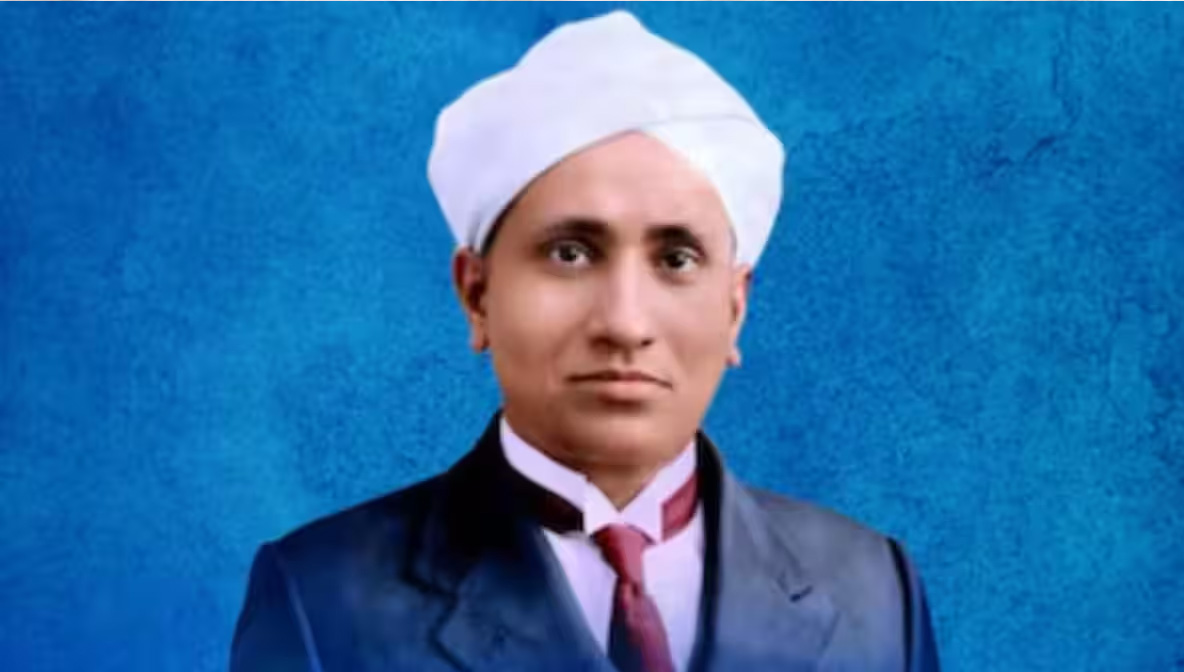

✨ Introduction
Born in 1888, Sir Chandrasekhara Venkata Raman was a luminous figure in physics. His passion turned the scattering of light into a scientific milestone—the Raman Effect—earning him the Nobel Prize in Physics in 1930. As India’s first Nobel laureate in science, he transformed how we decode molecular identity
🧬 Early Life & Background
C.V. Raman entered the world in Tiruchirapalli on November 7, 1888, to a humble schoolteacher and a nurturing mother. His father taught mathematics and physics, sparking curiosity that saw young Raman passing school exams at 11 and finishing college at just 16 with top honors in physics.
🎓 Career & Achievements
-
From Civil Service to Science: At 19, Raman joined the Indian Finance Service in Calcutta but pursued optics and acoustics research at the Indian Association for the Cultivation of Science during off-hours
-
Academic Breakthrough: In 1917, he became the first Palit Professor of Physics at Calcutta University.
-
Discovery of the Raman Effect (1928): With his student K.S. Krishnan, he demonstrated that light scattered by a transparent medium changes frequency—this “modified scattering” shaped molecular spectroscopy.
-
Global Acclaim: He received the Nobel Prize in 1930, becoming the first Asian to win in the sciences, was knighted in 1929, and became a Fellow of the Royal Society in 1924.
-
Building Institutions: Raman founded the Indian Journal of Physics (1926), the Indian Academy of Sciences (1934), and later directed IISc, Bangalore (1933–48). In 1948, he founded the Raman Research Institute in Bangalore.
💑 Personal Life
Raman married Lokasundari Ammal in 1907; they had two sons. Beyond physics, he had a deep appreciation for Indian classical music, and studied acoustics to enhance instrument design. A disciplined man, he credited success to independent thinking, persisting despite limited resources.
🕊️ Legacy & Impact
-
Raman Effect: A foundational principle in molecular spectroscopy, with far-reaching use in chemistry, materials science, medicine, and forensics.
-
Scientific Nation-building: He pioneered India’s homegrown scientific research ecosystem, enabling generations of scholars.
-
Inspiration & Recognition: Awarded the Bharat Ratna (1954) and Lenin Peace Prize (1957), his birthday, November 7, became celebrated as National Science Day.
💭 Final Thoughts
Raman wasn’t just an exceptional scientist—he was a visionary educator and institution-builder. His tireless belief in India’s intellectual potential and his research with limited means demonstrate that curiosity paired with dedication can triumph over adversity.
📚 What We Learn
-
Curiosity Triumphs: Even while balancing a government job, Raman let his inquisitiveness lead to breakthroughs.
-
Build for the Future: His efforts shaped lasting institutions—research thrives not just on discoveries but structures.
-
Science Knows No Boundaries: Raman’s work shows that world-class research can emerge from anywhere, not just elite labs.
Sir C.V. Raman’s life is a masterclass in blending intellectual bravery with institutional vision. His light‑scattering discovery still illuminates scientific inquiry—and his personal journey continuously motivates us to question more deeply and build more broadly.