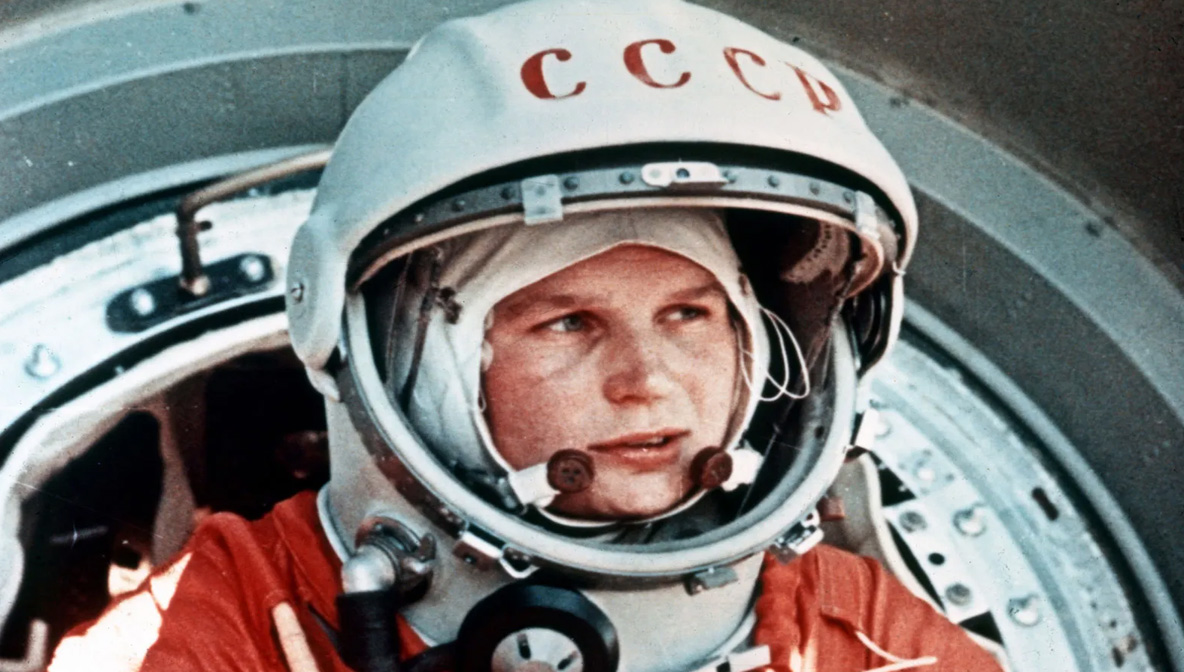

Look up at the night sky. For all of human history, its vast, dark expanse was a realm reserved for myth, for gods, for men with telescopes, and eventually, for men in rockets. But on a summer day in 1963, that all changed. A 26-year-old woman from a tiny Russian village, with no piloting experience, strapped herself into a metal capsule and was launched into the blackness of space. Her name was Valentina Tereshkova, and she wasn’t just a passenger; she was the sole commander of her spacecraft, Vostok-6. With a single orbit, she didn’t just break an altitude record; she shattered a millennia-old barrier, proving that the final frontier was not a male-only domain.
Her story is not one of a lifelong, single-minded pursuit of the stars. It is a story of a childhood forged in the crucible of war and poverty, of a young woman who loved to dance and parachute, who was plucked from obscurity to become a global icon for the Soviet Union’s Cold War propaganda machine. Yet, beneath the state-sponsored heroism was a person of immense courage, resilience, and quiet dignity. This is the biography of the first woman in space—a textile worker who became a cosmic pioneer, a symbol of a political system, and an enduring inspiration for generations of women who dare to look up and dream of touching the heavens.
Early Life & Background: A Childhood Woven with War and Work
Valentina Vladimirovna Tereshkova was born on March 6, 1937, in the small village of Bolshoye Maslennikovo, nestled in western Russia. Her life began not with privilege, but with profound hardship. Her family was simple and working-class. Her father, Vladimir Tereshkov, was a tractor driver, a veteran of the Soviet-Finnish War. Her mother, Elena Fyodorovna Tereshkova, worked at the Krasny Perekop textile mill.
Tragedy struck early. When Valentina was just two years old, her father was called to fight in World War II, known in Russia as the Great Patriotic War. He never returned, dying in the conflict in 1940. He became one of the millions of Soviet soldiers lost to the war, a “Fatherless Hero” whose sacrifice was a painful, defining feature of her childhood. Her mother was left alone to raise Valentina and her two older siblings, Ludmilla and Vladimir, in a country devastated by war.
Life was a relentless struggle. They lived in a small, cramped house, and food was often scarce. Valentina started school late, at age eight, her education repeatedly interrupted as she and her family worked to survive. She learned the value of hard work and sacrifice not from textbooks, but from the raw necessity of putting food on the table. Despite this, she was a bright and determined student. A pivotal moment came when she discovered a love for reading, particularly the poetry of Alexander Pushkin, which offered an escape from her difficult reality.
At age 16, her formal education was cut short. She left school and began working to help support her family. She took a job at the same tire factory where her mother worked, and later, following in her mother’s footsteps, she moved to the colossal Krasny Perekop cotton mill in Yaroslavl. Her days were spent amid the deafening roar of machinery, her hands guiding fabric, her world confined to the factory floor. It was a life laid out before her—one of honest, uncelebrated labor.
But a different passion was quietly taking root. Outside of the factory, Valentina was not the quiet textile worker she appeared to be. She was active and adventurous. She sang in a folk music group and, most importantly, she joined the Yaroslavl Air Sports Club. Here, she discovered parachuting. It was a popular hobby for Soviet youth, part of the state’s preparation for potential conflict. For Valentina, it was freedom. The rush of leaping from a plane, the silence of the freefall, the moment the canopy opened and she gained control—it was the antithesis of her life on the factory floor. She became a dedicated and skilled amateur parachutist, making over 150 jumps. This skill, born of passion, would soon become the unlikely key that unlocked the door to the cosmos.
Career & Achievements: From Parachutist to Cosmonaut
The early 1960s were the height of the Space Race, a fierce Cold War competition between the Soviet Union and the United States. After Yuri Gagarin’s historic first human spaceflight in 1961, the Soviet space chief, Sergei Korolev, conceived of a new, powerful propaganda coup: sending the first woman into space. The mission was not born from a place of gender equality, but from a desire to demonstrate Soviet superiority and the versatility of their technology.
The selection process was secretive and highly unconventional. The criteria were specific: they wanted a true “woman of the people,” preferably from a proletarian background, young, physically fit, ideologically reliable, and, crucially, an experienced parachutist. The Vostok spacecraft, unable to land softly, required the cosmonaut to eject at about 20,000 feet and parachute to the ground separately from the capsule. Of over 400 applicants, five women were selected for the female cosmonaut corps. One of them was Valentina Tereshkova, the textile worker and parachutist from Yaroslavl.
Her selection was a shock. She had no piloting experience, unlike her American counterparts. She was a civilian, a factory worker. But she was tough, resilient, and politically suitable. Her father was a war hero, and her own background was a propaganda dream. In early 1962, she and the four other women began an intensely grueling and secret training program. It was physically and mentally brutal. They were subjected to isolation tests, centrifuge runs that pushed them to the limits of G-force tolerance, weightlessness simulations, and complex technical training on the Vostok spacecraft. They had to learn everything from rocket science to navigation in a fraction of the time typically allotted to male cosmonauts.
In the end, Tereshkova was chosen for the Vostok-6 mission. The official reasons cited her impeccable background, her physical endurance, and her performance during training. Her now-famous call sign was “Chaika” – “Seagull.”
The Vostok-6 Mission: A Seagull in Orbit
On the morning of June 16, 1963, Valentina Tereshkova, clad in her spacesuit, was strapped into the Vostok-6 capsule. As the rocket engines ignited, she reportedly shouted a phrase dedicated to her mentor, Sergei Korolev: “Hey sky, take off your hat! I’m on my way!” For 70 hours and 50 minutes, almost three full days, she orbited the Earth 48 times. Her mission was not just symbolic; it was a serious scientific endeavor. She maintained a flight log, took photographs of the horizon (which later helped scientists identify aerosol layers in the atmosphere), and manually controlled the spacecraft’s orientation, a task that demonstrated her skill and composure.
The mission was not without its harrowing moments, which were kept secret for decades. There was a critical error in the spacecraft’s automatic navigation program, which, if left uncorrected, would have sent the capsule away from Earth, stranding her in space. Korolev and his team on the ground had to frantically develop a new set of landing coordinates, which they transmitted to her. She coolly input the new data, a testament to her training and nerve. Furthermore, she experienced severe space sickness, vomiting and feeling nauseous for much of the flight, but she concealed this from ground control, fearing it would jeopardize the mission and the future of women in space.
Her flight was a dual mission with Valery Bykovsky in Vostok-5, and the two spacecraft communicated with each other, another Soviet first. On June 19, 1963, Tereshkova guided her spacecraft through re-entry, ejected as planned, and parachuted safely to the ground in the Altai region of southern Siberia. Local villagers helped her out of her spacesuit and, in a moment of pure, surreal humanity, she shared her space food with them.
She returned to a hero’s welcome in Moscow, a global celebrity. The Soviet Union had achieved another spectacular first. Overnight, the “Seamstress of Yaroslavl” had become “The Goddess of Space.”
Personal Life: The Private Woman Behind the Public Icon
In the whirlwind of fame that followed her flight, Tereshkova’s personal life became a matter of state interest. In 1963, she married fellow cosmonaut Andriyan Nikolayev, who had flown on the Vostok-3 mission. Their union was orchestrated by Soviet Premier Nikita Khrushchev himself, who saw the perfect propaganda couple: “the first man and woman to conquer space.” Their wedding was a grand state event, a “cosmic wedding” covered by media worldwide.
In 1964, Tereshkova gave birth to their daughter, Elena Andriyanovna Nikolaeva-Tereshkova. Elena made history herself as the first child born to parents who had both traveled to space, and medical professionals closely monitored her from conception, concerned about potential effects of space radiation on her parents’ reproductive cells. Fortunately, Elena was born healthy and went on to become a respected doctor.
The marriage to Nikolayev, however, was reportedly strained, a relationship performed for the public rather than nurtured in private. They separated and eventually divorced in 1982, a rare and somewhat scandalous act in the Soviet Union, especially for such high-profile figures. Tereshkova later remarried, to Dr. Yuli Shaposhnikov, a deputy director of a medical institute. This marriage, far from the public eye, was described as a happy and supportive partnership until his death in 1999.
Throughout her life, Tereshkova remained a committed and loyal member of the Communist Party. She became a prominent political figure, serving on various Soviet and later Russian women’s committees and veteran councils. She was a deputy of the Supreme Soviet and remains a deputy in the Russian State Duma (parliament) to this day, a symbol of continuity from the Soviet era to the modern Russian Federation. Despite her political alignment, those who know her describe her as a kind, humble, and deeply private person who cherishes her family, particularly her daughter and grandchildren, above the glare of her historic achievement.
Legacy & Impact: The Enduring Flight of the Seagull
Valentina Tereshkova’s legacy is complex, powerful, and stretches far beyond her 70 hours in space.
-
Shattering the Celestial Ceiling: Her most profound impact was symbolic. She proved, unequivocally, that women possessed the “right stuff.” She demonstrated that women could handle the physical rigors of spaceflight, operate complex machinery under extreme stress, and serve as capable, courageous explorers. She became an instant and enduring feminist icon worldwide, a beacon of possibility for girls dreaming of careers in science, technology, and aviation.
-
A Cold War Pawn and a Soviet Hero: It is crucial to understand that her flight was a calculated political move. The Soviet Union used her as a tool to showcase the supposed equality and progressiveness of communism, contrasting it with the United States, which would not send a woman (Sally Ride) into space for another 20 years. While the reality for most Soviet women was far from equal, Tereshkova’s image was powerfully effective propaganda.
-
An Unexpected Hiatus for Women in Space: Ironically, her own mission led to a long hiatus for female cosmonauts. Soviet officials, perhaps unsettled by the challenges she faced, concluded that spaceflight was too dangerous for women. It would be 19 years before another woman, Svetlana Savitskaya, flew. Tereshkova’s legacy, therefore, is also a cautionary tale about the dangers of a “first” being treated as a token rather than a precedent.
-
An Enduring Cultural Icon: Her face was on stamps and posters across the globe. Streets, schools, and a crater on the far side of the Moon are named after her. She remains one of the most recognized and revered figures in Russia, a living link to the nation’s era of cosmic triumph.
-
A Lifelong Advocate: Even in her 80s, Tereshkova continues to be a vocal advocate for space exploration. In 2013, on the 50th anniversary of her flight, she offered to volunteer for a one-way trip to Mars if the opportunity arose, stating, “I am ready.” This statement underscores her lifelong passion and courage.
Final Thoughts, and What We Learn
The story of Valentina Tereshkova is not a simple narrative of a dream fulfilled. It is a story of how circumstance, politics, and personal passion can collide to create history. She was both an active agent of her own destiny and a passive symbol for a powerful state.
What We Learn from Her Life:
-
Potential is Everywhere: The first woman in space was not a trained test pilot from a military academy. She was a factory worker who loved parachuting. Her story teaches us that extraordinary potential can be found in the most ordinary of places, and that unique skills, no matter how seemingly unrelated, can be the key to unimaginable opportunities.
-
Courage is Acting in Spite of Fear: Tereshkova was not fearless. She experienced nausea, faced a potentially fatal spacecraft error, and carried the weight of her nation’s prestige. Her courage lay in her composure, her discipline, and her refusal to let her fear compromise the mission.
-
Legacy is Complicated: Her legacy is a blend of genuine inspiration and political manipulation. It reminds us that historical figures, especially during the Cold War, often operated within complex systems, and their achievements can be simultaneously personally heroic and politically instrumentalized.
-
The Importance of the “First”: While a “first” can sometimes be an isolated event, its symbolic power is immeasurable. Tereshkova’s flight planted a flag for all womankind in the cosmos. It forced the world to reimagine who could be an explorer, an astronaut, a hero.
-
Resilience is Forged in Adversity: The little girl who survived war, poverty, and the loss of her father had a resilience that served her perfectly in the brutal training and the isolation of space. Her early hardships did not break her; they prepared her.
Valentina Tereshkova, the Cosmic Seamstress, stitched a new thread into the fabric of human history. She took the humble, earthbound skills of her youth and used them to reach for the stars, forever changing our perception of what is possible and who gets to define the future of human exploration. Her flight was a brief, three-day journey, but its echo continues to inspire, a permanent reminder that the sky is not the limit, especially when you have the courage to jump.