
Early Life and Education
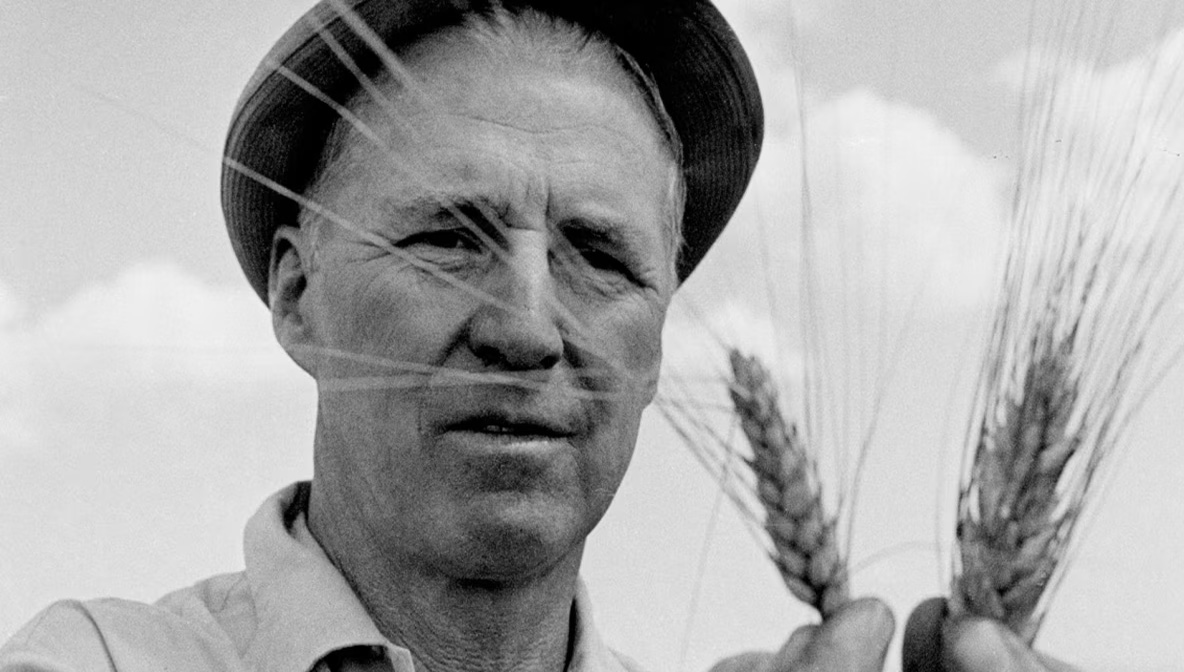
Norman Ernest Borlaug was born on March 25, 1914, on a farm near Cresco, Iowa, USA. Raised in a humble Norwegian-American farming family, Borlaug learned the values of hard work and resilience early in life. He attended a one-room schoolhouse and excelled academically and athletically.
In 1933, during the Great Depression, Borlaug enrolled at the University of Minnesota, initially studying forestry. He later shifted to plant pathology and graduated with a Ph.D. in plant pathology and genetics in 1942.
Career and the Birth of the Green Revolution
Norman Borlaug’s groundbreaking work began in the 1940s, when he joined the Cooperative Wheat Research and Production Program in Mexico, funded by the Rockefeller Foundation. Mexico was struggling with low crop yields and food insecurity.
Through persistent effort, Borlaug developed high-yield, disease-resistant wheat varieties, along with modern agricultural techniques. His approach combined selective breeding, crop rotation, fertilizer use, and irrigation methods.
The result was extraordinary: wheat production in Mexico tripled between 1944 and 1956, turning the country from a wheat importer into a self-sufficient nation.
This success sparked what became known as the Green Revolution, a global agricultural transformation that helped avert famine in Asia, Latin America, and the Middle East.
Global Impact
Borlaug’s work expanded to India and Pakistan in the 1960s, countries then facing severe famine threats. By introducing his hybrid wheat seeds and modern farming methods, both nations doubled their wheat production within a few years, feeding millions and stabilizing their food supplies.
Notable Achievements:
-
Credited with saving over a billion lives from hunger and starvation.
-
Brought modern agriculture to developing nations.
-
Advocated for science-based solutions to global food insecurity.
Awards and Recognition
Norman Borlaug’s contributions earned him global recognition. Some of his most notable honors include:
-
Nobel Peace Prize (1970) – For his contribution to world peace through increasing food supply.
-
Presidential Medal of Freedom (1977)
-
Congressional Gold Medal (2007)
-
Padma Vibhushan (India’s second-highest civilian award)
He is one of the few people in history to receive the Nobel Peace Prize, Presidential Medal of Freedom, and Congressional Gold Medal.
Later Years and Advocacy
Even into his 80s and 90s, Borlaug remained an advocate for agricultural innovation. He co-founded the World Food Prize in 1986, an international award that recognizes individuals who improve the quality, quantity, or availability of food in the world.
He also worked with the Sasakawa Africa Association, promoting sustainable agriculture in sub-Saharan Africa.
Borlaug firmly believed in using science and technology to combat hunger, arguing that political will and education must go hand-in-hand with innovation to ensure long-term food security.
Death and Legacy
Norman Borlaug passed away on September 12, 2009, at the age of 95. His legacy is not just in awards, but in lives saved, famines prevented, and an enduring model for fighting hunger.
Known as the “Father of the Green Revolution”, Borlaug’s influence continues through the work of agronomists, plant scientists, and policy makers inspired by his mission.
What We Learn from Norman Borlaug
-
Science can solve real-world problems – Borlaug used agricultural research to address hunger and malnutrition.
-
Perseverance matters – He worked in difficult field conditions for years before success.
-
Global thinking, local action – His solutions were tailored to each region’s needs.
-
Peace and food are connected – He showed that food security is essential for global stability.