
In a world saturated with leadership advice that focuses on the “what” and the “how”—what to do, how to manage, how to execute—one voice cut through the noise with a radically simple question: “Why?” Simon Sinek isn’t just a motivational speaker or a leadership guru. He is an optimist, a cultural anthropologist of the business world, and the architect of a framework that has reshaped how organizations, from giant corporations to tiny startups, think about their very reason for existence.
His breakthrough idea, “The Golden Circle,” feels less like a business theory and more like a truth we all knew deep down but had forgotten. He didn’t invent the concept of purpose, but he gave it a language, a structure, and a compelling argument that has inspired millions. From the military to the tech world, his message of “Start With Why” has become a mantra for those who believe that building a business, leading a team, or crafting a career is ultimately an act of faith in a brighter future. This is the story of how a man who felt unfulfilled in advertising found his own “why” and helped countless others find theirs.
Introduction: The Prophet of Purpose
Before 2009, Simon Sinek was a relatively unknown branding consultant. After September 29, 2009, he became a global phenomenon. That was the day a video of a talk he gave was posted on YouTube. It was called “How Great Leaders Inspire Action,” and it featured a simple, hand-drawn diagram of three concentric circles: “Why,” “How,” and “What.” This was “The Golden Circle.”
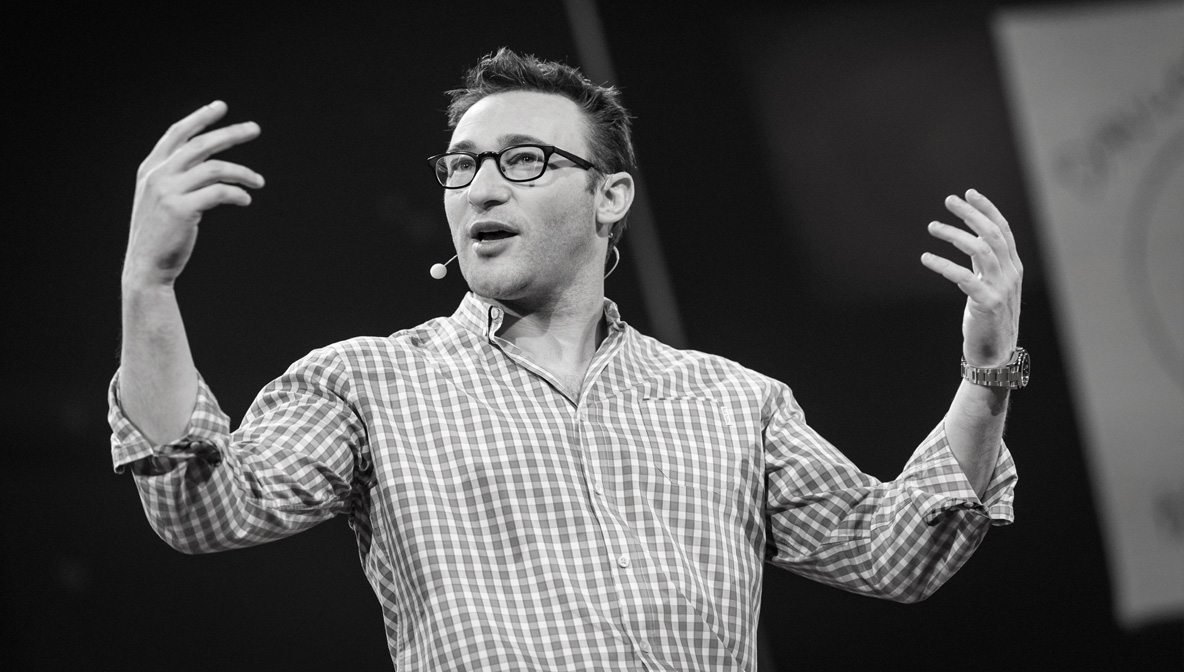
The talk didn’t have high production value. It was just a man in a simple sweater, speaking with passionate conviction on a stage. But the idea was so powerful, so elegantly simple, that it went viral. Today, that TED Talk has been viewed over 60 million times, making it one of the most popular of all time.
Sinek’s core argument is that every organization on the planet knows what they do. Some know how they do it. But very few can clearly articulate why they do what they do. This “why” isn’t about making a profit; that’s a result. The “why” is your purpose, your cause, your belief. Your why is the reason your organization exists.
He uses Apple as his prime example. If Apple were like everyone else, their marketing would start with the “what”: “We make great computers.” But instead, they start with their “why”: “We believe in challenging the status quo. We believe in thinking differently.” The computers are simply the proof of that belief. People don’t buy what you do; they buy why you do it.
This idea resonated on a profound level because it wasn’t just about business. It was about human biology. Sinek connects his theory to the brain, explaining that the “why” speaks to the limbic system, the part of the brain responsible for feelings, trust, and loyalty—not just language. It explains the gut feeling we have about certain brands and leaders.
Simon Sinek became the voice for a growing hunger in the workplace for meaning, for something more than just a paycheck. In an age of cynicism and burnout, he offered a message of hope, grounded in biology and illustrated by the stories of great leaders like Martin Luther King Jr. and the Wright brothers. He didn’t just want to help companies sell more products; he wanted to help build a world where people feel safe, inspired, and fulfilled at work.
Early Life & Background: The Empathic Immigrant
Simon Sinek was born in Wimbledon, England, in 1973. His background is a key to understanding his deep-seated empathy and his focus on human connection. His parents were both immigrants. His mother was from England, and his father was born in Budapest, Hungary, and fled the country as a refugee during the 1956 revolution, eventually making his way to South Africa and then London.
Growing up, Sinek was surrounded by stories of struggle, resilience, and the kindness of strangers who helped his father build a new life. These stories weren’t abstract history; they were family lore. They instilled in him a fundamental belief in the goodness of people and the importance of helping others. He has often said that his father’s experience taught him that safety is not the absence of danger, but the presence of human connection.
When he was young, his family moved to Johannesburg, South Africa, and then later to London before finally settling in the United States, in New Jersey. Being the new kid, multiple times over, forced him to become a keen observer of social dynamics. He had to learn how to read people, make friends quickly, and navigate different cultures. This constant experience of being an outsider honed the empathetic skills that would later become the heart of his work.
He attended Northern Valley Regional High School at Demarest and then went on to study cultural anthropology at Brandeis University. This choice of major is critically important. Cultural anthropology is the study of human societies and cultures. It trains you to look for the underlying patterns, rituals, and beliefs that govern human behavior. While his peers were studying business or economics to learn the “how,” Sinek was in the library, studying why human tribes and organizations function the way they do. He was, in essence, preparing for his life’s work without even knowing it.
After college, he moved to New York City and, somewhat ironically given his future message, fell into a career in advertising. He worked at some of the top agencies in the world, including Euro RSCG and Ogilvy & Mather. And he was miserable.
He found the work manipulative. The goal was to persuade people to buy things they didn’t need, using tactics that preyed on their insecurities. He felt he was using his skills to make money for large corporations without making a positive impact on anyone’s life. He was successful by external measures, but he was deeply unfulfilled. He had lost his “why,” or more accurately, he had never found it in the first place.
This period of profound dissatisfaction and a growing sense of despair was the crucible in which his ideas were forged. He was living the inverse of his own future philosophy. He was doing the “what” (advertising) without a “why” he believed in. He was, as he would later describe it, “at rock bottom.”
Career & Achievements: Finding the Golden Circle
The turning point came when Sinek decided to leave advertising. He started his own consulting firm, but he struggled. He was still doing the same kind of work, just for himself. The breakthrough happened during a conversation with a friend. He was trying to explain why some leaders and organizations are able to inspire loyalty and innovation while others can’t, even with better resources.
In a moment of frustration, he said, “It all comes down to one thing: why.” And then he drew three concentric circles on a napkin.
This was the birth of The Golden Circle. He began testing this theory in his consulting work, and he saw it resonate immediately. He wasn’t selling a complex business strategy; he was giving people a lens to see the world differently. He started giving small talks, honing his message.
His first book, Start With Why: How Great Leaders Inspire Everyone to Take Action, was published in 2009. It laid out his philosophy in full. The book was a slow burn, but when his TED Talk went viral later that year, it exploded. The book became a massive bestseller, and Sinek was thrust onto the global stage.
He had found his “why”: “To inspire people to do the things that inspire them so that, together, we can change our world.” Every talk, every book, every consulting engagement was now an expression of that single, clear purpose.
He followed this with a series of bestselling books that deepened and expanded his core ideas:
-
Leaders Eat Last: Why Some Teams Pull Together and Others Don’t (2014): This book explored the biological and anthropological roots of leadership. He introduced the concept of the “Circle of Safety,” arguing that a leader’s primary job is to create an environment of trust and cooperation where people feel safe from internal politics and external threats. The title comes from the U.S. Marine Corps, where junior Marines eat first and the leaders eat last, symbolizing the leader’s role as protector.
-
Together is Better: A Little Book of Inspiration (2016): A short, illustrated book that distilled his ideas about teamwork and collaboration into a simple, powerful fable.
-
The Infinite Game (2019): This was perhaps his most ambitious work since Start With Why. He argued that business and leadership are not “finite games” with known players, fixed rules, and a clear endpoint (like football). They are “infinite games” with unknown players, changing rules, and the objective is to keep playing—to outlast the competition, not just to win a quarterly report. This book was a direct challenge to the short-termism plaguing modern capitalism.
Beyond his books, Sinek built a massive platform. He became one of the most in-demand speakers in the world. He launched “A Bit of Optimism,” a popular podcast where he interviews people from all walks of life to discover what inspires them and how they overcome challenges. He also leads “The Optimism Company,” which provides training and resources for organizations looking to build more inspiring and human-centered cultures.
Personal Life: Practicing What He Preaches
Simon Sinek is notoriously private about the intimate details of his personal life. He rarely discusses romantic relationships or family in public forums. However, his personality and lifestyle are very much an extension of his philosophy.
He is known to be intensely disciplined and structured. He is a vocal advocate for routines and rituals that support mental and physical well-being. He has spoken openly about his decision to stop drinking alcohol, not because he had a problem, but because he felt it was negatively impacting his sleep and overall happiness. This decision reflects his core belief in making conscious choices that align with your “why.”
He lives in New York City but is an avid traveler, often weaving stories from his travels into his talks to illustrate cultural differences and universal human truths. His style is consistent and recognizable: almost always seen in a simple, button-down shirt and dark jeans. It’s a uniform that removes the distraction of fashion and keeps the focus squarely on his ideas.
Perhaps the most telling aspect of his personal life is his authenticity. The man you see on stage is the same man his friends and colleagues describe. He is genuinely optimistic, curious, and deeply caring. He doesn’t just lecture about empathy and human connection; he practices it in his interactions. This congruence is a huge part of his credibility. In a field sometimes accused of hypocrisy, Sinek walks the talk.
Legacy & Impact: The Ripple Effect of Purpose
Simon Sinek’s impact is difficult to overstate. He hasn’t just sold books; he has changed the vocabulary and priorities of leadership.
-
He Mainstreamed “Purpose”: Before Sinek, “mission statements” were often corporate jargon, filled with empty phrases. He forced companies to dig deeper, to ask the fundamental question of “why do we get out of bed in the morning?” Today, it’s standard practice for organizations of all sizes to define their purpose, and Sinek is the reason why.
-
He Made Leadership About Biology, Not Just Strategy: By connecting his ideas to the human limbic system and our ancient need for safety and belonging, he gave leadership a scientific and emotional weight that pure business strategy lacks. He made it okay to talk about love, trust, and empathy in the boardroom.
-
He Gave a Generation Permission to Seek Meaning: His message resonated powerfully with Millennials and Gen Z, who are often characterized by their desire for purposeful work. He gave them a language to articulate their dissatisfaction with traditional, hierarchical, and purely profit-driven companies and validated their search for something more.
-
He Influenced a Wide Spectrum of Organizations: His ideas are taught in business schools, but they are also practiced in the military, adopted by non-profits, and used by governments. The U.S. Armed Forces have invited him to speak multiple times, seeing a direct alignment between his “Circle of Safety” and the bonds of trust required in combat units.
Of course, he has his critics. Some argue that his ideas are too simplistic, that “starting with why” isn’t a substitute for a solid business model or operational excellence. Others point out that in a ruthless capitalist system, the “infinite game” is a luxury not all companies can afford. But even his critics acknowledge the power of his core message: that people are not resources to be managed, but human beings to be inspired.
What We Learn: The Enduring Lessons from Simon Sinek
The real value of Simon Sinek’s work isn’t in memorizing The Golden Circle; it’s in adopting the mindset it represents.
-
Clarity of “Why” is Your Greatest Asset: Whether you’re a CEO, a team leader, or an individual contributor, knowing your personal “why” is the key to resilience, motivation, and making better decisions. When you know your purpose, the “what” you do and “how” you do it naturally fall into place. It acts as a compass in times of uncertainty.
-
Leadership is a Service, Not a Privilege: The “Leaders Eat Last” philosophy flips the traditional org chart. The leader is not at the top to be served; they are at the center to serve and protect their team. Your success as a leader is measured by the success and well-being of the people you lead.
-
Build a Circle of Safety: The primary responsibility of any leader is to create an environment where people feel safe to be themselves, to express ideas, and to take risks without fear of humiliation or punishment. In a Circle of Safety, internal politics decline, and cooperation and innovation thrive.
-
Play the Infinite Game: Stop obsessing over short-term wins and beating the competition. Focus on a Just Cause—a vision of a future so compelling that you are willing to make sacrifices to see it realized. Build an organization that is resilient, ethical, and built to last for generations, not just for the next earnings call.
-
Optimism is a Choice and a Strategy: Sinek’s entire brand is built on a foundation of realistic optimism. He doesn’t ignore challenges; he believes we have the capacity to overcome them together. Choosing optimism is not about being naive; it’s about believing in our collective potential to build a better world.
Simon Sinek’s story is a powerful reminder that the most successful careers are often born not from a desire for success, but from a period of deep dissatisfaction and a search for meaning. He found his “why” in the depths of his own unhappiness and, in sharing it, gave millions of others a framework to find their own. He taught us that the energy that builds great companies, inspires loyal teams, and changes the world doesn’t come from a detailed business plan, but from a clear, compelling, and passionately held belief. He reminded us all to always, always start with why.