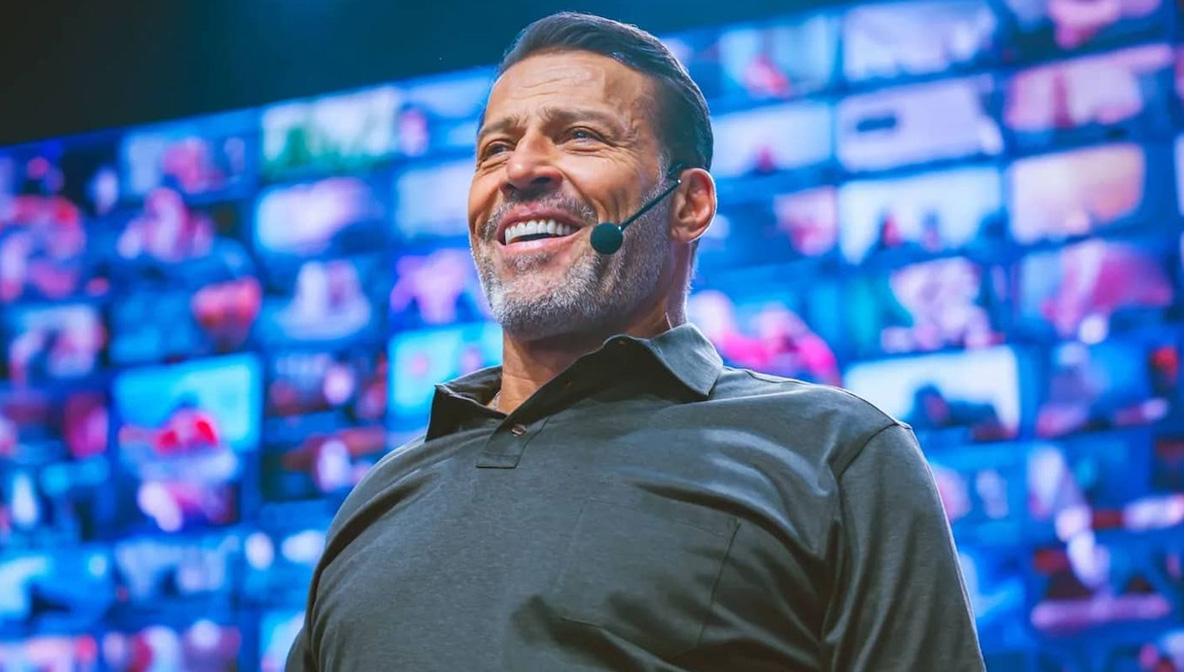

If you were to close your eyes and picture a “motivational speaker,” the image that likely forms is of a towering, 6’7″ figure with a booming voice, a magnetic presence, and an almost superhuman energy. That is Tony Robbins. But to label him merely a motivational speaker is like calling the Pacific Ocean a puddle. He is a force of nature, a life and business strategist, a bestselling author, a philanthropist, and for millions, a catalyst for profound personal transformation.
For over four decades, Tony Robbins has been a dominant figure in the landscape of self-improvement. He has coached presidents, Olympic athletes, Hollywood stars, and Fortune 500 CEOs. He has filled stadiums with tens of thousands of people, leading them through firewalks and emotional breakthroughs. He has built a business empire spanning seminars, coaching, supplements, and best-selling books. His story is not one of privilege or luck, but of a relentless, self-driven climb from a childhood of poverty and trauma to becoming one of the most recognized and influential personal development icons in the world. This is the story of how Anthony J. Mahavorick became Tony Robbins, and how he has dedicated his life to teaching others how to do the same for themselves.
Introduction: The Architect of Change
What is it about Tony Robbins that captivates so many? It isn’t just his size or his voice, though they are undeniable assets. It’s his unwavering belief in a fundamental principle: that the power to shape our lives lies not in our conditions, but in our decisions. He operates on the conviction that human beings can change anything—their finances, their relationships, their health, their emotional state—if they can change their “state” and their “story.”
Robbins is not a theoretical philosopher. He is a practitioner, a strategist. His work is a fusion of neurology, psychology, and peak performance strategies. He took complex psychological principles from pioneers like Neuro-Linguistic Programming (NLP) and made them accessible and actionable for the masses. His famous “firewalk”—where participants walk barefoot over hot coals—isn’t a magic trick; it’s a physical metaphor for his core teaching: you can do things you once believed were impossible by changing your state and focus.
He is a polarizing figure, to be sure. Critics point to his aggressive sales tactics, the high cost of his seminars, and his sometimes overly simplistic solutions to complex problems. Supporters, however, point to the tangible results: marriages saved, businesses turned around, and lives pulled from the brink of despair. Whether you see him as a savior or a salesman, his impact on the self-help industry is immeasurable. He didn’t just join the field; he reshaped it in his own larger-than-life image, proving that personal development could be a spectacle, a business, and a mission, all at once.
Early Life & Background: The Forging of a Fighter
To understand the drive behind Tony Robbins, you must first understand his beginning. He was born Anthony J. Mahavorick on February 29, 1960, in North Hollywood, California. His childhood was not just one of financial struggle; it was one of chaos and trauma.
His parents divorced when he was seven, and his mother remarried several times. He has described his home life as abusive and volatile. He once recounted a story of his mother pulling a gun on his stepfather during a Christmas Eve argument. Food was often scarce. At one point, he says, his family was so poor that their Thanksgiving dinner consisted of a donated box of mashed potato flakes and powdered gravy.
By the age of eleven, he was the “man of the house,” tasked with protecting his mother and siblings. He recalls having to physically intervene to stop a violent fight between his mother and a stepfather. This environment forced him to grow up fast. He developed a deep-seated drive to never be a victim of his circumstances again. He was determined to understand what created happiness and success, precisely because he had so little of it.
As a teenager, he worked odd jobs to help support the family. He was tall and lanky, and by his own account, awkward and unhappy. His home life left him feeling powerless. This feeling of being out of control became the central problem he would dedicate his life to solving, first for himself, and then for others.
His turning point came when he was 17. He came home one day to find all the family’s possessions on the front lawn—they had been evicted. It was a rock-bottom moment. It was also the moment he decided that his life would change. He started devouring self-help books, from Dale Carnegie’s How to Win Friends and Influence People to the works of Ralph Waldo Emerson. But his life truly shifted when he began working for Jim Rohn, a motivational speaker and philosopher. Rohn became his first mentor, teaching him the principles of personal development, leadership, and the importance of “working harder on yourself than you do on your job.”
Robbins began applying these principles with ferocious intensity. He started selling Rohn’s seminars, discovering a natural talent for persuasion and inspiration. But he wanted more. He wanted to understand the very mechanics of the human mind. This quest led him to study Neuro-Linguistic Programming (NLP) under its co-creators, John Grinder and Richard Bandler. He became a dedicated student, eventually working with Bandler and learning the techniques for rapid behavioral change that would become the bedrock of his own methodology.
Career & Achievements: Building an Empire of Empowerment
Tony Robbins’ career began in the late 1970s and early 80s, promoting seminars for Jim Rohn and later for NLP founders. But the true birth of “Tony Robbins” as the world knows him happened in the 1980s. He started his own company and began conducting his own seminars, initially small workshops that focused on the NLP techniques he had mastered.
His first major breakthrough was his infomercial for his audio program, Personal Power. The infomercial was a masterpiece of marketing. It featured rapid-fire editing, powerful testimonials, and, most importantly, Tony himself—charismatic, intense, and speaking directly to the viewer’s deepest fears and desires. It was an unprecedented success, selling over $100 million worth of programs and making him a household name almost overnight.
This success allowed him to scale his live events to a level never before seen in the personal development world. His flagship program, “Unleash the Power Within” (UPW), became a phenomenon. A multi-day, high-intensity seminar, UPW was designed to be a crash course in taking control of your life. It featured his signature firewalk on the first night—a powerful, visceral experience designed to shatter limiting beliefs. Attendees would scream, cry, dance, and cheer as Robbins, pacing the stage like a caged tiger, guided them through processes to break negative emotional patterns and install new, empowering ones.
He didn’t stop there. He built a sprawling ecosystem of personal development:
-
“Date with Destiny”: A longer, more intensive seminar focused on uncovering one’s core beliefs and life purpose.
-
“Business Mastery”: Translating his principles for entrepreneurs and corporate leaders.
-
“Financial Mastery”: Teaching investment strategies and wealth creation principles.
-
Coaching Programs: Building a global network of coaches trained in his methodologies.
His 1991 book, Awaken the Giant Within, became an instant classic. It laid out his core philosophy in a comprehensive guide, covering everything from the mastery of emotions to the science of achievement. It was followed by other bestsellers like Unlimited Power and Money: Master the Game.
His client list expanded to include the world’s most powerful people. He has been a strategic coach to figures like President Bill Clinton, Serena Williams, and Leonardo DiCaprio, and consulted for companies like Salesforce and AT&T. He founded a dozen companies, launched a successful line of health supplements, and co-founded a private equity firm.
Perhaps one of his most significant achievements is his philanthropy. Through his Anthony Robbins Foundation, he has focused on feeding the hungry, providing gifts for children in foster care and shelters, and offering his programs to incarcerated individuals, homeless populations, and youth organizations. He has personally provided millions of meals through his International Basket Brigade.
Personal Life: Walking the Talk
Tony Robbins’ personal life is, like his career, large and intense. He is married to Sage Robbins, and their relationship is often a central part of his teachings on love and partnership. He has three children from previous relationships.
He is famously disciplined in his own habits, a practice he calls “rituals.” He starts each day with a “priming” exercise, which involves breathing techniques, visualization, and expressing gratitude—a practice he has done for decades. He follows a strict, healthy diet, though he is known for his unique, almost clinical approach to food, often drinking a special shake he designed for optimal nutrition.
He owns homes around the world, including a famous estate in Fiji, which he purchased and transformed into a luxury resort, Namale Resort & Spa, which also serves as a location for his high-end mastermind retreats.
His life has not been without controversy. He has faced lawsuits from former participants and criticism for his aggressive, sometimes confrontational style in seminars. In 2016, a BuzzFeed News investigation alleged a pattern of inappropriate behavior, which Robbins has vehemently denied. These incidents are part of the complex picture of a man who operates at an extreme scale and with extreme intensity.
What is undeniable is that he lives the principles he teaches with an almost fanatical devotion. His energy, his business success, and his philanthropic efforts are all testaments to a man who is relentlessly committed to growth and contribution, exactly as he preaches.
Legacy & Impact: The Titan of Transformation
Tony Robbins’ impact on culture and the self-help industry is colossal.
-
He Mainstreamed Personal Development: Before Robbins, self-help was often seen as niche or New Age. He brought it into the mainstream with mass-market infomercials, stadium events, and corporate consulting. He made working on yourself not just acceptable, but aspirational.
-
He Pioneered the Large-Scale Seminar Model: He proved that tens of thousands of people would pay to be part of a massive, communal transformation experience. The modern personal development industry, with its high-ticket events and coaching franchises, owes much of its structure to his model.
-
He Popularized Practical Psychology: He took concepts from NLP, cognitive psychology, and peak performance research and distilled them into simple, repeatable processes. Phrases like “breaking state,” “modeling,” and “limiting beliefs” entered the popular lexicon largely through his work.
-
He Focused on Massive Action: Unlike many thinkers who focus solely on mindset, Robbins’ philosophy is intensely action-oriented. His mantra is that the “path to success is to take massive, determined action.” He pushes people to move from insight to implementation immediately.
His legacy is a dual one. For his millions of followers, he is a life-changing guide who provided the tools and the push they needed to transform their lives. For the industry, he is the benchmark, the figure who defined what it means to be a global self-help titan. He created a playbook that countless others have tried to follow.
What We Learn: The Enduring Lessons from Tony Robbins
Whether you ever attend a seminar or not, the core principles of Tony Robbins’ teaching are powerful and universally applicable.
-
Change Your State, Change Your Life: Your emotional and physiological state dictates your actions. If you’re feeling defeated, you’ll act defeated. Robbins teaches that you can change your state instantly by changing your physiology (posture, breathing, movement) and your focus. This is the power behind his famous cry of “Change your state!”
-
The Power of Decision: Robbins teaches that it is in the moments of decision that your destiny is shaped. Most people don’t decide; they hesitate. True power comes from making a clear, committed decision and then taking action to back it up.
-
The Science of Achievement, The Art of Fulfillment: Success is not just about achieving goals (the science), it’s about enjoying the process and finding meaning (the art). Lasting fulfillment comes from following the twin rule: 1) Always grow, and 2) Always contribute. Progress equals happiness.
-
Identify Your Limiting Beliefs: We all have stories we tell ourselves about why we can’t have what we want. Robbins’ work is about ruthlessly identifying those “limiting beliefs” and “reprogramming” them with new, empowering beliefs.
-
The Strategy of Modeling: If you want to succeed, find someone who is already getting the results you want and model their beliefs, mental strategies, and behaviors. You don’t need to reinvent the wheel; you just need to find a proven path and follow it.
-
Raise Your Standards: The number one reason people don’t get what they want is they haven’t set a high enough standard for themselves. You must decide what is acceptable and what is unacceptable in your life and refuse to tolerate anything less than your standard.
Tony Robbins’ story is the ultimate testament to the idea that we are not defined by our past, but by the decisions we make in the present. He took a childhood of pain and scarcity and used it as fuel to build a life of abundance and contribution. He is a living example of his own central teaching: that within every person lies a “sleeping giant”—a vast reservoir of potential, power, and passion. His life’s work has been to provide the alarm clock.