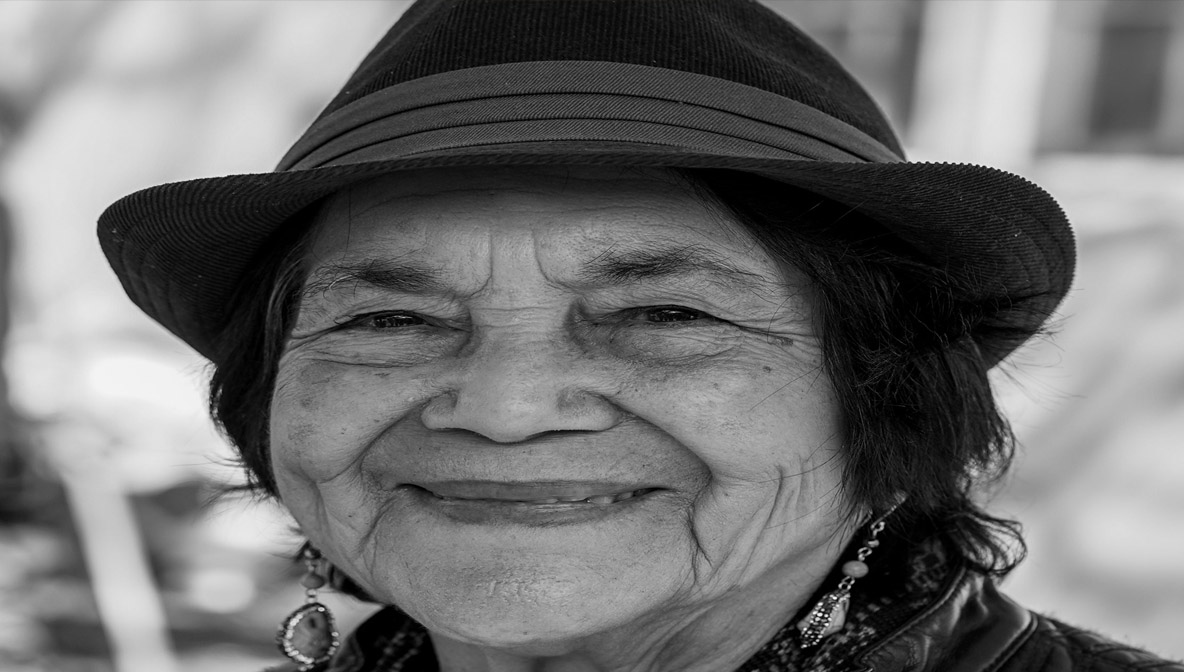

For decades, the story of the American farmworker movement has been told through a singular lens. Textbooks and documentaries have often focused on one man: Cesar Chavez. He was the face, the martyr, the saint-like figure who gave his life to the cause. But behind every great movement, there are great women, and in this case, that woman was Dolores Huerta.
For over 60 years, Dolores Huerta has been a force of nature. She is a firebrand organizer, a tenacious negotiator, and the co-founder of the United Farm Workers (UFW). She coined the most famous rallying cry in Latino history—”Sí, se puede”—and has been arrested 22 times for standing up for what is right. She has walked picket lines while raising 11 children and has been beaten by police for exercising her right to protest.
Yet, for all her monumental achievements, her story has often been relegated to a footnote. Now, at the age of 95, Dolores Huerta is once again making headlines, but for a reason that is shaking the very foundation of the civil rights movement she helped build. In March 2026, she came forward with a devastating secret she had kept for nearly 60 years: that her partner in the movement, Cesar Chavez, sexually assaulted her on two occasions, resulting in two pregnancies .
This is not just a story of political struggle; it is a story of personal sacrifice, of a woman who chose to bear her burden in silence to protect a cause she believed in, and who now, at the twilight of her life, has chosen to tell the truth. This is the full, complex, and inspiring biography of Dolores Huerta.
Introduction: The Voice of the Voiceless
If you have ever chanted “Yes, we can” at a rally, a political convention, or even a sporting event, you have Dolores Huerta to thank. That phrase, “Sí, se puede,” is her gift to the world . It encapsulates the spirit of optimism and resilience that has defined her life.
Dolores Huerta is a living legend. She is a labor leader, a civil rights icon, and a feminist champion who has spent her life fighting for the dignity of the working poor. She negotiated the first-ever collective bargaining agreements for farmworkers, secured pensions and health benefits for some of the most exploited laborers in America, and lobbied for the laws that gave them the right to organize .
But in March 2026, her legacy became intertwined with a painful chapter of her past. In an explosive investigation by The New York Times, Huerta alleged that Cesar Chavez, the sainted leader of the UFW, forced her into sexual encounters in the 1960s . The revelation has sent shockwaves through the activist community, forcing a re-evaluation of two icons. For Huerta, it was a secret that weighed on her for decades, a burden she carried to protect the movement she loved. Her decision to speak out, alongside other women, has redefined her story—not just as a fighter for others, but as a survivor of the very abuses that often thrive in the shadows of powerful movements.
Early Life & Background: Forged in the Valley
Dolores Clara Fernández was born on April 10, 1930, in the small mining town of Dawson, New Mexico . She was the second child of Juan Fernández and Alicia Chávez. Her father was a coal miner and a union activist who later went into politics, serving in the New Mexico Legislature . From him, she inherited the blood of an organizer. She would later recall hearing him tell stories about union organizing when she was very young.
But her parents divorced when she was just three years old, a rarity for the time. Her mother, Alicia, took Dolores and her two brothers and moved to the central California farmworker community of Stockton . This move would define the rest of Dolores’s life.
Stockton was a crucible of cultures and a hub of agricultural labor. Alicia Chávez was no shrinking violet. She was a businesswoman who owned a restaurant and later a 70-room hotel . In that hotel, she welcomed low-wage workers and farmworker families, often charging them next to nothing or giving them free housing when they were down on their luck. “The dominant person in my life is my mother,” Huerta later said. “She was a very intelligent woman and a very gentle woman” .
Alicia taught her daughter about compassion, but life in Stockton also taught her about injustice. As a young girl, Dolores witnessed the brutal conditions faced by migrant farmworkers who came through the valley. They lived in squalor, worked from sunup to sundown for pennies, and had no access to clean water or bathrooms .
Two specific incidents hardened her resolve. In school, a teacher accused her of cheating because her papers were “too well-written,” an act Huerta attributed to racial bias against her Hispanic heritage . Then, at the end of World War II, white men brutally beat her brother for wearing a “Zoot Suit,” a popular fashion among Mexican-American youths at the time . These experiences lit a fire in young Dolores that would never go out.
Education: Seeing the Hunger in the Classroom
Dolores was an active student at Stockton High School, involved in numerous clubs and even serving as a majorette. She was also a dedicated member of the Girl Scouts until the age of 18 . After graduating in 1947, she attended college at the University of the Pacific’s Stockton College (now San Joaquin Delta Community College), where she earned a provisional teaching credential .
In the early 1950s, she began teaching elementary school. It was there she had an epiphany that changed the course of her life. She looked at her students, the children of farmworkers, and saw that they were coming to school hungry and wearing shoes with holes in them. “I couldn’t tolerate seeing kids come to class hungry and needing shoes,” she famously said. “I thought I could do more by organizing farm workers than by trying to teach their hungry children” .
It was a radical realization. She understood that the conditions in the fields were the root cause of the problems in the classroom. She left her teaching job behind, trading the stability of a salary for the uncertainty of activism. She was about to find her true calling.
Career & Achievements: The Heart of the Movement
Dolores Huerta’s career is a masterclass in grassroots organizing. She didn’t just join a movement; she helped build it from the ground up, brick by brick.
The Community Service Organization (CSO)
In 1955, Huerta co-founded the Stockton chapter of the Community Service Organization (CSO) with legendary organizer Fred Ross . The CSO was a Latino civil rights group that fought for economic improvements, voter registration, and against police brutality. It was grueling, door-to-door work, and Huerta excelled at it. She was quickly promoted and became a key lobbyist in Sacramento, pushing for legislation to allow Spanish-speaking people to take their driver’s exam in Spanish and to repeal the Bracero Program, which brought in cheap migrant labor and undercut domestic farmworkers .
Co-founding the United Farm Workers (UFW)
It was through the CSO that she met a soft-spoken organizer named Cesar Chavez. They recognized a shared vision. In 1962, frustrated with the CSO’s reluctance to focus on farmworkers, they both resigned and co-founded the National Farm Workers Association (NFWA) . Gilbert Padilla was also a key co-founder .
This was a family affair. At one point, Huerta was living in Stockton with her children while Chavez was in Delano. The workload was immense. Huerta was the primary negotiator and lobbyist, while Chavez was the spiritual leader and strike strategist.
The Delano Grape Strike and “Sí, Se Puede”
In 1965, when Filipino American farmworkers (AWOC) went on strike against grape growers in Delano, the NFWA voted to join them . It was a pivotal moment. Huerta was thrust into the national spotlight. She directed the UFW’s national boycott, traveling across the country to convince consumers not to buy grapes . She was the lead negotiator in the historic contract with the Schenley Wine Company in 1966, marking the first time farmworkers had successfully bargained with a major agricultural enterprise .
During a campaign in Arizona in 1972, where farmworkers were facing brutal opposition, Huerta coined the phrase that would become her legacy. When activists felt defeated, she rallied them with the simple, powerful declaration: “Sí, se puede” — “Yes, we can” .
Lobbying for Change
Beyond the strikes and boycotts, Huerta understood the power of the law. She was instrumental in lobbying for the California Agricultural Labor Relations Act of 1975 . This was a landmark piece of legislation—the first law in the United States that granted farmworkers the right to collectively bargain for better wages and working conditions. It was the culmination of years of struggle.
The 1988 Beating
Her activism came at a great physical cost. In 1988, during a peaceful protest against the policies of then-presidential candidate George H.W. Bush in San Francisco, Huerta was severely beaten by police officers . Officer Frank Achim struck her with a baton, breaking several ribs and requiring emergency surgery to remove her spleen. The beating was caught on video and sparked national outrage. Huerta later won a substantial judgment, which she used to benefit farmworkers, and the incident led to major reforms in the San Francisco Police Department’s crowd control policies .
The Dolores Huerta Foundation
After stepping down from the UFW board in 1999, Huerta didn’t retire. In 2002, she used a $100,000 prize to found the Dolores Huerta Foundation . The foundation focuses on grassroots organizing at the community level, developing leaders, and advocating for policies that benefit working families, immigrants, women, and LGBTQ+ rights .
Personal Life: A Balancing Act of Family and Revolution
If Dolores Huerta’s public life was about building a movement, her private life was about holding a family together while doing it. It was not easy, and it was far from conventional.
Dolores was a mother of 11 children . Her personal relationships were complex and intertwined with her activism.
-
Ralph Head: She married her high school sweetheart in 1947, and they had two daughters. The marriage ended in divorce in 1950 .
-
Ventura Huerta: She married fellow activist Ventura Huerta in 1955, with whom she had five children. That marriage also ended in divorce in 1963 .
-
Richard Chavez: Later, she entered into a long-term relationship with Richard Chavez, Cesar’s brother. They had four children together .
Juggling 11 children and a life on the road, in picket lines, and in jail cells required a village. She relied heavily on her mother, Alicia, and a network of friends and fellow activists to help raise her kids. “My mother kept me going,” she once said. Her children were often brought to rallies and strikes; the movement was their daycare. While she was a loving mother, her dedication to la causa meant she was frequently absent, a sacrifice that her children have spoken about with both pride and pain.
In a shocking revelation in 2026, Huerta detailed another layer of her personal history. She stated that two of her 11 children were conceived as a result of sexual encounters with Cesar Chavez in the 1960s . She described one incident where he pressured her into sex in a hotel room, and another in 1966 where he drove her to a secluded grape field in Delano and raped her . She stated that she felt unable to refuse due to the power dynamics—he was her boss, her admired colleague, and the leader of the movement to which she had devoted her life . The children from those encounters were placed for adoption and raised by other families .
Net Worth: A Life Not Measured in Dollars
When discussing the net worth of someone like Dolores Huerta, it feels almost antithetical to her life’s mission. She was not an entrepreneur or a corporate executive; she was a community organizer.
However, various sources estimate Dolores Huerta’s net worth to be in the range of $2 million to $5 million .
This wealth is not accumulated from a high salary from the UFW, where leaders lived modestly. Instead, it comes from:
-
Speaking Engagements: As a revered public figure, she commands fees for speaking at universities and conferences.
-
Book Royalties and Documentaries: Income from films like the 2017 documentary Dolores.
-
Awards and Prizes: Including the $100,000 Puffin/Nation Prize for Creative Citizenship, which she used to seed her foundation .
-
Legal Settlement: The settlement from her 1988 beating case was significant.
It is also important to note that the Dolores Huerta Foundation manages millions of dollars in assets dedicated to community work. Huerta herself lives a modest life, her true wealth measured in the laws she changed and the lives she uplifted.
Legacy & Impact: A Giant Under Review
Dolores Huerta’s legacy is seismic. She is arguably the most influential Latina in the history of the United States. Her work with the UFW lifted an entire class of people out of abject poverty and gave them dignity. The legal protections she fought for—clean drinking water in the fields, rest breaks, ban on the short-handled hoe, the right to unionize—are now standards we take for granted .
She broke gender barriers in a male-dominated movement, facing criticism and machismo but never backing down. Her later work with the Feminist Majority Foundation and her efforts to elect women and Latinas to office paved the way for a generation of Hispanic politicians .
But as of 2026, her legacy is now part of a much larger, more painful conversation. By coming forward with her allegations against Cesar Chavez, she has placed truth above legacy. She has forced historians, activists, and the public to confront the reality that heroes are human, and that movements must be accountable for the sins of their leaders. Her decision to speak out—to say that protecting the movement’s image came at the cost of her own truth—is perhaps her final, most difficult act of activism. It has led to the cancellation of Cesar Chavez Day events and a widespread re-evaluation of his commemorations . Her legacy now includes the courage to tell her own story, no matter the cost.
What We Learn: The Complexity of Courage
The life of Dolores Huerta teaches us profound lessons about courage, sacrifice, and the nature of justice.
First, we learn that true courage often means sacrificing personal comfort for the greater good. Huerta gave up a stable teaching career, faced jail time, and endured physical brutality because she believed in something bigger than herself.
Second, we learn that the fight for justice is intersectional. Huerta understood that labor rights, women’s rights, immigrant rights, and civil rights are all connected. You cannot separate the worker from the woman, or the citizen from the immigrant.
Finally, we learn that holding onto the truth can be a form of suffering, and speaking it can be a form of healing. For 60 years, Huerta carried a trauma in silence to protect a movement. Her decision to finally speak out at age 95 teaches us that it is never too late to seek justice for oneself, and that we must always be willing to listen to the voices that have been silenced, no matter how uncomfortable the story may be.
Social Media Links and Foundation
While Dolores Huerta herself may not be actively tweeting, her work and legacy are carried on through her official foundation.
-
Dolores Huerta Foundation (Official Website): www.doloreshuerta.org
-
Facebook: The Dolores Huerta Foundation has an active Facebook page where they post updates on campaigns and events.
-
Instagram: @DoloresHuertaFoundation
-
Twitter/X: @DHFCommunity
10 Unknown Facts About Dolores Huerta
Here are ten things you might not know about the iconic activist.
-
She was a majorette. In high school, the fiery activist was a baton-twirling majorette .
-
She has an asteroid named after her. Asteroid 6849 Doloreshuerta was named in her honor .
-
She has her own state day. In California (2018) and Washington State (2019), April 10th is officially “Dolores Huerta Day” .
-
She was once denied service at a diner with Robert F. Kennedy. Just hours before he was assassinated in 1968, Huerta was with RFK at the Ambassador Hotel. Earlier that day, they had been denied service at a diner because of her ethnicity .
-
She speaks about “spiritual forces.” Huerta has often credited her strength to the spiritual resilience taught to her by her mother, saying Hispanic women understand the power of fasting and sacrifice .
-
She never planned to be a activist. She was a teacher first and only fell into activism when she saw the systemic failures impacting her students.
-
She has been arrested 22 times. All for non-violent civil disobedience .
-
Her father was a politician. Juan Fernández served in the New Mexico Legislature, giving Dolores an early understanding of how government could work for (or against) the people .
-
She was a key negotiator, not just a supporter. Unlike many female activists of her era who were relegated to support roles, Huerta was the lead contract negotiator for the UFW.
-
She served on OpenAI’s advisory board. As recently as 2025, at age 95, she joined a temporary philanthropic advisory board for OpenAI, showing her willingness to engage with new frontiers of advocacy .
Frequently Asked Questions (FAQs)
Given the renewed interest in her life, here are answers to the most common questions about Dolores Huerta.
1. Who is Dolores Huerta?
Dolores Huerta is a renowned American labor leader and civil rights activist who co-founded the United Farm Workers (UFW) with Cesar Chavez. She is a key figure in the farmworker movement and the originator of the slogan “Sí, se puede” .
2. What is Dolores Huerta famous for?
She is famous for her instrumental role in the Delano grape strike, her skills as a negotiator and lobbyist for farmworker rights, co-founding the UFW, and coining the rallying cry “Sí, se puede” .
3. How old is Dolores Huerta?
She was born on April 10, 1930. As of 2026, she is 96 years old .
4. What are the allegations Dolores Huerta made against Cesar Chavez?
In March 2026, Huerta publicly alleged that Cesar Chavez sexually assaulted her on two occasions in the 1960s. She described one instance as coercion in a hotel room and another as rape in a car in a secluded grape field. She stated that these encounters resulted in two pregnancies .
5. Why did Dolores Huerta wait so long to come forward?
Huerta stated that she remained silent for nearly 60 years to protect the farmworker movement. She feared that exposing the truth would damage the UFW and undo the progress they had fought so hard to achieve .
6. How many children does Dolores Huerta have?
Dolores Huerta has 11 children .
7. What is the Dolores Huerta Foundation?
It is a community benefit organization founded by Huerta in 2002 that focuses on grassroots organizing, leadership development, and advocacy in areas like health, education, and economic development .
8. What awards has Dolores Huerta won?
She has won numerous awards, including the Presidential Medal of Freedom (2012), the Eleanor Roosevelt Award for Human Rights (1998), and she was the first Latina inducted into the National Women’s Hall of Fame (1993) .
9. What is Dolores Huerta’s net worth?
Her net worth is estimated to be between $2 million and $5 million, accumulated through speaking fees, book royalties, and awards .
10. Did Dolores Huerta ever run for political office?
No, she has never run for office. Instead, she has dedicated her life to organizing and lobbying, and has worked extensively to encourage and empower other Latinas and women to run for office .
Dolores Huerta’s story is a testament to the fact that history is never simple. She is a giant of social justice whose shoulders we stand on. And now, in the autumn of her life, she has shown us another kind of strength: the strength to be vulnerable, to speak an uncomfortable truth, and to remind us that the fight for justice must also include justice for ourselves.