
More Than Just a Spoonful of Sugar
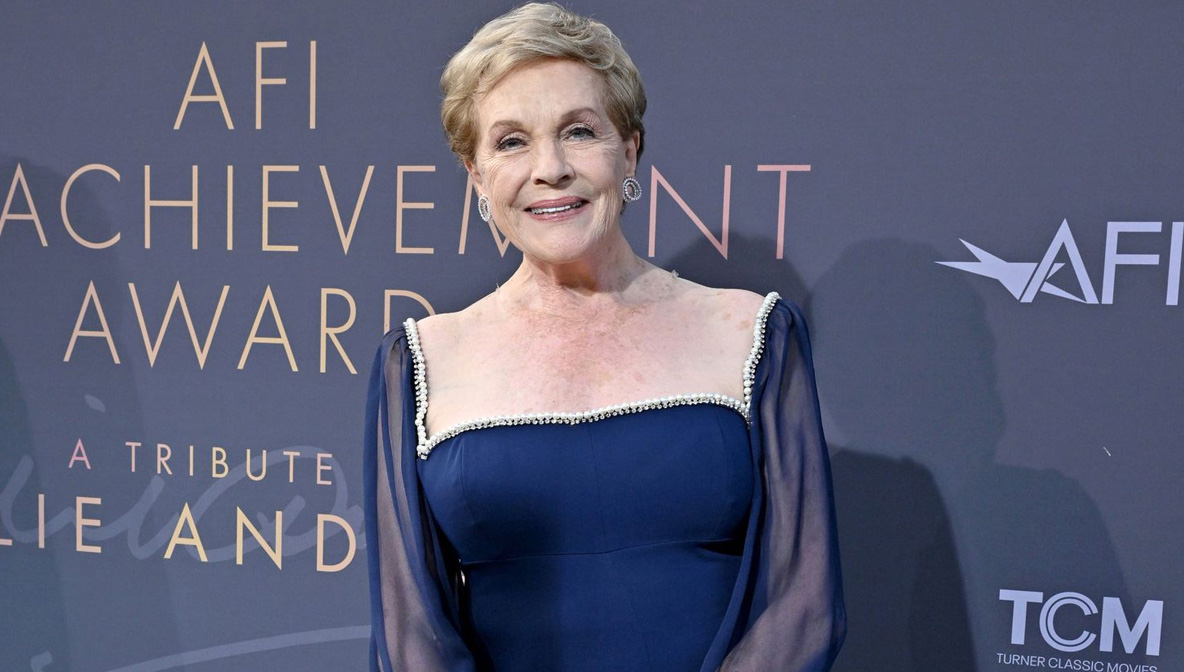
When you hear the name Julie Andrews, an immediate, visceral reaction occurs. A flood of familiar, comforting images: the majestic Alps, a carpet bag, a perfect octave leap into “The Sound of Music.” She is Maria, Mary Poppins, Queen of Genovia. But to define Julie Andrews by these iconic roles alone is to see only the glittering surface of a profound and resilient depth. Her story is not a fairy tale, but a testament to raw talent forged in fire, of a voice that soared above personal tragedy, and of a grace that turned professional devastation into reinvention. This is the biography of a woman who didn’t just perform magic on screen; she built her own life with an iron will, velvet grace, and an unbreakable spirit that continues to inspire generations.
Early Life & Background: A Voice Born from the Blitz
Julie Andrews was born Julia Elizabeth Wells on October 1, 1935, in Walton-on-Thames, Surrey, England. Her childhood was framed not by idyllic English countryside, but by the looming shadow of World War II and a complicated family life.
Her mother, Barbara Ward, was a talented pianist, and her stepfather, Ted Andrews (whom Julie later considered her true father), was a singer with a powerful tenor voice. Her biological father, Edward “Ted” Wells, was a teacher. Her parents’ divorce and her mother’s subsequent marriage to Ted Andrews created a home filled with music, but also with tension. Ted Andrews, while instrumental in training her voice, was known to have a volatile personality and a drinking problem.
The family’s struggles were amplified by the war. They lived in London during the Blitz, experiencing nightly bombings firsthand. Young Julie was evacuated several times, facing instability and fear. Yet, it was in this crucible that her legendary voice was discovered. Her stepfather recognized her freakish, four-octave vocal range—a “freak” voice, as she later called it—when she was just a child. By the age of 10, she was being professionally trained, her voice so precise and mature it belied her tiny frame.
This period forged Julie’s core characteristics: a steely discipline, a preternatural professionalism born from necessity, and the ability to create pockets of beauty and order amidst chaos—a trait her most famous characters would later embody.
Education: The Stage as Her Classroom
Julie Andrews’s education was unconventional. Formal schooling took a backseat to the rigorous tutelage of her musical family and the greatest teacher of all: the stage.
-
Vocal Training: Her primary education was her voice. Under the strict, often difficult, guidance of her stepfather and her mother, she learned vocal technique, breath control, and stage presence with the intensity of a conservatory student.
-
The “Infant Phenomenon”: She attended the Girls’ School in Beckenham, Kent, briefly, but her career quickly eclipsed traditional education. By 12, she was performing professionally on the BBC radio show Educating Archie. She later attended the Arts Educational School in London, but her real learning happened in rehearsals and performances.
-
A Practical PhD in Performance: Her true alma mater was the British music hall and pantomime circuit. Performing in shows like Cinderella and Aladdin, she learned comedy timing, how to handle live audiences, and the grueling pace of a performer’s life. This “old school” training gave her an unshakable foundation that Hollywood would later marvel at.
Career & Achievements: A Meteoric Rise, a Fall, and a Phoenix’s Return
Broadway Stardom (1950s): Julie’s big break came at 19, when she was cast as Polly Browne in the British musical The Boy Friend on Broadway (1954). Her crystal-clear soprano and fresh-faced charm took New York by storm. Just two years later, she created the role that would make her a legend: Eliza Doolittle in My Fair Lady (1956). Her performance was hailed as a triumph, though the film role infamously went to Audrey Hepburn. Simultaneously, she originated Guinevere in Camelot (1960) opposite Richard Burton, cementing her as the First Lady of the American Musical Theatre.
Hollywood Royalty (1960s): When she was passed over for the My Fair Lady film, it seemed a crushing blow. Instead, it led to her cinematic destiny. Walt Disney, seeing her on The Garry Moore Show, cast her as the titular Mary Poppins (1964). The role won her the Academy Award for Best Actress. The very next year, she starred as Maria von Trapp in The Sound of Music (1965), a film that became one of the highest-grossing of all time and defined her in the public’s heart. She followed this with acclaimed roles in The Americanization of Emily (1964), Hawaii (1966), and Thoroughly Modern Millie (1967).
A Devastating Turning Point & Reinvention (1970s-1990s): The 1970s and 80s saw mixed film success, but her second marriage to filmmaker Blake Edwards led to creative collaborations like *10* (1979) and Victor/Victoria (1982), the latter earning her a fourth Oscar nomination. Then, in 1997, disaster struck. After throat surgery to remove non-cancerous nodules, Julie Andrews’s singing voice was irrevocably damaged. For a performer whose identity was tied to her vocal instrument, this was a catastrophic loss.
She fell into a deep depression but, characteristically, did not surrender. She reinvented herself:
-
As a Director: She directed a revival of The Boy Friend.
-
As a Author: She became a bestselling children’s book author, co-writing over 30 books with her daughter.
-
As a Film Star for a New Generation: She voiced Queen Lillian in the Shrek films and, pivotally, played Queen Clarisse Renaldi in The Princess Diaries (2001), introducing her to a new, adoring generation.
-
As a Narrator and Presence: Her speaking voice, still crisp and resonant, became a beloved instrument for narration and acting.
Awards & Accolades: Her mantle holds an Academy Award, multiple Golden Globes, Grammys, Emmys, a BAFTA, a Kennedy Center Honor, a Screen Actors Guild Life Achievement Award, and a Dameship from Queen Elizabeth II.
Personal Life: Finding Her Own Harmony
Julie’s personal life has been a journey toward the stability her childhood lacked. She married set designer Tony Walton in 1959 (divorced 1967), with whom she had her daughter, Emma Walton Hamilton. Her true anchor came when she married legendary director Blake Edwards in 1969. Theirs was a deep, artistic, and enduring partnership that lasted until his death in 2010. She became stepmother to his two children, and they adopted two Vietnamese daughters, Amy and Joanna, in the early 1970s. The family splits time between New York, the Hamptons, and Switzerland. Her life reflects the themes of her work: family, love, and creating beauty from complexity.
Net Worth
While specific figures are always estimates, Julie Andrews’s net worth is generally placed in the range of $30 million to $45 million. This wealth has been accumulated not from a single blockbuster, but from a lifetime of work: her early Broadway triumphs, her legendary film roles which continue to generate royalties, her successful ventures as an author, voice work, and later film roles. It’s a fortune built on resilience and diversified talent, rather than fleeting fame.
Legacy & Impact: An Echo That Never Fades
Julie Andrews’s legacy is multifaceted:
-
The Gold Standard of the Musical: She is the vocal and stylistic benchmark against which all musical theatre and film singing is measured.
-
A Cultural Touchstone: Mary Poppins and The Sound of Music are not just movies; they are childhood rituals, passed down through families, embedding values of kindness, courage, and joy.
-
A Master Class in Resilience: Her response to losing her singing voice is her most powerful lesson. She demonstrated that identity is not one thing, and that artistry can find new forms.
-
Timeless Elegance and Grace: In an age of celebrity scandal, she has maintained a reputation of profound professionalism, kindness, and wit, earning universal respect.
What We Learn from Julie Andrews
Her life teaches us that:
-
Discipline is the foundation of magic. The effortless grace on screen was born from brutal, childhood discipline.
-
You can grieve a loss and still move forward. She honored her lost voice but refused to be its prisoner.
-
Elegance is strength under control. Her poise is not passivity; it’s the visible form of an interior steel.
-
Your second act can define you as powerfully as your first. Reinvention is possible at any stage.
Social Media Links
Julie Andrews does not maintain personal social media accounts. Authentic updates can be found via:
-
The Julie Andrews Collection (Her publishing venture): Website and associated social channels.
-
Her official biography and news: Through reputable entertainment sources and her publishers’ announcements.
10 Unknown Facts About Julie Andrews
-
War-Time Performer: She performed for troops during WWII with her parents’ vaudeville act, singing for soldiers in often dangerous conditions.
-
A Stage Name from Her Stepfather: She legally adopted “Julie Andrews” from her stepfather, Ted Andrews, early in her career.
-
The My Fair Lady Snub was Technical: Director George Cukor reportedly felt she wasn’t “bankable” enough as a film star, and producer Jack Warner wanted a bigger name (Hepburn) despite Hepburn’s singing being dubbed.
-
She Helped Discover a Young Star: During the Broadway run of The Boy Friend, a young understudy named Dick Van Dyke sometimes performed. She later recommended him for Mary Poppins.
-
She Performed at the Met: In 1992, long before her voice loss, she performed a concert of show tunes with the Metropolitan Opera Orchestra.
-
A Near-Miss for Gone with the Wind: As a child, she was considered for the role of Bonnie Blue Butler, but her mother felt the subject matter was too adult.
-
She’s a Lifelong Learner: Despite her limited formal education, she is an avid reader and researcher, deeply immersing herself in the history and context of her roles.
-
Secretly Hilarious: Her comic timing is underrated. Watch her in The Princess Diaries or Blake Edwards’s films for a masterclass in dry, sophisticated wit.
-
A Bond with the Real Maria: She formed a close, lasting friendship with the real Maria von Trapp, who affirmed Julie’s portrayal captured her spirit.
-
Honorary “Mum” to Many: She has a longstanding tradition of mentoring young performers, offering advice and support with maternal warmth.
FAQs About Julie Andrews
Q: Can Julie Andrews sing anymore?
A: Following her 1997 surgery, she lost her legendary singing voice. She can speak beautifully and has sung sparingly in very limited ranges (as in the Princess Diaries films), but the iconic soprano voice is no longer. She has made peace with this, focusing on her writing and acting.
Q: Was Julie Andrews really singing in Mary Poppins and The Sound of Music?
A: Absolutely. Every note from Maria and Mary Poppins is Julie’s own, pristine voice. The helicopter shot opening of The Sound of Music was done in a single, technically perfect take.
Q: What is her relationship with the Sound of Music cast?
A: She remains close with many, particularly Christopher Plummer (Captain von Trapp), with whom she shared a playful, lifelong friendship. She has also maintained bonds with the actors who played the children.
Q: Is she really a dame?
A: Yes! She was made a Dame Commander of the British Empire (DBE) by Queen Elizabeth II in 2000 for services to the performing arts.
Q: What are her best books for children?
A: The Very Fairy Princess series and The Great American Mousical, co-written with her daughter Emma, are wonderful starting points.
Q: Did she and Blake Edwards collaborate often?
A: Yes, on several films including The Tamarind Seed (1974), *10* (1979), S.O.B. (1981), Victor/Victoria (1982), and That’s Life! (1986).
Julie Andrews’s story is a symphony in multiple movements: a startling overture, a soaring crescendo, a moment of profound silence, and a final, rich movement of complex, beautiful harmony. She is, and will always be, the very definition of a class act.