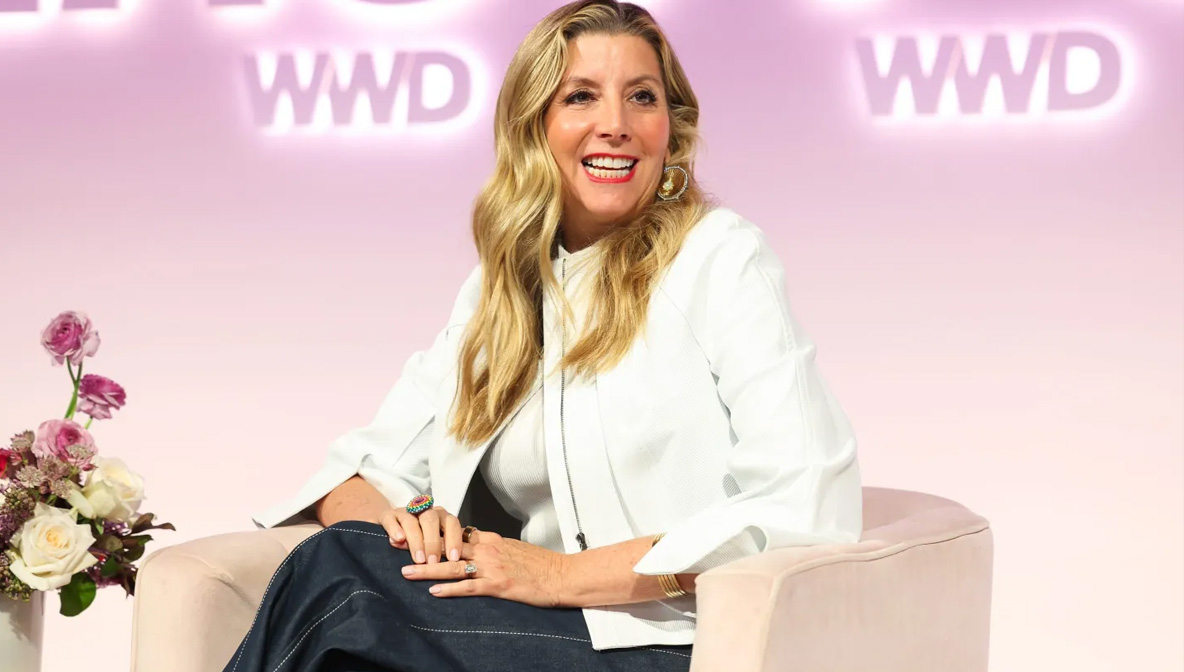

Let’s be honest. Most of us have had a “million-dollar idea” in the shower or while staring at the ceiling at 3 AM. The difference between us and Sara Blakely is that she actually did something about hers. In fact, she turned that single, simple idea into a billion-dollar empire, all starting with a pair of scissors and a problem she wanted to solve.
Sara Blakely isn’t just the founder of Spanx; she’s a modern-day business folk hero. She’s the self-made billionaire who started with $5,000 in savings and a fierce belief in a product that didn’t yet exist. She rewrote the rules of the undergarment industry not by being a seasoned CEO, but by being a frustrated consumer with a brilliant idea and the guts to see it through. Her story is a masterclass in ingenuity, relentless perseverance, and the power of solving a universal, yet unspoken, problem. This is the story of how a door-to-door fax machine salesperson cut the feet off her pantyhose and sparked a shapewear revolution.
Introduction: The Accidental Disruptor
In a world of complex tech startups and venture capital-funded behemoths, Sara Blakely’s success feels refreshingly tangible. She didn’t have an MBA. She didn’t have a network of angel investors. She didn’t even have any experience in fashion or manufacturing. What she had was a personal frustration and an unwavering, almost naive, belief that she could fix it.
Spanx didn’t come from a corporate boardroom; it was born in Blakely’s apartment. It’s a product designed by a woman, for women, in the most literal sense. She understood a pain point that the male-dominated hosiery industry had completely ignored: women wanted undergarments that smoothed their lines, made them feel confident in their clothes, but didn’t add bulk or look clunky.
With a personality that is equal parts Southern charm and shark-tank savvy, Blakely broke into an entrenched industry by being persistent, creative, and leveraging her greatest asset: her story. She became the face of her brand, the relatable everywoman who had stumbled upon a genius solution. Today, Spanx is a household name, a verb (“I’m wearing Spanx!”), and a global phenomenon. But the journey from that “aha” moment to becoming the world’s youngest self-made female billionaire is a tale of hustle, rejection, and one very lucky break with Oprah Winfrey.
Early Life & Background: The Roots of Resilience
Sara Treva Blakely was born on February 27, 1971, in Clearwater, Florida. Her upbringing was a key training ground for her future entrepreneurial spirit. Her father was a trial attorney, and her mother was an artist. She has often said that her father’s influence was particularly formative. He would regularly ask his children a question at the dinner table: “What have you failed at this week?”
This wasn’t meant to be discouraging. Quite the opposite. He was reframing failure as a necessary and positive step towards trying new things. If you weren’t failing, you weren’t pushing your boundaries. This lesson in embracing failure became the bedrock of Blakely’s resilience, allowing her to face countless rejections without losing steam.
From a young age, she showed signs of an entrepreneurial mindset. In high school, she started a business teaching other kids how to type. She was also a talented orator and competed in speech competitions, a skill that would later prove invaluable for pitching her product and herself.
However, her path wasn’t straightforward. Like many entrepreneurs, her initial ambitions were different. Her dream was to be a lawyer, just like her father. But life had a different plan. She took the Law School Admission Test (LSAT) and, despite her skills as a debater, she scored poorly—not once, but twice. It was a major setback, a door slamming shut on the future she had envisioned. At the time, it felt like a crushing failure. In hindsight, it was the first step toward her true calling.
Education: A Different Kind of Classroom
Blakely attended Florida State University, where she graduated in 1993 with a degree in Legal Communications. While her degree was related to law, her real education was happening outside the classroom. To put herself through school, she worked at various jobs, developing a thick skin and a salesperson’s tenacity.
Her most significant post-college education, however, came from a job she held for seven years. Needing to pay the bills after her law school dreams faded, she took a job at Disney World, working for a brief stint (just three months) loading tourists onto rides. She then moved to Clearwater, Florida, and took a job selling fax machines door-to-door for the company Danka.
This wasn’t a glamorous job. It involved cold-calling, facing constant rejection, and trying to sell a product that nobody was excited about. For seven years, she drove around Florida in her car, making sales pitches. This experience, while grueling, was her business school. It taught her how to sell, how to handle “no,” and how to communicate the value of a product directly to a customer. She was, in essence, building the muscles she would need to sell an invisible product—smoother lines and more confidence—to the entire world.
Career & Achievements: The Birth of a Billion-Dollar Idea
The legendary Spanx origin story took place in 1998. Blakely was getting ready for a party and wanted to wear a pair of white pants with open-toed sandals. She loved the pants but hated the visible panty line and the look of her underwear underneath. The existing solutions were terrible. Control-top pantyhose had the feet and the awkward seamed toe, making them impossible to wear with sandals. She wanted something that would smooth her from the waist down without being a full pair of stockings.
In a moment of pure ingenuity, she went into her bathroom, took a pair of control-top pantyhose, and cut the feet off. It was an instant solution. She realized she had stumbled onto something. For the first time, she could wear her favorite pants and feel confident and comfortable.
For the next two years, while still selling fax machines during the day, she spent her nights and weekends researching and developing her idea. This is where her hustle truly began.
-
The $5,000 Gamble: She used her entire life savings of $5,000 to start the company. She was so cautious with her funds that she wrote her own patent, spending hundreds of hours at the library studying patent law to avoid the $3,000-$5,000 fee for a patent lawyer. (She was eventually granted the patent).
-
The Cold Calls: She cold-called hosiery mills, trying to find someone to manufacture her product. She was hung up on repeatedly. Most mills were run by male executives who didn’t understand the product or its potential. Finally, after two years of rejection, the owner of a mill in North Carolina agreed to help her after asking his daughters what they thought of the idea. They loved it.
-
The Name “Spanx”: She came up with the name herself. She wanted a name that was catchy, memorable, and a little bit funny. She liked the sound of “Spanks” but thought “Spanx” was more ownable and brand-friendly. She believed the “k” sound made people pay attention.
-
The Big Break – Oprah: For two years, she personally packed and shipped every order, often driving her car to the post office. Her big break came in 2000, completely unexpectedly. A friend of a friend sent a gift basket of Spanx to Oprah Winfrey’s show. Oprah’s producers tried the product and loved it. Soon after, Oprah named Spanx her “Favorite Thing” of the year. The day the show aired, Spanx sold out completely. The website crashed, and the phones at Neiman Marcus rang off the hook.
-
The Richard Branson Moment: Another legendary moment came when she managed to get her product to billionaire Richard Branson’s office. He was so impressed that he invited her to lunch, and he later became a mentor and supporter.
From there, the company exploded. She expanded the product line from footless pantyhose to dozens of different shapewear items, leggings, and activewear. She retained 100% ownership of the company, a rarity in the business world, which allowed her to make all the key decisions and reap the full financial reward.
Personal Life: Grounded at the Top
Despite her immense success, Sara Blakely has remained famously down-to-earth and relatable. She is married to Jesse Itzler, an entrepreneur, author, and former rapper (he co-wrote the NBA on NBC theme song “I Love This Game”). Together, they have four children and split their time between Atlanta, Georgia, and other homes.
Their relationship is a partnership of two unique entrepreneurial spirits. Itzler is known for his own extreme approaches to life and business, and they often speak about how they support and challenge each other.
Blakely’s personal philosophy is deeply intertwined with her work. She is a huge proponent of visualization and positive thinking. She has spoken about how she used to practice writing her autograph as a kid, imagining she was famous, and how she visualized Oprah loving her product long before it happened.
She is also deeply committed to philanthropy, with a particular focus on empowering women. In 2006, she founded the Sara Blakely Foundation, and in 2013, she signed The Giving Pledge, committing to donate at least half of her wealth to charity. A significant portion of her giving goes to organizations that support female entrepreneurs around the world.
Net Worth: The $1.1 Billion Validation
In 2021, Sara Blakely made headlines when she sold a majority stake in Spanx to the global investment firm Blackstone. The deal valued the company at a staggering $1.2 billion. Because she had never given up equity, this transaction turned her officially into a self-made billionaire, with her personal net worth skyrocketing to over $1.1 billion.
What was remarkable about the deal was how she celebrated it. She took her entire staff on an all-expenses-paid trip to New York City, where they stayed at the Plaza Hotel, had a private concert with John Legend, and were each given $10,000 and two first-class plane tickets to anywhere in the world. It was a testament to her character and her recognition that her employees were integral to her success.
Legacy & Impact: More Than Just Shapewear
Sara Blakely’s impact extends far beyond the wardrobe drawers of millions of women.
-
She Created a New Product Category: Before Spanx, “shapewear” was granny panties and bulky, uncomfortable girdles. Blakely rebranded and reinvented the category, making it modern, desirable, and even a little bit cool. She turned a functional undergarment into a must-have fashion item.
-
She Paved the Way for Female Founders: As one of the most prominent self-made female billionaires, she became a powerful role model. She proved that a woman with no formal training, no family money, and no connections could build a colossal business by solving a real-world problem for women.
-
The Power of 100% Ownership: Her decision to bootstrap and never take venture capital is a legendary case study. It gave her complete creative control and allowed her to build the company at her own pace, according to her own vision. It’s a powerful lesson in retaining ownership of your ideas.
-
Marketing Genius: Her marketing strategy was pure brilliance. She focused on creating a fantastic in-store experience with knowledgeable staff. She used her own compelling story as the central marketing message. And she leveraged PR and word-of-mouth masterfully, turning the Oprah endorsement into a cultural moment.
What We Learn: The Enduring Lessons from Sara Blakely
The story of Spanx is a treasure trove of practical lessons for anyone with a dream.
-
Solve Your Own Problem: The best business ideas often come from your own frustrations. Don’t look for problems in abstract markets; look at your own life. What annoys you? What could be better? You are your own best focus group.
-
Embrace Failure as Feedback: Her father’s dinner table question was life-changing. Don’t be afraid to fail. See every “no” and every setback as a necessary step that brings you closer to a “yes.” Resilience is the number one predictor of entrepreneurial success.
-
Start Where You Are with What You Have: You don’t need a massive loan or a team of experts to start. Blakely started with $5,000 and a lot of hustle. Use the resources you have right now. Action begets more action.
-
Protect Your Intellectual Property: Her decision to patent her idea was crucial. It protected her from copycats and gave her a legal monopoly on her invention for years. If you have a unique idea, take the steps to protect it.
-
Bootstrap When You Can: While not right for every business, bootstrapping forces discipline and creativity. It allows you to retain control and all the equity. Consider whether you really need outside funding, or if you can get started on your own.
-
Be the Face of Your Story: People connect with people, not just products. Blakely’s authentic, relatable story was her most powerful marketing tool. Don’t be afraid to put yourself out there and share your journey.
Social Media Links
While she is not hyper-active, you can follow Sara Blakely here:
-
Instagram: @sarablakely (She shares personal moments, business insights, and motivational posts)
-
Facebook: Sara Blakely
-
LinkedIn: Sara Blakely
-
The Spanx Instagram: @spanx
10 Unknown Facts About Sara Blakely
-
She was a stand-up comedian. For a brief period, she tried her hand at comedy to overcome her fear of public speaking.
-
She wrote her own patent. To save money, she spent nights at the library studying patent law and wrote the entire patent application herself.
-
She sold her product out of her car trunk. In the early days, she would personally visit Neiman Marcus and demo the product for buyers in the bathroom, with her inventory in the trunk of her car.
-
She was on the cover of Forbes magazine in 2012, being named the world’s youngest self-made female billionaire at the time.
-
She credits Wayne Dyer’s “The Power of Intention” as a book that profoundly influenced her mindset during the early stages of building Spanx.
-
She failed the LSAT twice. This “failure” was the pivotal moment that redirected her path toward entrepreneurship.
-
The first Spanx prototype was made with white fabric because she couldn’t find a manufacturer who had skin-toned fabric readily available.
-
She initially wanted to call the product “Sara’s Smoothers” but thankfully settled on the much catchier “Spanx.”
-
She appeared on the TV show Undercover Boss in 2012 to get an unfiltered look at her own company.
-
She and her husband, Jesse Itzler, have a “No Phone Zone” policy during family dinners to ensure quality time.
A Small FAQ Section
Q: How old was Sara Blakely when she started Spanx?
A: She was 27 years old when she had the initial idea in 1998, and she was 29 when she officially launched the company in 2000.
Q: Did Sara Blakely have any investors?
A: No, she famously bootstrapped the company with her $5,000 in savings and never took any outside investment until the 2021 sale to Blackstone.
Q: What was her job before Spanx?
A: She sold fax machines door-to-door for seven years for a company called Danka.
Q: Is Spanx only for women?
A: Primarily, yes. However, the company has occasionally dabbled in products for men, but its core business and brand identity are centered on women’s shapewear and apparel.
Q: What is Sara Blakely’s most important piece of advice for entrepreneurs?
A: She often says, “Fail big, fail fast, and fail often.” Embrace failure as a learning tool and don’t let the fear of it stop you from trying.
Sara Blakely’s story is a powerful reminder that you don’t need permission to be great. You just need an idea, the courage to start, and the resilience to keep going. She looked at a pair of pantyhose and saw a billion-dollar opportunity, proving that the next world-changing idea could be hiding in your own bathroom.