
Introduction
Imagine a world without email. Not just without the constant ping of work messages, but without the ability to instantly share a photo with a relative across the globe, receive a digital birthday card, or apply for a job with a click. It’s almost impossible. This fundamental fabric of our modern digital lives has a single, humble origin point, and it wasn’t in a glossy Silicon Valley boardroom. It was in a nondescript lab in Cambridge, Massachusetts, in 1971, by a man named Ray Tomlinson.
Ray Tomlinson wasn’t a celebrity CEO seeking fame or fortune. He was a quiet, brilliant engineer working on ARPANET, the precursor to the internet. His groundbreaking invention wasn’t a complex piece of hardware but a simple program and a clever idea. He figured out how to send a message from one computer to another on a network, and in doing so, he created email as we know it. But his most enduring legacy is a tiny symbol he plucked from the keyboard to make it work: the @ symbol. This is the story of the unassuming man who quietly launched a communication revolution.
Early Life & Background: The Tinkerer from New York
Raymond Samuel Tomlinson was born in Amsterdam, New York, in 1941. Growing up in the small village of Vail Mills, New York, he exhibited the classic traits of an inventor from a young age. He was fascinated by how things worked. He would spend hours tinkering with old radios and electronic kits, driven by an innate curiosity about the unseen forces—electricity and radio waves—that could transmit sound and information.
This passion for engineering led him to the prestigious Rensselaer Polytechnic Institute (RPI), where he participated in a co-op program with IBM. This hands-on experience in the nascent computer industry was formative. After earning his bachelor’s degree in electrical engineering from RPI in 1963, he continued his academic journey at the Massachusetts Institute of Technology (MIT).
At MIT, Tomlinson immersed himself in the world of large-scale computing, working on projects related to speech synthesis and the TX-2 computer. He earned his Master’s degree in Electrical Engineering in 1965. His education placed him at the epicenter of computer science innovation, equipping him with the skills that would soon change the world. In 1967, he joined the technology company Bolt, Beranek and Newman (now BBN Technologies), which was a key contractor for the U.S. Department of Defense’s Advanced Research Projects Agency (ARPA). It was here that Tomlinson found himself on the front lines of a digital frontier: the ARPANET.
Career & Achievements: The Accidental Invention That Changed Everything
When Tomlinson started at BBN, his work was focused on developing the TENEX operating system and contributing to the Network Control Protocol (NCP), the foundation of ARPANET. The ARPANET itself was a monumental achievement—it was the first network to allow different computers to communicate with each other. However, communication at the time was more like leaving a note on someone’s desk than having a conversation.
Before Tomlinson, messaging existed, but it was incredibly limited. There were programs like SNDMSG, which allowed users on the same computer to leave messages for each other in a shared mailbox file. It was a digital sticky note system. Meanwhile, there was a separate, experimental file-transfer protocol called CPYNET that could send files between computers on the ARPANET.
The “Aha!” Moment
Tomlinson’s genius lay in connecting these two isolated ideas. He wondered: what if you could append a message to a mailbox file on a remote computer? In late 1971, he began experimenting, modifying the SNDMSG and CPYNET programs.
The challenge was simple but critical: how do you specify that a message is intended for a user on a different machine, and not the local one? He needed a separator that wouldn’t appear in anyone’s name and would clearly indicate the destination.
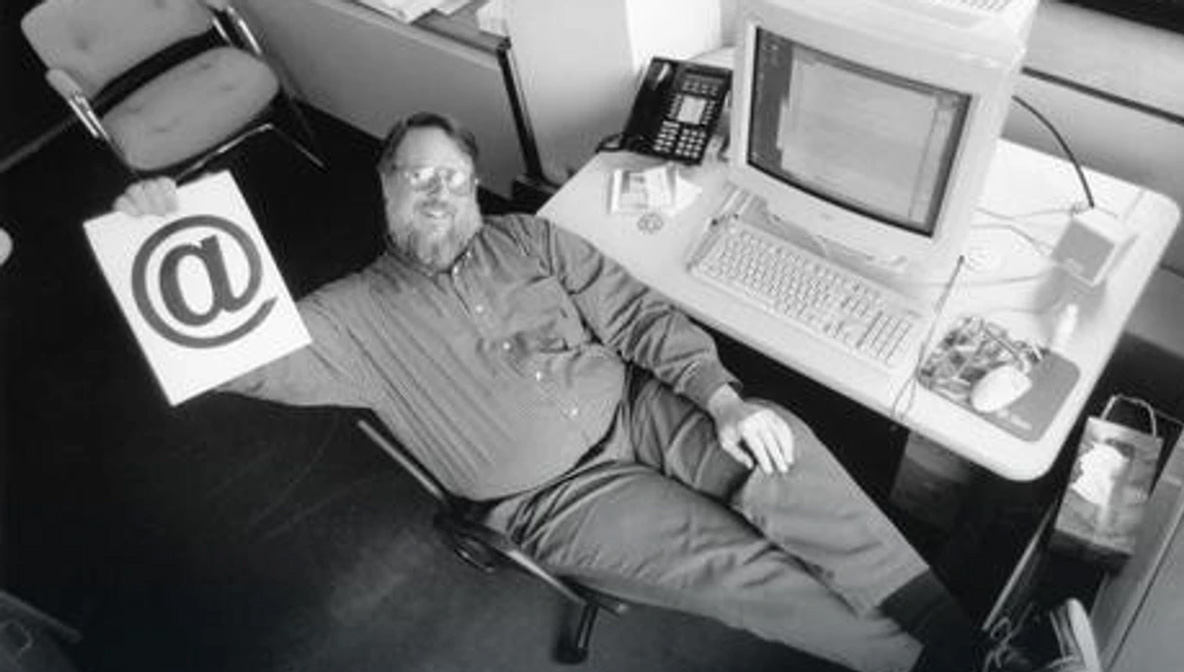
His eyes scanned the keyboard, settling on a symbol that was languishing in obscurity. The @ symbol, which originally meant “at the rate of” in accounting (e.g., 10 widgets @ $2 each), was perfect. It was logical, available, and virtually unused in computing. It elegantly denoted the user’s location: username@hostname.
The First Email
Sitting at a Teletype Model 33 terminal connected to the ARPANET, Tomlinson sent the first network email from one computer in his lab to another, sitting right beside it. What was the content of this world-changing message? Tomlinson himself admitted he couldn’t remember. He said it was something entirely forgettable, like “QWERTYUIOP” or the first line of the keyboard. The test messages were arbitrary; the achievement was everything.
When he showed his breakthrough to a colleague, his only instruction was, “Don’t tell anyone! This isn’t what we’re supposed to be working on.” He knew he was using company time for an unofficial, personal project. But the cat was soon out of the bag. The utility of email was so immediately obvious to the small community of ARPANET users that it spread like wildfire. Within years, email became the most popular activity on the network, far surpassing file transfers and remote computing.
A Lifetime of Contribution
Tomlinson continued to work at BBN for over three decades, contributing to many other important networking protocols and technologies. He was a key figure in the development of standards for email, including the familiar “From,” “To,” and “Subject” fields we use today. He never sought the spotlight for his invention, preferring the collaborative, problem-solving environment of engineering.
Personal Life: The Humble Engineer
Ray Tomlinson was the antithesis of the flamboyant tech pioneer. He was described by colleagues and friends as modest, unassuming, and deeply private. He never patented email, believing it was an inherent part of the networked system he was building, not a separate product. He drove a modest car, lived a quiet life, and enjoyed flying glider planes in his spare time—a hobby that reflected his love for elegant, silent, and efficient systems.
He understood the profound impact of his work but was often bemused by the later problems it created, like spam. He saw spam as an inevitable, if unfortunate, consequence of an open system, and he believed in developing technical solutions to fight it rather than restricting the openness of the network. Tomlinson was inducted into the Internet Hall of Fame in 2012, a recognition of his monumental contribution. He passed away from a heart attack in 2016 at the age of 74.
Legacy & Impact: The Symbol That Defined an Era
It is difficult to overstate Ray Tomlinson’s impact. His invention of network email was a paradigm shift in human communication.
-
The Democratization of Communication: Before email, long-distance communication was slow (snail mail) or expensive (phone calls, telegrams). Email made instant, asynchronous, and virtually free communication accessible to everyone with a network connection. It flattened geographical barriers and accelerated the pace of business, science, and personal relationships.
-
The @ Symbol’s Second Life: Tomlinson single-handedly rescued the @ symbol from obscurity. It was a forgotten key on the typewriter until he赋予了它新的生命. Today, the @ symbol is one of the most recognizable characters in the world. It is the very foundation of digital identity, not just for email but for every social media platform, online service, and digital transaction. It is a symbol of connectivity, of being “at” a place in the digital universe.
-
The Foundation for Everything: Email was the first “killer app” of the internet. It was the application that demonstrated to millions of people why they needed to be connected. It drove the adoption of the internet from a military and academic tool into a household utility. Social media, e-commerce, and cloud computing all rest on the foundational concept of networked communication that email pioneered.
-
Transforming Society: Email reshaped how we work, learn, and govern. It enabled remote work, global collaboration on scientific projects, and new forms of political and social organization. It created new industries and made old ones more efficient.
Final Thoughts, and What We Learn
Ray Tomlinson’s story is a powerful lesson in the nature of innovation. It reminds us that world-changing ideas don’t always come from a quest for glory or profit. They often emerge from simple curiosity, from a desire to solve a small, interesting problem. Tomlinson wasn’t trying to reinvent communication; he was just tinkering, connecting two existing tools in a novel way because he could.
His life teaches us several crucial lessons:
-
Innovation is Often Incremental: The greatest breakthroughs can be a recombination of existing ideas. Tomlinson didn’t invent messaging or file transfer; he simply bridged them.
-
Elegance Over Complexity: The most powerful solutions are often the simplest. The
user@hostsyntax is a model of elegant, intuitive design that has remained unchanged for over 50 years. -
Focus on the Problem, Not the Fame: Tomlinson’s humility and dedication to engineering, rather than self-promotion, stand in stark contrast to today’s tech culture. His satisfaction came from building something that worked, not from the accolades it brought him.
-
The Power of a Single Idea: One person, working on a side project, can alter the course of history. It underscores the importance of allowing space for creativity and exploration, even within structured environments.
In an age of digital noise and constant connection, it’s worth pausing to remember the quiet engineer who started it all. The next time you send an email or see the @ symbol, think of Ray Tomlinson. His legacy is not just in the messages we send, but in the connected world he helped build—one simple, brilliant symbol at a time.