
✨ Introduction
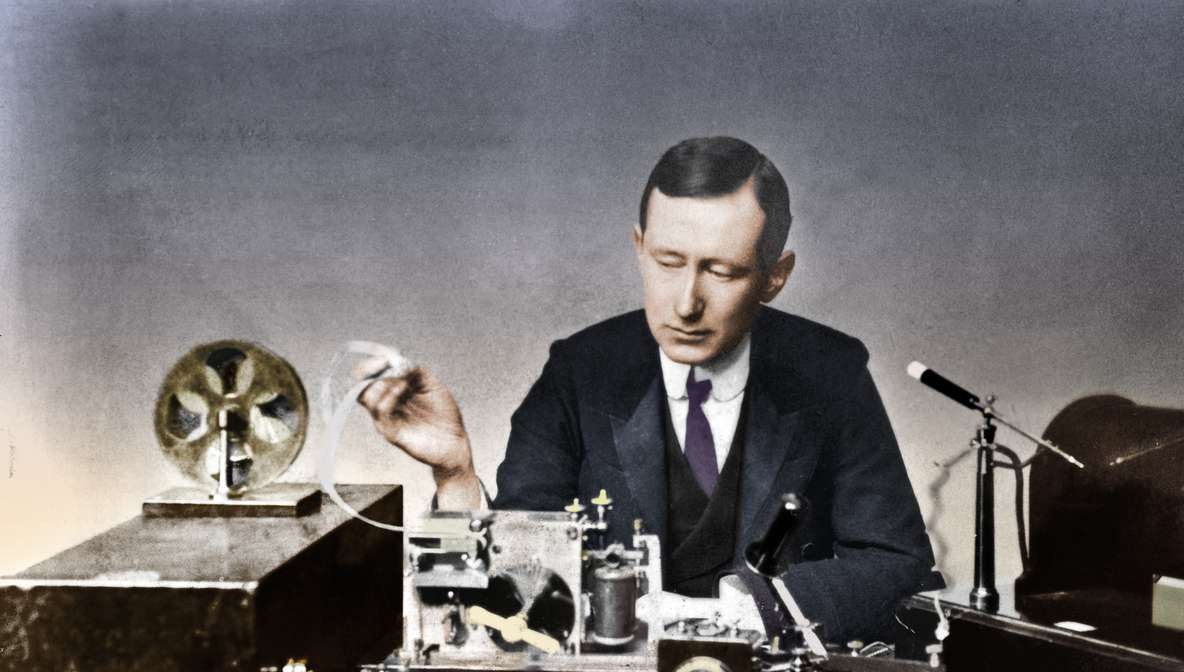
Guglielmo Marconi (1874–1937) was an Italian-Italian/Irish inventor, entrepreneur, and physicist whose visionary work propelled the invention of radio, forever reshaping global communication. His blend of technical experimentation and commercial insight earned him the title “father of wireless” and a shared Nobel Prize in Physics in 1909
🧬 Early Life & Background
-
Birth & Family: Born 25 April 1874 in Bologna, Italy, to a landowner father, Giuseppe Marconi, and Irish-descendant mother, Annie Jameson of the Jameson whiskey lineage
-
Education: Home-schooled by tutors; formal schooling was sporadic. Mentored by Vincenzo Rosa and later by physicist Augusto Righi at University of Bologna, where he absorbed Heinrich Hertz’s findings on electromagnetic waves
-
First Experiments: By 1894–95, in his villa’s attic “Stanza dei bachi,” he sent wireless signals over a mile—an impressive feat that spurred him to seek patents and funding
🚀 Career & Achievements
-
London Move & Patent: In 1896 he moved to London and secured the first wireless telegraphy patent; founded the Wireless Telegraph & Signal Company in 1897
-
Milestone Transmissions:
-
1898: Crossed the English Channel with wireless communication.
-
1901: Sent the iconic Morse “S” signal from Cornwall to Newfoundland, shattering perceptions of radio’s limits
-
-
Innovation & Expansion: Developed tuning methods (patent No. 7777) to allow multi-channel transmissions, enabling long-range, interference-free wireless systems
-
Nobel & Maritime Safety: Shared the 1909 Nobel Prize with Karl Braun; his radios became lifelines on the Titanic and other ships
-
Further Innovations: Advanced short-wave and microwave communication, introduced directional “beam” systems aboard his yacht Elettra, and launched the world’s first microwave radiotelephone link in 1932
-
Business Endeavors: Co-founded what would become the BBC (initially station 2LO in 1922), and established Vatican Radio in 1931
💑 Personal Life
-
Marriage & Children: Wed Beatrice O’Brien in 1905; they had three children before annulling in 1927. Later married Maria Cristina Bezzi-Scali, and their daughter Elettra became the namesake of his yacht
-
Interests & Honors: Enjoyed cycling, motoring, and hunting. Ennobled as Marchese in 1929, he served in Italy’s Senate, was President of the Royal Italian Academy, and supported Mussolini’s regime
🕊️ Legacy & Impact
-
Communication Revolution: Marconi’s work fundamentally established the basis for modern radio, TV, radar, and wireless technologies, impacting everything from global news to mobile communication
-
Lifesaving Influence: His maritime radios notably saved thousands, shaping international safety protocols.
-
Cultural & Institutional Remembrance: Recognized by Italy and abroad—Rome and BBC radio paused in mourning at his death. His villa, Mausoleum, and the Marconi Foundation preserve his memory, and public places continue to bear his name
🧠 Final Thoughts
Marconi was more than a technologist—he was a storyteller and visionary whose work turned electromagnetic theory into practical, widespread systems. He bridged science and business in ways that few thinkers of his time managed, and his blend of curiosity, insight, and entrepreneurial instinct fueled global transformation.
✅ What We Learn
-
Persistence beats skepticism: Marconi overcame academic rejection and proved naysayers wrong.
-
Vision must be paired with action: He didn’t just invent—he patented, capitalized, and commercialized.
-
Real-world impact defines legacy: His innovations weren’t academic; they saved lives and connected the world.