
Introduction
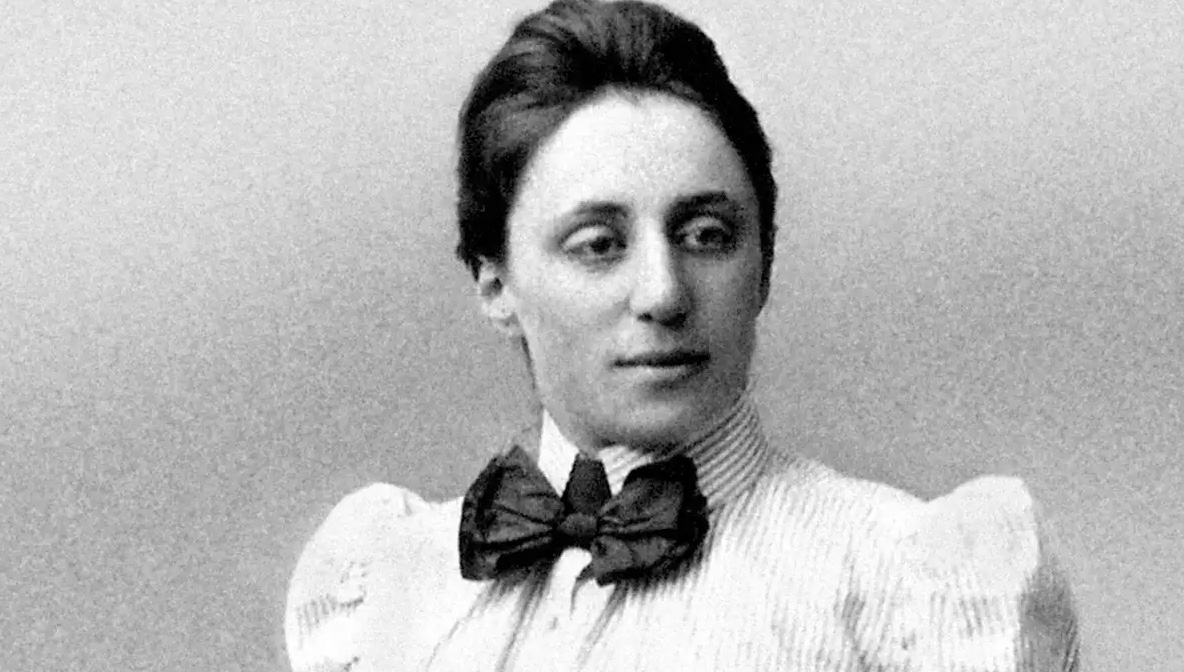
Amalie Emmy Noether (1882–1935) was a groundbreaking German mathematician whose revolutionary work in abstract algebra and theoretical physics transformed 20th-century mathematics. Despite facing severe gender discrimination, she developed Noether’s Theorem, a foundational principle linking symmetry and conservation laws in physics, and became one of the most influential algebraists of her time. Albert Einstein called her a “creative mathematical genius”—yet she struggled for recognition in a male-dominated academic world.
Early Life and Education
Born on March 23, 1882, in Erlangen, Germany, Noether grew up in a family of mathematicians (her father, Max Noether, was a noted algebraic geometer). Despite women being barred from university enrollment, she:
-
Audited classes at the University of Erlangen (1900–1902).
-
Earned a doctorate summa cum laude (1907) under Paul Gordan, working on algebraic invariants.
Key Contributions and Discoveries
1. Noether’s Theorem (1915–1918)
While working with David Hilbert and Felix Klein at the University of Göttingen, Noether proved:
“Every differentiable symmetry of a physical system has a corresponding conservation law.”
This theorem became the backbone of modern physics, explaining:
-
Conservation of energy (time symmetry).
-
Conservation of momentum (space symmetry).
-
Key principles in relativity and quantum field theory.
2. Abstract Algebra Revolution
Noether shifted algebra from computational to axiomatic, pioneering:
-
Noetherian rings (foundational in algebraic geometry).
-
Ideals in ring theory (influencing modern algebra).
-
Work on group representations (later crucial in particle physics).
3. Fight for Academic Recognition
Despite her brilliance:
-
She lectured without pay or title for years (“Hilbert’s assistant”).
-
In 1919, she finally became Privatdozent (a low-rank lecturer).
-
Nazi policies forced her to flee to the U.S. in 1933 (she was Jewish).
Exile and Legacy at Bryn Mawr (1933–1935)
After fleeing Germany, Noether taught at Bryn Mawr College and lectured at Princeton. Tragically, she died suddenly in 1935 from complications after surgery.
Posthumous Recognition
-
The Noether Lecture (AMS) honors women in mathematics.
-
Asteroid 7001 Noether and lunar crater Noether bear her name.
-
Her work underpins the Standard Model of particle physics.
Final Thoughts
Noether’s genius reshaped mathematics and physics, yet she battled sexism and antisemitism throughout her career. Her story is a testament to perseverance in the face of exclusion—and her theorems remain indispensable in science today.