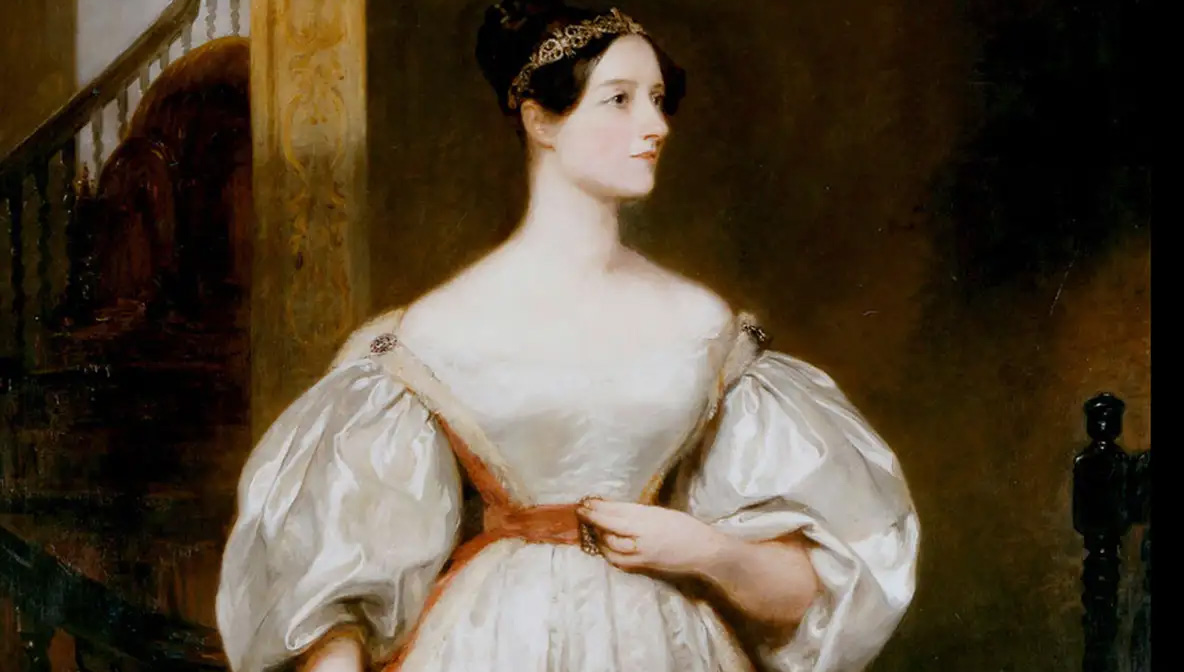

Introduction: A Woman Ahead of Her Time
In the 19th century, when society rarely gave women a chance to step into science or mathematics, one remarkable woman dared to dream. Augusta Ada Byron Lovelace, better known as Ada Lovelace, not only studied mathematics but also became the world’s first computer programmer—long before computers even existed.
Her story is one of curiosity, imagination, and courage. She combined logic with creativity, numbers with poetry, and in doing so, left behind a legacy that still inspires computer scientists today.
Early Life: Born into Fame and Turmoil
Ada Lovelace was born on December 10, 1815, in London. She was the only legitimate child of the famous poet Lord Byron and his wife, Lady Anne Isabella Byron.
Her father, Lord Byron, was a brilliant but troubled poet. Just weeks after Ada’s birth, her parents separated. Byron left England and never saw his daughter again. He died when Ada was only eight years old.
Lady Anne, determined to prevent Ada from becoming “too poetic” like her father, pushed her towards mathematics and science. Ironically, this decision gave Ada the tools to create poetry of a different kind—the poetry of numbers.
A Curious Mind: Ada’s Fascination with Machines
As a child, Ada showed an extraordinary imagination. At the age of 12, she wrote a book called Flyology, where she illustrated and explained how a flying machine might work. This passion for understanding how things functioned never left her.
Her tutors quickly noticed that Ada was gifted in mathematics. She was mentored by leading mathematicians of her time, including Mary Somerville, one of the few female scientists recognized in Britain.
Meeting Charles Babbage: A Historic Partnership
In 1833, at the age of 17, Ada met Charles Babbage, a brilliant inventor and mathematician who was designing the Difference Engine, an early mechanical calculator.
Babbage was impressed by Ada’s intelligence. He called her the “Enchantress of Numbers.” Their friendship and collaboration would go on to shape the history of computing.
Ada Lovelace and the Analytical Engine
Babbage later designed a more ambitious machine, the Analytical Engine—a mechanical computer that could be programmed to perform different calculations.
In 1842, Ada was asked to translate an Italian paper about the Analytical Engine written by mathematician Luigi Federico Menabrea. But Ada went far beyond translation.
She added her own detailed notes and explanations, which turned out to be three times longer than the original paper. Within those notes was something revolutionary:
👉 A step-by-step method for how the Analytical Engine could calculate Bernoulli numbers.
This is now recognized as the first computer program in history.
Vision Beyond Her Time
What makes Ada Lovelace truly extraordinary is her vision. She didn’t just see the machine as a calculator. She predicted that one day, machines like the Analytical Engine could:
-
Compose music 🎼
-
Create art 🎨
-
Process words and numbers ✍️
In other words, Ada imagined modern computers nearly 100 years before they became reality.
Later Years and Legacy
Sadly, Ada Lovelace’s life was short. She struggled with health issues and passed away from uterine cancer at the age of 36, on November 27, 1852.
But her contributions lived on. She is remembered today as:
-
The first computer programmer
-
A pioneer who combined science and imagination
-
A role model for women in STEM (Science, Technology, Engineering, Mathematics)
Interesting Facts About Ada Lovelace
-
💡 First Programmer: Her algorithm for the Analytical Engine is widely regarded as the first computer program.
-
💡 Friend of Mary Somerville: She was mentored by one of the first women scientists.
-
💡 Foresight of AI: Ada predicted machines could go beyond math and help with music and art.
-
💡 National Day: “Ada Lovelace Day” is celebrated every October to honor women in science and technology.
FAQs About Ada Lovelace
Q1: Why is Ada Lovelace famous?
Ada Lovelace is famous for writing the first computer algorithm and for her visionary ideas about the future of computing.
Q2: Who was Ada Lovelace’s father?
Her father was Lord Byron, the famous English poet.
Q3: Did Ada Lovelace invent the computer?
No, she did not invent the computer. Charles Babbage designed the Analytical Engine, but Ada created the first program for it.
Q4: What is Ada Lovelace Day?
It is celebrated on the second Tuesday of October to honor women in STEM.
Q5: How did Ada Lovelace die?
She died of uterine cancer at the young age of 36.
Conclusion: The Legacy of Ada Lovelace
Ada Lovelace was more than a mathematician. She was a dreamer who combined logic with creativity. She saw the potential of machines in ways that even their inventors couldn’t imagine.
Today, every time we use a computer, smartphone, or even artificial intelligence, we are living in the world Ada envisioned nearly two centuries ago.
She was truly the Enchantress of Numbers, and her story continues to inspire generations of innovators.