
Introduction: The Dream of Human Flight
For centuries, humans dreamed of flying like birds. From Leonardo da Vinci’s sketches to hot air balloons, the sky always fascinated people. But no one had truly conquered controlled, powered flight—until two determined brothers from Ohio changed the course of history.
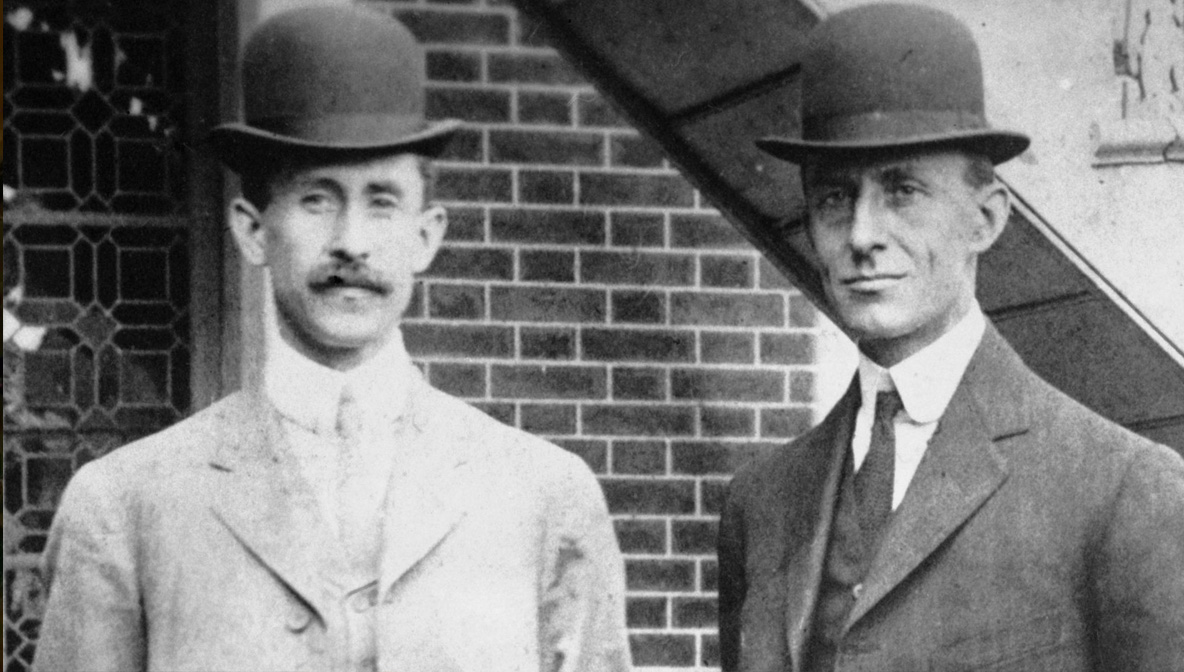
This is the inspiring story of Orville and Wilbur Wright, known to the world as the Wright Brothers, who turned an impossible dream into reality.
Early Life: Simple Beginnings
The Wright brothers were born into a modest family in the late 19th century.
-
Wilbur Wright was born on April 16, 1867 in Millville, Indiana.
-
Orville Wright followed on August 19, 1871, in Dayton, Ohio.
Their father, Milton Wright, was a bishop, and their mother, Susan Catherine Koerner Wright, was mechanically gifted. In fact, she often built household gadgets and encouraged her children to explore and invent.
The brothers shared a strong curiosity about the world. When their father gave them a small toy helicopter powered by a rubber band, young Orville and Wilbur were mesmerized. That simple gift sparked a lifelong passion for flight.
The Path to Invention: Curiosity Meets Skill
Unlike many inventors, the Wright brothers didn’t attend college. Instead, they developed practical skills early on.
-
In their teenage years, they started a printing business.
-
Later, they opened a bicycle shop in Dayton, repairing and building bicycles.
Working with bicycles taught them about balance, mechanics, and control—skills that would prove crucial in aviation.
But their minds never stopped wondering: “If we can balance on a bicycle, can we also balance in the air?”
Studying the Science of Flight
In the late 1800s, many inventors were attempting to build flying machines, but most failed. The Wright brothers approached the problem differently.
They carefully studied the works of earlier pioneers, like:
-
Otto Lilienthal (a German glider pioneer)
-
Octave Chanute (an American aviation experimenter)
The brothers realized that the key challenge wasn’t just building a machine—it was controlling it in the air.
So, they built gliders and tested them on the sandy dunes of Kitty Hawk, North Carolina, where strong winds and soft landings made conditions perfect for experiments.
The Breakthrough: The First Powered Flight
After years of trial and error, the Wright brothers designed their own lightweight engine with the help of their mechanic, Charlie Taylor. They also invented a system called wing-warping to control the plane in flight—an early form of what we now call aerodynamic control surfaces.
On December 17, 1903, history was made.
-
At 10:35 a.m., Orville Wright piloted the first successful powered flight.
-
The aircraft, known as the Wright Flyer, flew for 12 seconds and covered 120 feet.
Three more flights followed that day, with Wilbur making the longest one—59 seconds over 852 feet.
Human flight was no longer a dream. It was real.
Facing Challenges and Skepticism
Although the Wright brothers had achieved something extraordinary, not everyone believed them at first. Many newspapers ignored or doubted their claims.
It took years of demonstrations and persistent effort before the world recognized their invention. By 1908, the Wright brothers were giving public demonstrations in the United States and Europe, finally earning the respect they deserved.
Later Life and Legacy
-
Wilbur Wright sadly passed away in 1912 from typhoid fever at the age of 45.
-
Orville Wright lived until 1948, witnessing airplanes transform into powerful machines used for travel, trade, and even warfare.
The Wright brothers’ invention opened the door to the modern aviation industry, forever changing how humans connect, explore, and dream.
Today, their names are synonymous with courage, persistence, and innovation.
Interesting Facts About the Wright Brothers
💡 Their first flight in 1903 was shorter than the wingspan of a Boeing 747.
💡 Neither brother married; they dedicated their lives to invention.
💡 They funded their experiments entirely from their bicycle shop.
💡 The Wright Flyer is preserved at the Smithsonian National Air and Space Museum in Washington, D.C.
💡 North Carolina’s license plates proudly carry the slogan: “First in Flight.”
FAQs About the Wright Brothers
Q1: Who were the Wright Brothers?
Orville and Wilbur Wright were American inventors credited with achieving the first controlled, powered, and sustained flight on December 17, 1903.
Q2: Where did the Wright Brothers fly the first airplane?
They flew at Kitty Hawk, North Carolina, chosen for its strong winds and soft sand dunes.
Q3: Why are the Wright Brothers important?
They invented and flew the world’s first successful airplane, laying the foundation for modern aviation.
Q4: How long did the first Wright Brothers flight last?
The first flight lasted 12 seconds and covered 120 feet.
Q5: What happened to Wilbur and Orville Wright?
Wilbur died in 1912, while Orville lived until 1948, continuing to work on aviation projects.
Conclusion: The Legacy of Flight
The Wright brothers proved that with persistence, curiosity, and courage, even the most impossible dreams can come true.
From a small toy helicopter in their childhood to the first successful airplane in 1903, their journey inspires innovators across the globe. Every time we board a plane today, we are flying on the wings of their vision.
The Wright Brothers didn’t just invent an airplane—they gave humanity the freedom of the skies.