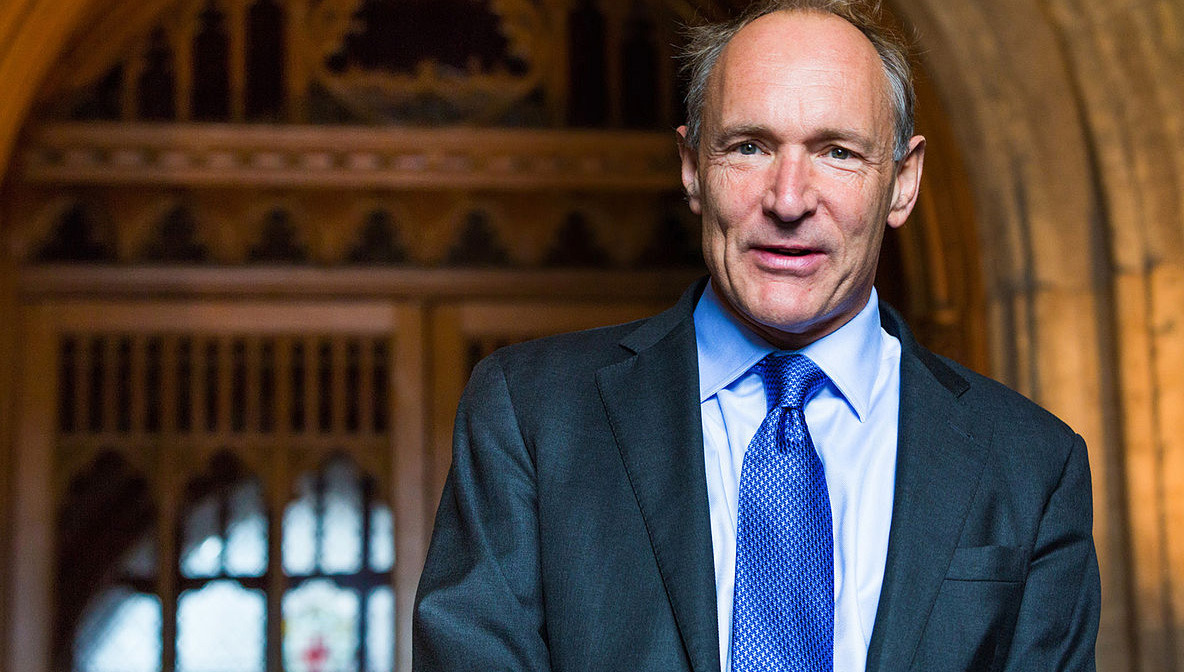

Introduction: The Father of the Web
Imagine life without the web—no Google, no social media, no online shopping, no instant access to information. Hard to picture, right?
Yet, just a few decades ago, the World Wide Web did not exist. Then came one visionary computer scientist—Sir Tim Berners-Lee. His idea changed how we communicate, learn, and live. This is the inspiring story of the man who gave the world its greatest digital gift.
Early Life: A Curious Child in London
Timothy John Berners-Lee was born on June 8, 1955, in London, England.
Both of his parents, Conway Berners-Lee and Mary Lee Woods, were computer scientists who worked on one of the earliest computers, the Ferranti Mark 1. Growing up in such a household, Tim was surrounded by discussions about logic, programming, and machines.
As a child, he loved tinkering. He built gadgets, played with model railways, and showed an unusual curiosity about how things worked. This passion for invention would later fuel his groundbreaking idea.
Education and Early Career
Tim attended Queen’s College, Oxford University, where he studied physics. At Oxford, he displayed both creativity and rebelliousness—famously building his own computer out of spare parts, including a TV set.
After graduating in 1976, he worked at several companies as a software engineer. In these jobs, he learned about networking, databases, and information management—skills that would shape his vision of a connected world.
The Birth of a Revolutionary Idea
In 1980, Tim joined CERN (the European Organization for Nuclear Research) in Switzerland as a consultant.
CERN was a hub for brilliant scientists, but they faced one major problem: information sharing. Researchers came from different countries and used different computer systems, making collaboration difficult.
Tim saw this as an opportunity. He envisioned a system where documents could be connected through “hypertext”—allowing people to click links and move from one page to another easily.
He called his proposal: “Information Management: A Proposal” (1989).
His bosses at CERN called it “vague but exciting.”
1990: The Birth of the World Wide Web
By late 1990, Tim Berners-Lee had created the basic technologies that form the foundation of the web today:
-
HTML (Hypertext Markup Language) – the code for creating web pages.
-
HTTP (Hypertext Transfer Protocol) – the rules for communication between computers.
-
URL (Uniform Resource Locator) – the addresses we use to find web pages.
On December 20, 1990, he launched the first-ever website:
👉 http://info.cern.ch
It explained how the web worked and how others could create their own websites.
This was the birth of the World Wide Web.
A Gift to Humanity
What makes Tim Berners-Lee extraordinary is not just his invention but his decision about it.
Instead of selling the World Wide Web as a commercial product, in 1993 he and CERN made it free and available to everyone.
This generosity ensured the web spread rapidly across the world, becoming the backbone of modern life—from email to e-commerce, education to entertainment.
Later Work and Recognition
Tim didn’t stop after inventing the web.
-
In 1994, he founded the World Wide Web Consortium (W3C) at MIT to develop open standards and keep the web free and accessible.
-
In 2004, he was knighted by Queen Elizabeth II, becoming Sir Tim Berners-Lee.
-
In 2016, he received the Turing Award, often called the “Nobel Prize of Computing.”
Even today, he advocates for a free, open, and safe internet, warning against misuse, surveillance, and inequality online.
Interesting Facts About Tim Berners-Lee
💡 His first website (info.cern.ch) still exists online.
💡 He invented the web on a NeXT computer (a company founded by Steve Jobs).
💡 Unlike many inventors, he never patented the web, ensuring it stayed open.
💡 He has also spoken about the dangers of “fake news” and privacy issues online.
💡 He is working on a new project called Solid, aimed at giving people control over their own data.
FAQs About Tim Berners-Lee
Q1: Who is Tim Berners-Lee?
Tim Berners-Lee is a British computer scientist, best known as the inventor of the World Wide Web in 1989.
Q2: What did Tim Berners-Lee invent?
He created the World Wide Web, including the first web browser, HTML, HTTP, and URL systems.
Q3: Why is Tim Berners-Lee famous?
He made the web free for everyone, allowing it to grow into the global communication and information system we use today.
Q4: What was the first website?
The first website was info.cern.ch, launched in 1990, explaining how the web worked.
Q5: Is Tim Berners-Lee still alive?
Yes, as of today, Sir Tim Berners-Lee continues to work on projects promoting a fair and open web.
Conclusion: The Legacy of a Digital Pioneer
Tim Berners-Lee’s invention transformed the world. From a modest idea at CERN to the creation of the World Wide Web, his vision has connected billions of people across the planet.
Unlike many inventors, he gave his creation as a gift to humanity, ensuring it remained open and free.
Every time we browse a website, share a post, or search for information, we are walking on the path he created.
He is not just the inventor of the World Wide Web—he is a reminder that one idea, driven by curiosity and generosity, can change the entire world.