
Introduction
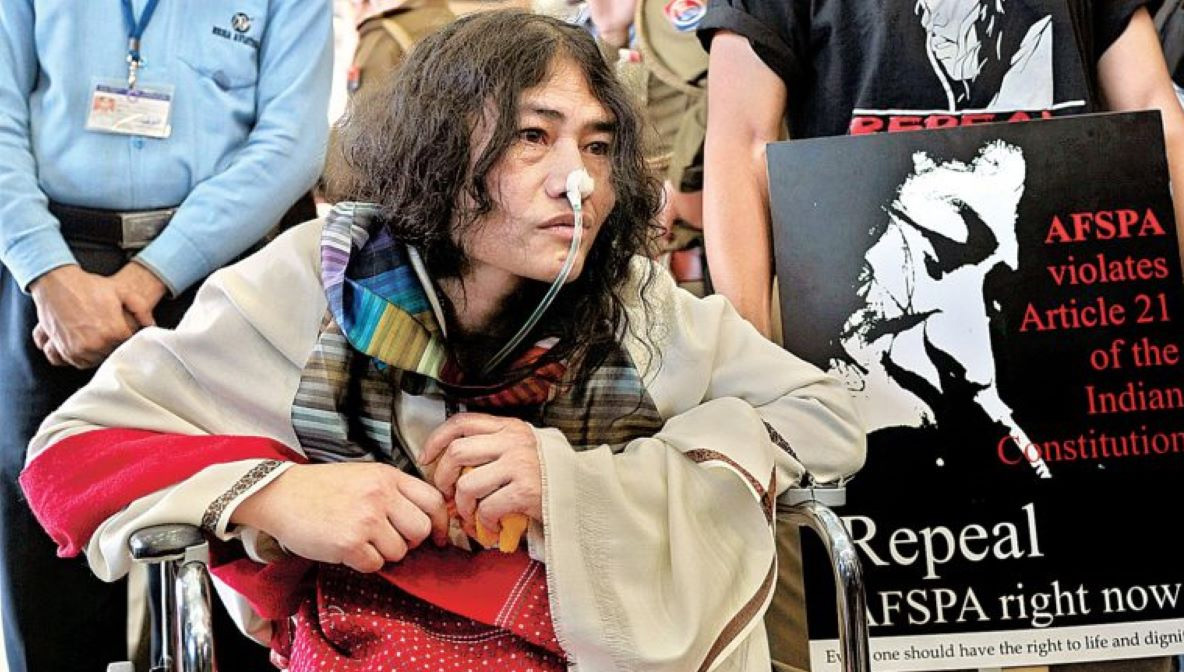
In the conflict-ridden state of Manipur, where violence and military presence have long shaped daily life, one woman chose a path of peace that echoed across the globe. Irom Sharmila, also known as the “Iron Lady of Manipur,” transformed silent resistance into a powerful weapon. Her 16-year-long hunger strike, one of the longest in human history, was not just a protest—it was a testament to courage, conviction, and the strength of non-violence.
Sharmila’s fight was against the Armed Forces Special Powers Act (AFSPA), a law many accused of enabling human rights violations. Her peaceful rebellion turned her into an international symbol of resistance and moral strength, earning admiration far beyond the borders of India.
Basic Information:
-
Full Name: Irom Chanu Sharmila
-
Nicknames: “Iron Lady of Manipur”, “Mengoubi” (The Fair One)
-
Born: March 14, 1972
-
Birthplace: Kongpal, Imphal, Manipur, India
-
Nationality: Indian
-
Occupation: Activist, Poet, Politician
-
Cause: Repeal of AFSPA (Armed Forces Special Powers Act)
-
Famous For: 16-year-long hunger strike, one of the world’s longest
Early Life and Background:
Irom Sharmila was born into a humble Meitei family in Imphal, Manipur. From a young age, she showed deep sensitivity to social issues. She wrote poetry and was deeply involved in local community work.
She trained in naturopathy and aspired to become a social reformer.
The Turning Point: Malom Massacre (2000)
On November 2, 2000, in Malom (a town in Imphal), 10 innocent civilians were killed by Indian paramilitary forces. This tragic event, known as the Malom Massacre, was carried out under the controversial AFSPA law, which gives sweeping powers to the military in disturbed areas.
The massacre deeply shook Irom Sharmila. Just three days later, on November 5, 2000, she began her historic hunger strike demanding the repeal of AFSPA.
The Hunger Strike (2000–2016):
Duration:
16 years (November 5, 2000 – August 9, 2016)
How It Was Sustained:
She was arrested and force-fed through a nasal tube for most of the 16 years. She was charged with attempt to commit suicide, a criminal offense under Indian law at the time.
Support & Recognition:
-
Became a symbol of non-violent resistance like Mahatma Gandhi
-
Gained international attention from human rights groups like Amnesty International
-
Was nominated for the Nobel Peace Prize
Ending the Fast (2016):
After 16 years, Irom Sharmila ended her fast on August 9, 2016. She announced plans to enter politics to fight AFSPA in a new way.
Political Journey:
2017 Manipur Assembly Elections:
-
Party Formed: People’s Resurgence and Justice Alliance (PRJA)
-
Contested From: Thoubal, against then-Chief Minister Okram Ibobi Singh
-
Result: Lost with only 90 votes
Despite the poor result, her stand was courageous. Her foray into politics showed her commitment to democratic processes.
Personal Life:
-
Marriage: Married Desmond Coutinho, a British citizen, in 2017
-
Current Residence: Kerala, India
-
Post-political Life: Lives a quiet life away from the spotlight, working on social issues
Awards and Recognitions:
-
Gwangju Prize for Human Rights (2007)
-
Mayillama Award
-
Lifetime achievement by Asian Human Rights Commission
What We Learn from Irom Sharmila:
-
Non-violence has immense power – Her protest became a global example of peaceful resistance.
-
Endurance is revolutionary – 16 years of fasting showed unparalleled willpower.
-
One person can make a difference – She highlighted an ignored issue on the national stage.
-
Moral conviction is stronger than political might – She stayed true despite public indifference and state pressure.
-
Politics alone isn’t the only answer – Her loss in elections didn’t erase her influence as a reformer.
-
Silence can speak louder than violence – Her quiet protest echoed through the country.
-
Human rights are universal – Her fight was not just for Manipur but for all those living under AFSPA.
Conclusion
Irom Sharmila’s life reminds us that the quietest voices can stir the loudest storms. Her battle was not won in the traditional sense—AFSPA still exists—but she shifted the national conscience and brought global attention to a region long ignored.
Her journey teaches us the power of personal sacrifice, the enduring strength of non-violence, and the importance of standing firm for justice—even when the world turns its back. In a time when activism often relies on noise and numbers, Irom Sharmila showed that one person, with truth on their side, can stand against the most powerful forces—and be heard.