
🖋️ Introduction
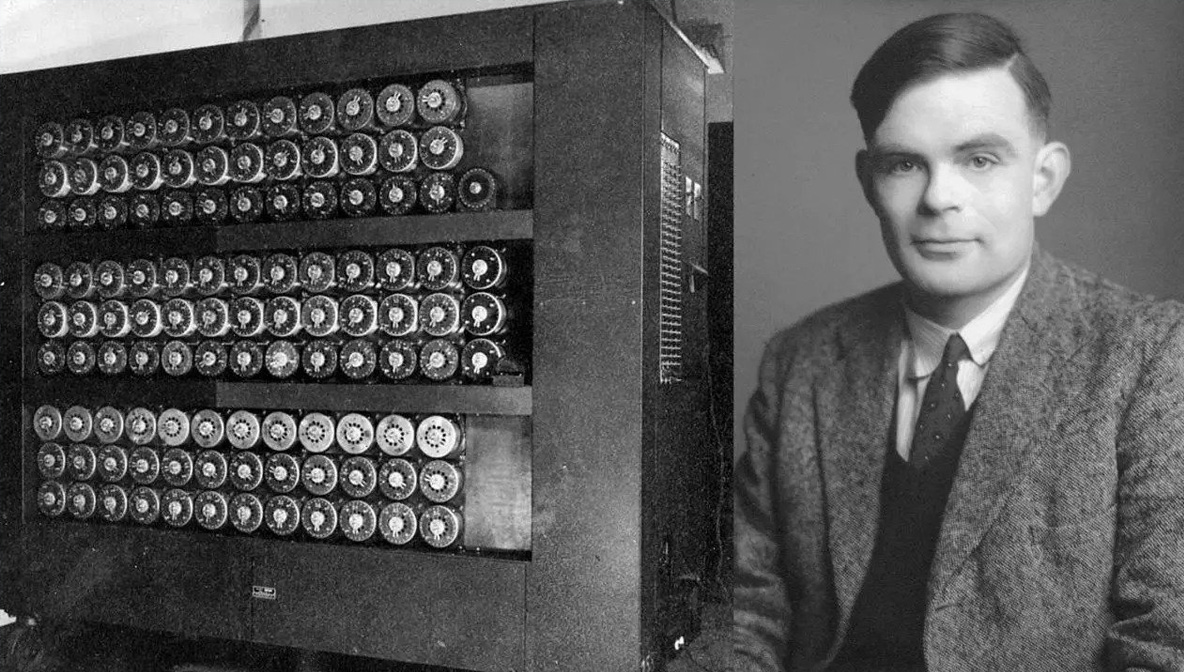
Alan Turing (1912–1954) was a British mathematician, computer scientist, cryptanalyst, and philosopher whose work laid the foundation for modern computing and artificial intelligence. Known as “The Father of Theoretical Computer Science” and a key figure in defeating Nazi Germany during WWII, Turing’s legacy is one of brilliance, tragedy, and transformation.
Despite facing persecution due to his homosexuality, Turing’s visionary mind gave birth to ideas that would revolutionize the 20th and 21st centuries—from the Turing Machine to early AI concepts.
📅 Early Life and Background
-
Date of Birth: June 23, 1912
-
Place of Birth: Maida Vale, London, England
-
Education: King’s College, Cambridge | Princeton University
-
Fields: Mathematics, Cryptography, Logic, Computer Science
Turing was a prodigy. He solved complex problems at an early age and was fascinated by logic and numbers. At King’s College, Cambridge, he earned high distinction in mathematics. In 1936, while studying under Alonzo Church at Princeton University, he wrote the groundbreaking paper that introduced the Turing Machine, a concept that still defines how computers function today.
💡 The Turing Machine: A Computing Revolution
In 1936, Turing published “On Computable Numbers,” introducing the Turing Machine—a hypothetical device that could simulate the logic of any algorithm.
This work:
-
Established the limits of what can be computed
-
Laid the groundwork for modern programming and algorithm theory
-
Became a cornerstone in the field of theoretical computer science
Turing showed that computers could, in theory, perform any calculation, as long as it was logically definable.
🕵️♂️ World War II: Breaking the Enigma Code
When World War II broke out, Turing joined Britain’s Government Code and Cypher School at Bletchley Park. He led efforts to break the German Enigma cipher, used by the Nazi military to send encoded messages.
Key Achievements:
-
Designed the Bombe, an electromechanical machine to decode Enigma
-
Cracked critical German messages, including U-boat communications
-
Significantly shortened WWII by at least two years
-
Saved an estimated 14 million lives
Despite this, his work remained top-secret for decades.
🤖 Post-War Contributions and AI Vision
After the war, Turing worked on developing one of the world’s first digital computers at the National Physical Laboratory and later at the University of Manchester.
In 1950, he proposed the Turing Test, a method to determine whether a machine could exhibit intelligent behavior indistinguishable from a human. This became a foundational principle in the field of artificial intelligence.
He asked, “Can machines think?”—a question that still drives AI research today.
⚖️ Persecution and Tragic Death
Despite his contributions, Turing was prosecuted in 1952 for homosexuality, then a criminal offense in the UK. Given the choice between imprisonment and chemical castration, he chose the latter.
Turing was found dead from cyanide poisoning on June 7, 1954, in an apparent suicide at just 41 years old. His death remains one of science’s greatest tragedies.
🏅 Recognition and Legacy
Alan Turing’s genius was only fully acknowledged decades after his death.
Posthumous Recognition:
-
2009: UK Prime Minister Gordon Brown issued a formal apology
-
2013: Royal pardon from Queen Elizabeth II
-
2019: Chosen as the face of the £50 British banknote
-
Numerous films and books, including “The Imitation Game” (2014)
Today, Turing is hailed as a founding father of computer science and artificial intelligence and a symbol of justice for LGBTQ+ communities worldwide.
🧠 What We Learn from Alan Turing
-
Genius Can Be Silenced—But Not Forever
Though shunned by society, Turing’s ideas outlived his critics. -
True Innovation Comes From Asking “Why Not?”
Turing dared to ask questions no one had before—paving the road to modern computing. -
Diversity Drives Progress
His identity, while persecuted, did not define or limit his brilliance—it shaped it. -
Perseverance in the Face of Injustice
Turing’s life proves that one mind can reshape an entire era.
🙏 Conclusion
Alan Turing didn’t just imagine machines that could compute—he imagined futures. His legacy is etched not only in computer algorithms and artificial intelligence, but in the ongoing fight for justice, equality, and recognition.
He taught us that even under crushing societal pressure, truth, logic, and humanity can prevail. Today, every time we use a computer, we echo the vision of a man who dared to change the world.
“Sometimes it is the people no one can imagine anything of who do the things no one can imagine.” – Alan Turing