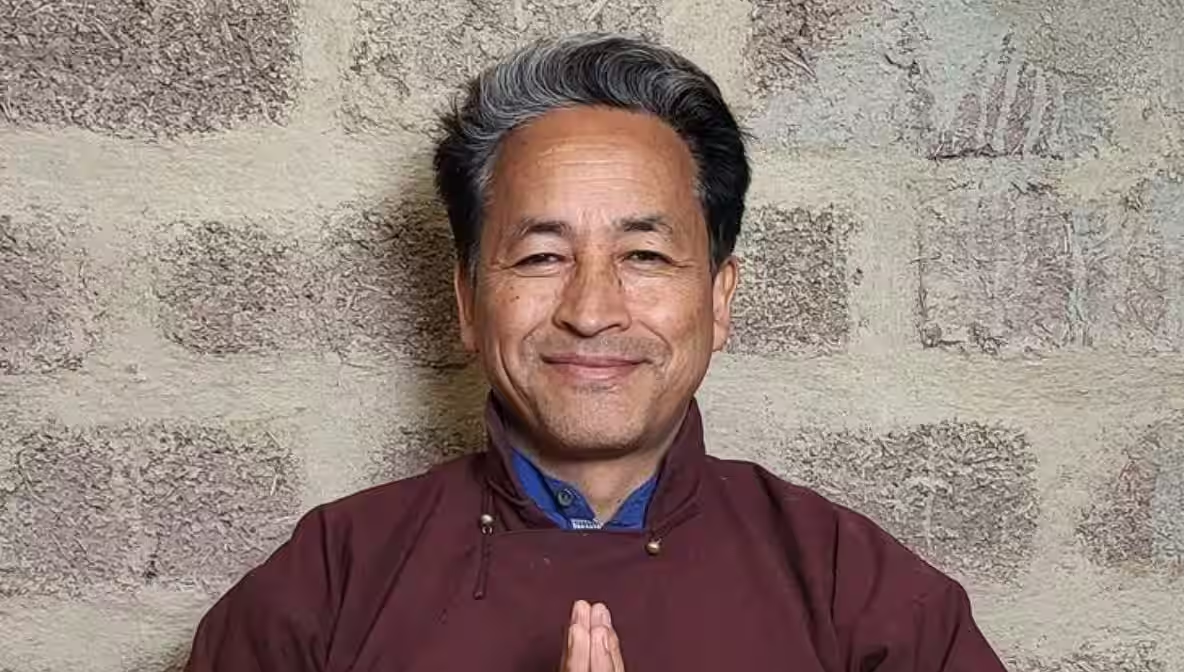

The Teacher Who Refused to Let His Students Fail
You’ve probably seen the movie 3 Idiots. Remember the brilliant, quirky engineer Phunsuk Wangdu who believed in learning over rote memorization and built a school in the middle of nowhere? Well, that character wasn’t entirely fiction. It was inspired by a real person—a man from a tiny village in Ladakh who has spent his life proving that the education system is broken and that we need to fix it.
But Sonam Wangchuk is so much more than just a movie inspiration. He’s an engineer who built artificial glaciers to save farmers from drought. He’s a teacher who turned a 95% failure rate into a 25% failure rate in his region. And in recent years, he’s become the voice of an entire region, fighting for constitutional rights and the protection of his homeland’s fragile ecosystem. He’s been on hunger strikes, been detained under the National Security Act, and has inspired millions of young Indians to question the system .
This is the story of a man who has spent his life asking uncomfortable questions and refusing to accept the answers he was given.
Introduction: The ‘Unbearably Curious’ Boy Who Became a Movement
Let me paint you a picture. Imagine a little boy in the 1970s, growing up in a village so remote that it has only five houses. There’s no school, no electricity, no running water. His mother teaches him to read and write using the only materials available to her—her own knowledge and a deep understanding of their culture .
That boy was Sonam Wangchuk. He was, by all accounts, “unbearably curious” . He debated everything, questioned everything, and never took no for an answer. When he was finally sent to school in Srinagar at age nine, he couldn’t understand a word of Urdu. His silence was mistaken for stupidity. He was beaten. He was humiliated. And he decided to run away—alone, to Delhi, at just 11 years old—to find a school that would actually teach him .
That one act of defiance set the tone for his entire life. He’s been running from broken systems and running toward better ones ever since.
Today, he’s one of the most recognizable faces in India. He’s an engineer, an education reformer, a climate activist, and the inspiration behind one of Bollywood’s most beloved characters. But more than that, he’s the man who has become the conscience of Ladakh—a region caught between development and destruction, between tradition and modernity .
Early Life & Background: Born in a Village with No School
The Uleytokpo Years
Sonam Wangchuk was born on September 1, 1966, in Uleytokpo, a tiny hamlet near Alchi in Ladakh, India. To give you an idea of how remote this place is, it’s about 44 miles (70 kilometers) from Leh, the region’s largest city. It’s the kind of place where the air is thin, the winters are brutally cold, and everyone knows everyone .
His family was one of only five households in the village. There was no formal school. So, his mother, Tsering Wangmo—a woman he once described as “never schooled but highly educated”—took on the role of teacher. She taught him to read, write, and do basic arithmetic in his native Ladakhi language .
In those early years, his classroom was the world around him. He played in the fields, sowed seeds, worked with animals, jumped in the river, and climbed trees. He later said that these experiences developed his skills so much that when he finally joined school at age nine, he was promoted twice in a single year .
The Move to Srinagar
Everything changed when his father, Sonam Wangyal, was elected to the Jammu and Kashmir legislative assembly in 1975 . The family moved to Srinagar, the summer capital of the state. For a boy who had only spoken Ladakhi, the transition was a nightmare. The language of instruction in his new school was Urdu. He couldn’t understand the teachers, couldn’t communicate with the other students, and was regularly beaten for his perceived lack of intelligence .
This period became what he calls the “darkest part” of his childhood . He was so miserable that he attempted to run away from home. His father found him at the bus station, but instead of punishing him, he listened. He sent young Sonam to a boarding school in Delhi, where the education was more accommodating .
Education: Learning on His Own Terms
The Engineering Degree
Wangchuk eventually returned to Srinagar to pursue a bachelor’s degree in Mechanical Engineering at the Regional Engineering College (now the National Institute of Technology). He graduated in 1987 .
His time in college was formative. He had a falling out with his father over his choice of engineering stream, leading him to finance his own education by giving English coaching classes to other students . This early taste of teaching would prove to be a turning point.
Beyond Engineering
In 2011, long after he’d already made a name for himself as an education reformer, Wangchuk went to France for two years of higher studies in Earthen Architecture at the CRATerre School of Architecture in Grenoble . It was a natural extension of his work—he was already building eco-friendly, sustainable structures in Ladakh and wanted to learn more.
Career & Achievements: The Man Who Built Ice Stupas
SECMOL: The Education Revolution
In 1988, fresh out of college, Wangchuk co-founded the Students’ Educational and Cultural Movement of Ladakh (SECMOL) with a group of like-minded students . The idea was simple: fix an education system that was clearly failing Ladakh’s children.
The statistics were staggering. In 1996, 95% of students in Ladakh failed their board exams . The curriculum was disconnected from local culture, and teachers were often untrained and unmotivated. Children were being beaten and humiliated for not understanding material that had no relevance to their lives.
SECMOL started small. They gave supplementary lessons to students who were failing. They emphasized hands-on learning. They rooted teaching materials in local culture. It worked .
In 1994, SECMOL launched Operation New Hope, a collaboration between the government, village communities, and civil society to reform the government school system across Ladakh . The program expanded to dozens of schools, and the failure rate gradually dropped from 95% to 25% .
Today, SECMOL’s main campus near the village of Phey is an alternative-education boarding school that caters specifically to students who have failed school exams. The campus runs on solar energy and is built out of rammed earth and straw-clay. It doesn’t use fossil fuels for cooking, lighting, or heating . Students learn academic subjects alongside life skills like cooking, agriculture, construction, and sports. They’re encouraged to build things, to innovate, to solve problems .
The Ice Stupa: An Artificial Glacier
In 2013, Wangchuk had another brilliant idea. Ladakh is a high-altitude cold desert, and farmers face a severe water shortage during the dry season. The glaciers are melting, and there’s just not enough water for irrigation .
Building on the work of engineer Chewang Norphel, Wangchuk came up with the Ice Stupa. The idea was to take stream water during the winter and freeze it into a cone-shaped artificial glacier—a structure that looks like a Buddhist stupa or temple. The ice would store the water throughout the winter and slowly release it during the spring and summer, providing irrigation when it was most needed .
The ice stupa was a massive success. It won him the 2016 Rolex Award for Enterprise . He was later invited to build one in the Swiss Alps . It was proof that solutions to climate change can be simple, local, and brilliant.
HIAL: The Himalayan Institute of Alternatives, Ladakh
In 2017, Wangchuk co-founded the Himalayan Institute of Alternatives, Ladakh (HIAL) with his wife, Gitanjali J Angmo. HIAL is a higher education center that focuses on sustainability and self-reliance. It awards fellowships for work on climate-friendly innovations that benefit communities in the Himalayas .
HIAL gained widespread recognition in 2021 for building portable solar-heated tents for the Indian Army, operating in the high-altitude, freezing conditions of the region .
Awards and Recognition
Wangchuk’s work has earned him numerous accolades over the years:
-
Ramon Magsaysay Award (2018): Often regarded as Asia’s Nobel Prize, this was awarded for his innovative educational reforms .
-
Rolex Award for Enterprise (2016): For the Ice Stupa invention .
-
Terra Award (2016): For his sustainable architecture work .
The “3 Idiots” Connection
In 2009, the Bollywood film 3 Idiots was released. It starred Aamir Khan as Phunsuk Wangdu, a brilliant and unconventional engineering student who rejects rote learning and champions creativity. The character’s name, his philosophy, and even the eco-friendly school he runs at the end of the film were all uncannily similar to Wangchuk’s own life .
Aamir Khan has denied that the character was directly based on Wangchuk, and director Rajkumar Hirani has said the character was inspired by someone he knew in film school. However, Wangchuk met Khan in 2008, and many believe—including Wangchuk himself—that his story influenced the character .
Whether the movie was directly based on him or not, it gave Wangchuk a level of fame that his work alone might not have achieved. He’s often referred to in the Indian media as “The real life Phunsuk Wangdu” .
Personal Life: A Quiet Private Life
Family
Wangchuk is married to Dr. Gitanjali J Angmo, an educator and social entrepreneur who co-founded HIAL with him . He was previously married to Rebecca Norman, an American citizen who came to volunteer at SECMOL, but that marriage ended in divorce .
Wangchuk comes from a large family—he’s one of nine siblings. His father was a well-known politician who went on a hunger strike in 1984 to demand tribal protections for Ladakhis. Interestingly, when he was on that strike, it was Prime Minister Indira Gandhi herself who flew to Leh to persuade him to break his fast .
The Simple Life
Despite his global fame, Wangchuk lives a modest, eco-friendly lifestyle in Ladakh. His net worth is estimated to be around ₹75 lakh (approximately $90,000) . Most of his earnings go into his educational and environmental projects . He doesn’t own a property in his village .
He lives what he preaches—sustainability, simplicity, and service.
Net Worth (Approximate)
Let’s be real for a second—this guy isn’t in it for the money. While most people with his level of fame would be raking in millions, Wangchuk’s net worth is estimated to be around ₹75 lakh (INR 7.5 million) , which is roughly $90,000 .
His income mostly comes from his YouTube channel, @wangchuksworld, which has over 1.7 million subscribers. He earns an estimated ₹3.5 lakh to ₹5.5 lakh per month from ad revenue, sponsorships, and other digital streams .
The man literally gives everything back to his projects. He leads a simple, eco-friendly lifestyle in Ladakh and doesn’t own a property in his home village . It’s refreshing to see someone with his level of influence stay so grounded.
Legacy & Impact: The Voice of Ladakh
Education Reform
Wangchuk’s legacy in education is undeniable. He took a region where almost every student was failing and turned it around. The SECMOL model has been replicated in other parts of India, and his ideas about practical, culturally-relevant learning have influenced educational policy .
Environmental Innovation
His Ice Stupa project has been recognized globally as a brilliant solution to water scarcity in cold desert regions. It’s a perfect example of how traditional knowledge and modern engineering can work together to solve climate problems .
The Political Fight
But Wangchuk’s recent legacy is more complicated and more significant. Since 2019, when Ladakh was made a Union Territory, he’s been at the forefront of a fight for constitutional safeguards. He’s demanding Sixth Schedule status, a provision that would give tribal communities greater autonomy over their land and resources .
He’s been on hunger strikes. He’s been detained under the National Security Act. He’s been accused of inciting violence, though he has consistently denied it. And he’s become the voice of a generation of young Ladakhis who feel their future is being decided without them .
His detention in 2025 under the NSA, following violent protests in Leh that left four people dead, was a turning point . The government accused him of making provocative statements that encouraged violence . His supporters saw it as a politically motivated attempt to silence a peaceful activist. He spent 170 days in custody before the government revoked the order .
And he’s still going. In June 2026, he joined a youth-led protest in Delhi over examination irregularities and went on a 21-day hunger strike . He was forcibly removed from the protest site by police and taken to a hospital . From the hospital, he appealed to protesters to continue their march to Parliament .
What We Learn from Sonam Wangchuk
-
Curiosity is a Superpower: His relentless questioning and refusal to accept the status quo are what made him successful. He never stopped asking “why?” .
-
Education Should Be Practical: He proved that learning doesn’t have to be about memorization and exams. It can be about building, creating, and solving real problems.
-
Lead by Example: He doesn’t just talk about sustainability; he lives it. He built a solar-powered school. He lives simply. His actions speak louder than his words .
-
Never Give Up: He’s been beaten, humiliated, arrested, and detained. He’s been on hunger strikes that nearly killed him. And he never stopped fighting for what he believes in.
Social Media Links
-
Instagram: @wangchuksworld
-
X (formerly Twitter): @Wangchuk66
-
YouTube: @wangchuksworld
10 Unknown Facts About Sonam Wangchuk
-
He Ran Away to Delhi at 11: Unable to bear the humiliation at his school in Srinagar, he escaped alone to Delhi and pleaded his case to a school principal .
-
He Taught English to Pay for College: He financed his own engineering degree by giving English coaching classes to other students .
-
His Father Went on a Hunger Strike Too: His father, Sonam Wangyal, was a politician who went on a hunger strike in 1984 for tribal rights. Prime Minister Indira Gandhi personally flew to Leh to persuade him to break his fast .
-
He Doesn’t Own Property: Despite his fame, Wangchuk doesn’t own a property in his home village of Uleytokpo .
-
He Built a Solar-Heated School: The SECMOL campus runs entirely on solar energy and uses no fossil fuels .
-
He Studied in France: At age 45, he went to France to study Earthen Architecture at a prestigious school in Grenoble .
-
His Mother Was His First Teacher: She taught him to read and write in a village with no school, using just her own knowledge and Ladakhi culture .
-
The 95% to 25% Miracle: When he started, 95% of Ladakhi students failed their board exams. Today, the failure rate is 25% .
-
He Built an Artificial Glacier in Switzerland: His Ice Stupa project was so successful that he was invited to build one in the Swiss Alps .
-
He Inspired a Bollywood Character: He’s widely considered the real-life inspiration behind Aamir Khan’s character Phunsuk Wangdu in the film 3 Idiots .
Frequently Asked Questions (FAQ)
1. Who is Sonam Wangchuk?
Sonam Wangchuk is an Indian engineer, education reformer, innovator, and climate activist from Ladakh. He is the founding director of SECMOL, the inventor of the Ice Stupa, and is widely considered the inspiration behind the character Phunsuk Wangdu in the Bollywood film 3 Idiots .
2. What is Sonam Wangchuk famous for?
He is famous for his education reforms in Ladakh (reducing the failure rate from 95% to 25%), inventing the Ice Stupa (an artificial glacier for water storage), and his activism for constitutional safeguards and autonomy for Ladakh .
3. What is the Ice Stupa?
The Ice Stupa is an artificial glacier that Wangchuk invented. It stores winter water in the form of a cone-shaped ice heap and releases it during the spring and summer to provide irrigation to farmers in Ladakh’s cold desert region .
4. What is SECMOL?
SECMOL stands for the Students’ Educational and Cultural Movement of Ladakh. It’s a non-profit organization Wangchuk co-founded in 1988 to reform education in Ladakh. It runs an alternative-education boarding school for students who have failed exams .
5. Is Sonam Wangchuk the inspiration for 3 Idiots?
He is widely considered the real-life inspiration for Aamir Khan’s character Phunsuk Wangdu. While the filmmakers have denied direct inspiration, the similarities are striking, and Wangchuk himself believes his story influenced the character .
6. What is the Sixth Schedule?
The Sixth Schedule is a provision in the Indian Constitution that gives tribal communities in certain states greater autonomy over their land and resources. Wangchuk has been demanding this for Ladakh to protect its fragile ecosystem and indigenous people .
7. Why was Sonam Wangchuk detained under the NSA?
He was detained under the National Security Act in September 2025 following violent protests in Leh that left four people dead. The government accused him of making “provocative statements” that incited the violence. He was released after 170 days .
8. What is Sonam Wangchuk’s net worth?
His net worth is estimated to be around ₹75 lakh (approximately $90,000) .
9. Is Sonam Wangchuk married?
Yes, he is married to Dr. Gitanjali J Angmo, an educator and social entrepreneur. He was previously married to Rebecca Norman .
10. What is Wangchuk’s educational qualification?
He has a Bachelor’s degree in Mechanical Engineering from the National Institute of Technology, Srinagar, and has studied Earthen Architecture at the CRATerre School of Architecture in Grenoble, France .
Conclusion: The Man Who Refuses to Stop Asking Questions
Sonam Wangchuk is a contradiction. He’s a humble man who lives a simple life in a remote village, but he’s also a global icon who has inspired millions. He’s an engineer who builds practical solutions, but he’s also a dreamer who imagines a better world. He’s a peace-loving activist who has been on hunger strikes, but he’s also been accused of inciting violence.
One thing is for sure: he never stops asking questions. He never stops fighting. And he never gives up.
In a world where it’s easier to accept the status quo, Wangchuk is a reminder that one person can make a difference. One person can challenge a broken education system. One person can invent a solution to a climate crisis. One person can stand up for an entire region.
He’s not perfect. He’s been accused of being provocative and divisive. His legacy is complex. But his commitment to his people, his environment, and his principles is unwavering. And in the end, that’s what makes him the real-life Phunsuk Wangdu.
As his brother said, “He is our Gandhi” . He’s the kind of man who makes you believe that change is possible, if only you’re willing to fight for it.