
Introduction
In the heart of Caracas, in a country fractured by authoritarian rule, economic collapse, and a massive exodus of its people, one woman’s name has become a rallying cry. It is whispered in bread lines, painted on protest signs, and banned from official ballots. That name is María Corina Machado. To her millions of supporters, she is “la candidata,” the candidate—a symbol of unwavering courage and the promise of a free Venezuela. To the regime of Nicolás Maduro, she is public enemy number one.
But who is the woman behind this political lightning rod? She is not a traditional, lifelong politician. She is a former industrial engineer and entrepreneur who entered politics not for power, but out of a profound sense of civic duty. Her journey from the boardroom to the front lines of a brutal political struggle is a story of immense personal sacrifice, strategic brilliance, and a resilience that has been tested by threats, exile, and the full force of a repressive state apparatus. This is not just a political biography; it is the story of a mother, a widow, and a patriot who has chosen to stand firm in the face of one of the world’s most entrenched dictatorships, becoming the living embodiment of her nation’s democratic hopes.
Early Life & Background: A Privilege Forged in Civic Duty
María Corina Machado Parisca was born on October 7, 1967, into one of Venezuela’s most prominent and affluent families. Her upbringing in Caracas was one of privilege, but it was a privilege intertwined with a deep-seated tradition of public service and a keen awareness of the nation’s potential.
Her family background is a microcosm of Venezuelan industry and civil society. Her father, Enrique Machado Zuloaga, was a successful businessman and former president of the Venezuelan Confederation of Industries (Conindustria). Her mother, Corina Parisca, came from a family with a long history in media and philanthropy. From a young age, María Corina was exposed to the inner workings of both the private sector and the nation’s challenges. Dinner table conversations likely revolved around economics, industry, and the country’s direction, instilling in her a belief that those with means and education had a responsibility to contribute to the public good.
She received an elite education, attending the prestigious private school, Escuela Campo Alegre, in Caracas. Demonstrating a sharp, analytical mind, she went on to study at the Andrés Bello Catholic University (UCAB), where she earned a degree in Industrial Engineering. This technical, problem-solving background would profoundly shape her political approach, leading her to view the nation’s crises not as ideological battles, but as systemic failures requiring practical, data-driven solutions.
Unlike many politicians who rise through party youth wings, Machado’s initial focus was on the non-profit sector. She co-founded and led the organization Súmate (“Join Up”) in 2002. Súmate was a strictly non-partisan civil association dedicated to promoting citizen participation, particularly in electoral processes. Its mission was to ensure free and fair elections through voter education, registration drives, and independent oversight. In its early days, Súmate was a beacon of civic engagement, funded in part by the National Endowment for Democracy, a U.S. Congress-funded grant-making organization. This international funding, while legal and transparent, would later be used by the Chavista regime to paint her as a “foreign agent” and a tool of American imperialism—a label that has stuck with her for two decades.
Her entry into formal politics was a direct result of her civic work. Witnessing the gradual erosion of democratic institutions under Hugo Chávez, she concluded that working from outside the system was no longer enough. She felt compelled to step into the political arena to defend the very democratic principles Súmate was created to protect.
Career & Achievements: From Civic Leader to Political Nemesis
Machado’s political career is a relentless and dangerous chess match against a regime that controls the board, the pieces, and the rules.
Entry into Politics and the National Assembly (2010-2014)
In 2010, she was elected to the National Assembly as a deputy for the state of Miranda. In the legislature, she quickly established herself as a formidable and fearless opposition voice. She was not a backbencher; she was a frontline combatant. Her engineering background was evident in her work. She became known for her meticulous, data-heavy reports on the government’s mismanagement, particularly in the state-run oil company PDVSA, and the devastating impact of price and currency controls on the economy.
Her most famous and controversial act came in 2014. Accepting an invitation from Panamanian President Ricardo Martinelli, she addressed a meeting of the Organization of American States (OAS). Speaking as Panama’s designated alternate representative—a procedural move to grant her the floor—she delivered a blistering indictment of the Maduro government’s violent crackdown on protestors. She held up photos of those killed and called for international intervention under the Inter-American Democratic Charter.
The backlash was swift and severe. The Venezuelan government immediately accused her of treason, conspiracy, and violating the constitution by accepting a “foreign title.” Within days, the regime-controlled prosecutor’s office opened a case against her, and the Maduro-stacked National Assembly voted to strip her of her parliamentary immunity and remove her from her seat. This act transformed her from a political opponent into a marked woman, a symbol of the regime’s intolerance for any dissent.
The Rise as a National Leader and the 2024 Primary
Despite being barred from holding public office since 2015, Machado’s influence only grew. She became a central figure in the most hardline faction of the opposition, advocating for a firm, principled stance against the regime and rejecting any negotiations she viewed as a surrender. She argued that the opposition’s past strategy of participating in flawed elections had only lent legitimacy to an illegitimate government.
Her moment of undeniable political ascendancy came in October 2023. In a primary election organized by the opposition itself, without any state support and in the face of government obstruction, an astonishing 2.4 million Venezuelans braved fear and logistical hurdles to vote. Machado won in a landslide, capturing over 90% of the vote. It was a stunning, unequivocal mandate. The people had chosen their candidate.
This victory presented the Maduro regime with its greatest challenge. It could not defeat her at the ballot box, so it resorted to its old tactics. Despite signing an agreement in Barbados with the opposition that promised to allow all candidates to compete, the regime’s Supreme Tribunal of Justice upheld the political disqualification (“inhabilitation”) against her, formally barring her from running in the 2024 presidential election. The message was clear: the people’s will was irrelevant.
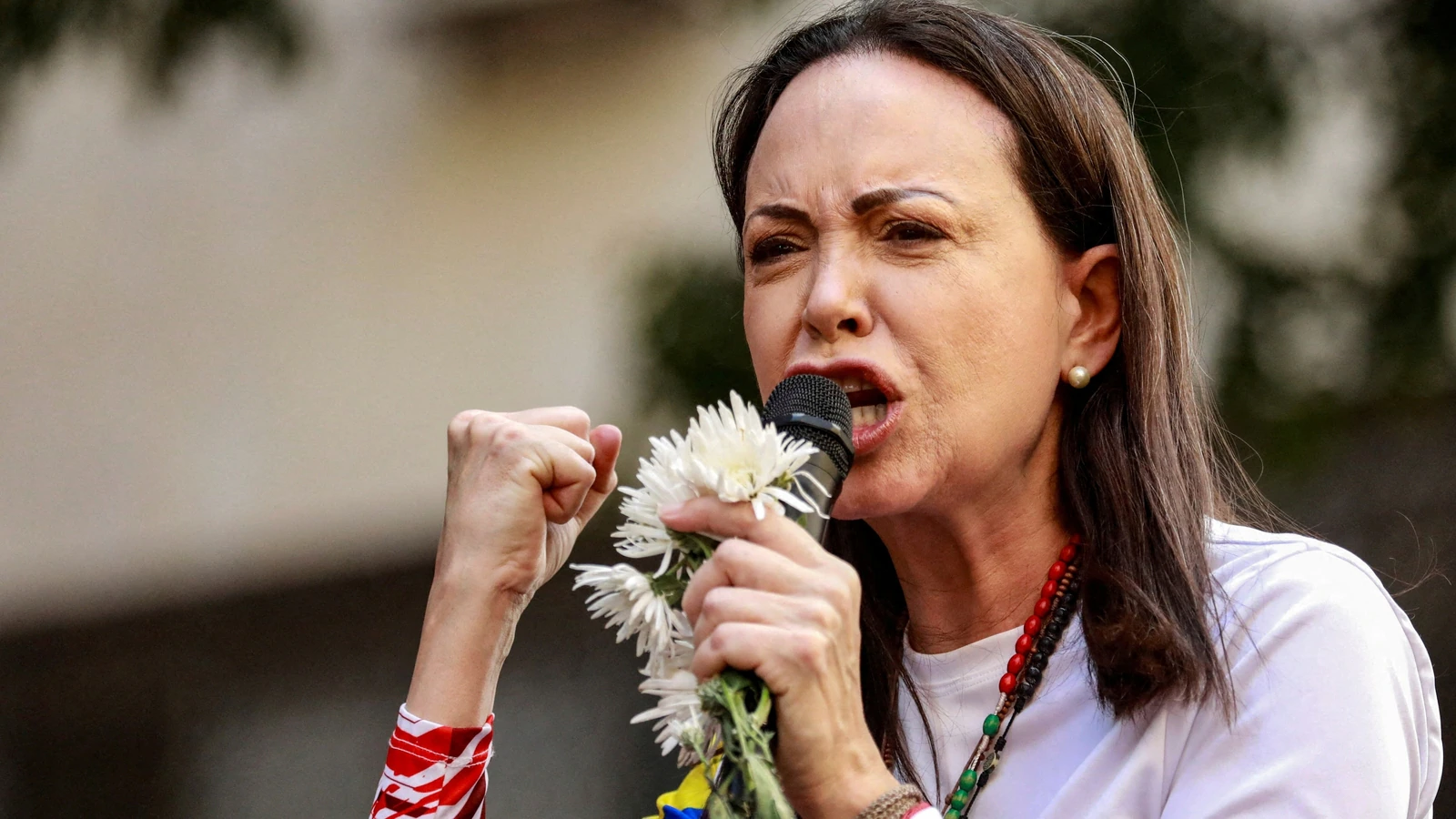
Yet, Machado refused to stand down. She embarked on a nationwide campaign tour, drawing massive, euphoric crowds wherever she went, a testament to her profound connection with the Venezuelan people. She named a surrogate, Corina Yoris, to replace her on the ballot, but the regime blocked Yoris’s candidacy as well, demonstrating that the ban was not on Machado personally, but on democracy itself. Her campaign became a powerful, non-violent resistance movement, proving that her real power comes not from a government title, but from the people who see her as their leader.
Personal Life: The Human Cost of Defiance
The personal price María Corina Machado has paid for her political stance is immense. Her life is a testament to the brutal personal toll of confronting a dictatorship.
She was married to Ricardo Sosa Pérez, with whom she had three children: Alejandro, Andrés, and Victoria. In a tragedy that marked her life profoundly, Ricardo died in a plane crash in 2009. She has spoken little about this profound personal loss, but it undoubtedly shaped her resilience and her determination. Raising three children as a single mother while simultaneously leading a high-stakes political battle against a ruthless regime adds an almost unimaginable layer of difficulty to her life.
Her family has been directly targeted by the state. Her sister, father, and other relatives have faced harassment, and in some cases, detention, as a means of pressuring her. This is a classic tactic of authoritarian regimes: to attack the family in order to break the dissident. It is a constant, psychological warfare designed to force her into exile or silence.
She lives under constant threat. Her security is a paramount concern, and she moves with a team of bodyguards, aware of the fate of other opposition figures in Venezuela and the region. Despite this, she projects an image of remarkable calm and determination. In public, she is often seen smiling, embracing supporters, and displaying a warmth that belies the steeliness of her resolve. This combination of maternal warmth and unbreakable will is central to her public persona, making her both relatable and formidable.
Legacy & Impact: A Symbol for Venezuela and the World
María Corina Machado’s legacy is still being written in the tense, uncertain streets of Venezuela. Yet, her impact is already profound and multifaceted.
-
The Unifier of a Fractured Opposition: For years, the Venezuelan opposition was plagued by infighting and conflicting strategies. Machado’s overwhelming primary victory consolidated the anti-Maduro vote around a single, clear leader for the first time in years. She provided a focal point for hope and resistance.
-
Exposing the Regime’s Illegitimacy: By banning the candidate chosen by millions in a transparent primary, the Maduro regime exposed its own fraudulent nature to the entire world. Machado’s very existence as a political force has become the most potent argument against the regime’s claims of democracy.
-
A New Model of Female Leadership in Latin America: She represents a distinct type of female leader—not a populist of the left or right, but a liberal democrat in the classical sense. She champions free markets, individual liberties, and the rule of law, offering a clear alternative to the socialist “caudillo” model and the conservative strongmen in the region.
-
The Power of Peaceful Resistance: In a context where many have lost faith in electoral change, she has channeled popular despair into a massive, disciplined, and non-violent political movement. Her strategy is one of civil resistance, using the regime’s own broken rules to highlight its injustice.
-
An International Symbol: Her plight has galvanized international attention. World leaders, from the United States to the European Union and Latin American capitals, recognize her as the legitimate representative of the Venezuelan people’s will. She has become a global symbol of the struggle for democracy against overwhelming odds.
Final Thoughts, and What We Learn
The story of María Corina Machado is a stark lesson in the brutal realities of 21st-century authoritarianism and the extraordinary courage required to challenge it.
What We Learn from Her Life:
-
Courage is a Daily Choice: Machado’s bravery is not a single act, but a continuous series of choices. Every speech, every public appearance, every day she remains in Venezuela is an act of defiance. It teaches us that true courage is a habit, not a moment.
-
Legitimacy Comes from the People, Not the State: Her power derives not from any official position—in fact, she holds none—but from the massive, organic mandate given to her by her fellow citizens. This is a powerful reminder that true authority is granted by consent, not by force.
-
Do Not Underestimate the Power of a Single, Determined Voice: In the face of tanks, tribunals, and terror, an unarmed woman with a powerful message has become the regime’s most significant threat. Her story proves that a single voice, if it speaks for millions, can shake the foundations of power.
-
The Personal is Political, and the Political is Deeply Personal: Her struggle shows that political conflict is not an abstract game. It invades homes, threatens families, and demands the deepest personal sacrifices. There is no clean separation between the public battle and the private life.
-
Hope is a Form of Resistance: In a country crushed by despair, her ability to inspire hope is her most revolutionary weapon. By simply continuing to believe—and making others believe—in the possibility of a different future, she wages a powerful form of psychological warfare against the regime’s narrative of inevitable domination.
María Corina Machado stands, unbowed, at the center of her nation’s storm. Whether she ever becomes president of Venezuela is almost secondary to the role she has already played. She has reminded her people of their own power, exposed the rotten core of a dictatorship, and shown the world that the desire for freedom cannot be disqualified by any court. She is the unbowed woman, and her story is far from over.