
In the dark, there is a formula. A killer stalks a group of teenagers. One by one, they fall to a gruesome fate, until only one remains—the “Final Girl.” She is pure, she is resourceful, she is the last one standing. In 1978, a 19-year-old unknown named Jamie Lee Curtis stepped into this role in a low-budget horror film called Halloween. As Laurie Strode, she didn’t just survive; she defined an archetype and launched a genre into the stratosphere. But the most compelling horror story, and the most inspiring tale of survival, was the one happening off-screen.
Jamie Lee Curtis is the original “scream queen,” but that title barely scratches the surface of her remarkable journey. She is the daughter of Hollywood royalty who had to forge her own identity in the shadow of immense fame and addiction. She is a beloved children’s book author and a fierce activist who has used her platform to champion LGBTQ+ rights, recovery, and human dignity. She is a woman who spent decades in a private war with opioid addiction, emerging on the other side with a radical honesty that has become her superpower. Her story is not just about surviving a fictional boogeyman; it’s about a real-life battle for sobriety, self-acceptance, and a legacy that goes far beyond the silver screen. This is the biography of the final girl who lived, and in living, taught us all how to fight our own monsters.
Early Life & Background: Growing Up in the Shadow of Giants
Jamie Lee Curtis was born on November 22, 1958, in Los Angeles, California. From the moment she took her first breath, she was front-page news. She was the daughter of two of Hollywood’s most glamorous and troubled icons: Tony Curtis, the dashing star of Some Like It Hot, and Janet Leigh, the shower-scene scream queen of Alfred Hitchcock’s Psycho. Her childhood was a paradox of immense privilege and profound emotional neglect.
Life inside the “Candyland,” as she called their home, was chaotic. Her father’s movie-star ego and rampant drug use created a volatile environment. Her parents’ marriage was a public spectacle that ended in a bitter divorce when Jamie was four. She and her older sister, Kelly, were raised by their mother, who, while more stable, was often working and emotionally distant. Jamie has spoken openly about the deep sense of loneliness and insecurity that plagued her childhood. She felt unseen, living in the long shadow of her parents’ colossal fame and personal demons.
The legacy of Psycho was particularly potent. The famous shower murder scene involving her mother was a cultural touchstone that both fascinated and haunted her. It created an unconscious link in her mind between acting, suspense, and violence—a link that would resurface at the very start of her career. She attended the prestigious Beverly Hills High School and then the University of the Pacific and the University of Southern California, but she never graduated, feeling lost and unsure of her place in the world. To support herself, she worked as a restaurant hostess and took small modeling jobs. The pressure to live up to her parents’ legacy was immense, and she initially resisted going into acting, terrified of the comparison and the potential for failure. But the pull was too strong. With a famous last name and a desperate need to carve out her own identity, she auditioned for her first professional role.
Career & Achievements: From Scream Queen to Everywoman
Curtis’s career is a fascinating study in reinvention, spanning five decades and multiple genres.
The Scream Queen Era (1978-1983)
Her big break came from a director who understood the power of her lineage. John Carpenter was casting a low-budget horror film and saw Janet Leigh’s daughter as the perfect choice for the lead. In Halloween (1978), Curtis’s Laurie Strode was a revelation. She wasn’t a sexualized victim; she was the bookish, responsible babysitter whose intelligence and resilience allowed her to survive the unstoppable Michael Myers. The film was a monumental success, becoming one of the most profitable independent films ever made and single-handedly creating the slasher genre boom.
Instantly typecast as the “scream queen,” she was thrust into a series of similar horror films: The Fog (1980), Prom Night (1980), Terror Train (1980), and Halloween II (1981). She was the undisputed queen of the genre, but she felt trapped. She was financially independent but artistically stifled, known only for running and screaming.
The Comedic Turn and Mainstream Stardom (1983-1994)
Her first major pivot was a brilliant one. She took a supporting role in the uproarious Eddie Murphy comedy Trading Places (1983). As Ophelia, the kind-hearted prostitute with a heart of gold, she held her own against comedy giants and showcased a previously unseen comedic talent and raw sex appeal in a now-iconic scene. It proved she was more than a horror star.
This led to a string of successful comedies that made her a bona fide movie star. She starred in the cult classic A Fish Called Wanda (1988), delivering a hilarious and seductive performance that earned her a BAFTA Award for Best Actress. She then transitioned into the family-action genre with True Lies (1994), where she performed her own stunts and stole the show as a bored housewife turned accidental spy, winning a Golden Globe. She had successfully shed the “scream queen” label and become one of the most versatile and bankable stars in Hollywood.
The Character Actress and the Return to Horror (1995-Present)
As she entered her 40s, Curtis continued to choose interesting, varied roles. She starred in the Freaky Friday remake (2003), showcasing her perfect comic timing and physicality. But her most profound professional journey has been her return to the franchise that started it all.
She reprised her role as Laurie Strode in Halloween H20: 20 Years Later (1998) and then, after a long hiatus, returned for a new trilogy of films beginning with Halloween (2018). This time, Laurie was not a victim, but a warrior. She was a traumatized, prepared, and fiercely determined survivor, a portrayal that mirrored Curtis’s own personal battles with addiction and trauma. The role was no longer about running; it was about standing and fighting. It was a full-circle moment that recontextualized her entire career, transforming a genre archetype into a powerful symbol of post-traumatic strength and resilience.
Personal Life: The Quiet Victory of Sobriety
Behind the glamorous movie-star image, Jamie Lee Curtis was fighting a brutal, private war. For nearly a decade, starting in 1989, she was addicted to opioid painkillers, initially prescribed after a minor cosmetic procedure. The addiction took hold silently, a “private misery” she hid from everyone, including her husband, the acclaimed actor and filmmaker Christopher Guest, whom she married in 1984.
The facade of the perfect Hollywood life—a successful career, a loving marriage, two adopted children, Annie and Thomas—was cracking under the weight of her secret. She would sneak away to steal Vicodin from friends’ medicine cabinets, living in constant fear of being exposed. The turning point came in 1998 when a friend in recovery confronted her. Reading a TV Guide article about another celebrity’s addiction, she saw herself in the story and knew she had to change. She sought help, and on July 23, 1999, she got sober.
This was the real final girl moment. Sobriety became the central, defining victory of her life. She has been radically open about her recovery, using her platform to destigmatize addiction and offer hope to others. Her marriage to Guest, which has lasted over four decades, is a testament to their partnership and her commitment to a stable, loving family life, a stark contrast to her own childhood.
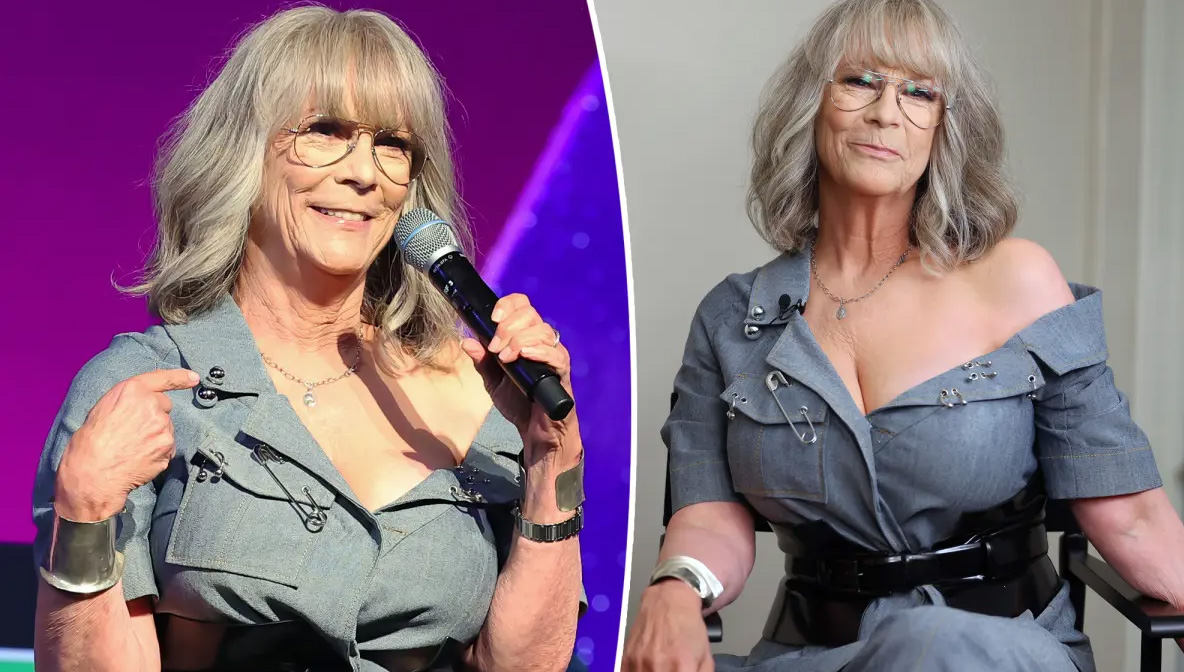
In her later years, she has embraced her identity with a joyful defiance. She is a bestselling children’s author, writing books that tackle childhood anxieties. She is a passionate advocate for LGBTQ+ rights and has been a vocal supporter of her daughter, Annie, who is transgender. She uses her Instagram not for curated perfection, but for raw, unfiltered honesty—posting photos of herself without makeup, celebrating her gray hair, and talking openly about aging, menopause, and the challenges of life. She has become a different kind of icon: a hero of authenticity.
Legacy & Impact: More Than a Survivor
Jamie Lee Curtis’s impact is layered and profound, extending far beyond the movie theater.
-
The Original Final Girl: She didn’t just play a role; she created a blueprint. Laurie Strode is the foundational text for every resilient female character in horror, from Scream to Stranger Things. She established that the true hero of a horror story is not the killer, but the woman who outsmarts and outlasts him.
-
A Champion for Recovery: Her public, unflinching honesty about her addiction and recovery is one of her greatest legacies. By sharing her story, she has broken down shame and provided a lifeline for countless people struggling with substance use disorder. She has made recovery visible and heroic.
-
Redefining Aging and Authenticity: In an industry obsessed with youth, Curtis is proudly, loudly middle-aged. She rejects Photoshop, celebrates her natural body, and speaks openly about the realities of being an older woman. She is a role model for graceful, honest aging, showing that power and beauty are not diminished by time but deepened by it.
-
A Bridge Between Eras: Her career connects Old Hollywood (through her parents) to the independent film revolution of the 70s, the blockbuster era of the 80s and 90s, and the modern age of legacy sequels. She is a living repository of film history.
-
The Power of Reinvention: She has successfully navigated multiple career phases: horror star, comedy lead, action hero, character actress, and author. Her career is a masterclass in adaptability and refusing to be pigeonholed.
Final Thoughts, and What We Learn
Jamie Lee Curtis’s life is a powerful narrative about the long, hard work of becoming yourself. It is a story that moves from the terror of being defined by others to the profound peace of self-definition.
What We Learn from Her Life:
-
Your Origin Story is Not Your Destiny: Born into a narrative of addiction and glamour, she could have been consumed by it. Instead, she acknowledged it, fought it, and wrote her own ending. We are not doomed to repeat the patterns of our past.
-
Vulnerability is the Ultimate Strength: Her decision to speak openly about her deepest shame—her addiction—disarmed it. She teaches us that sharing our struggles doesn’t make us weak; it makes us human, connectable, and ultimately, unbreakable.
-
It’s Never Too Late to Change Your Story: Her most powerful work, both on-screen as a traumatized Laurie Strode and off-screen as a recovery advocate, came in her 50s and 60s. Her life proves that our most meaningful chapters can be written long after we think the plot is set.
-
Authenticity is a Radical Act: In a world of filters and facades, her commitment to showing the real, unvarnished truth of her life—the wrinkles, the recovery, the joy, the pain—is a revolutionary act of courage. It gives others permission to do the same.
-
The Final Girl Wins by Enduring: The lesson of Laurie Strode, and of Jamie Lee Curtis, is that victory is not about never being hurt. It’s about being hurt, scarred, and traumatized, and still choosing to stand up, fight back, and live. The real horror isn’t the monster; it’s giving up. The real victory is survival.
Jamie Lee Curtis is the final girl who lived. She survived the specter of her parents’ legacy, the typecasting of Hollywood, and the private monster of addiction. She didn’t just survive; she thrived, transforming her pain into purpose and her platform into a beacon of hope and honesty. She is a living reminder that our scars are not signs of defeat, but proof of the battle we won.