
Introduction
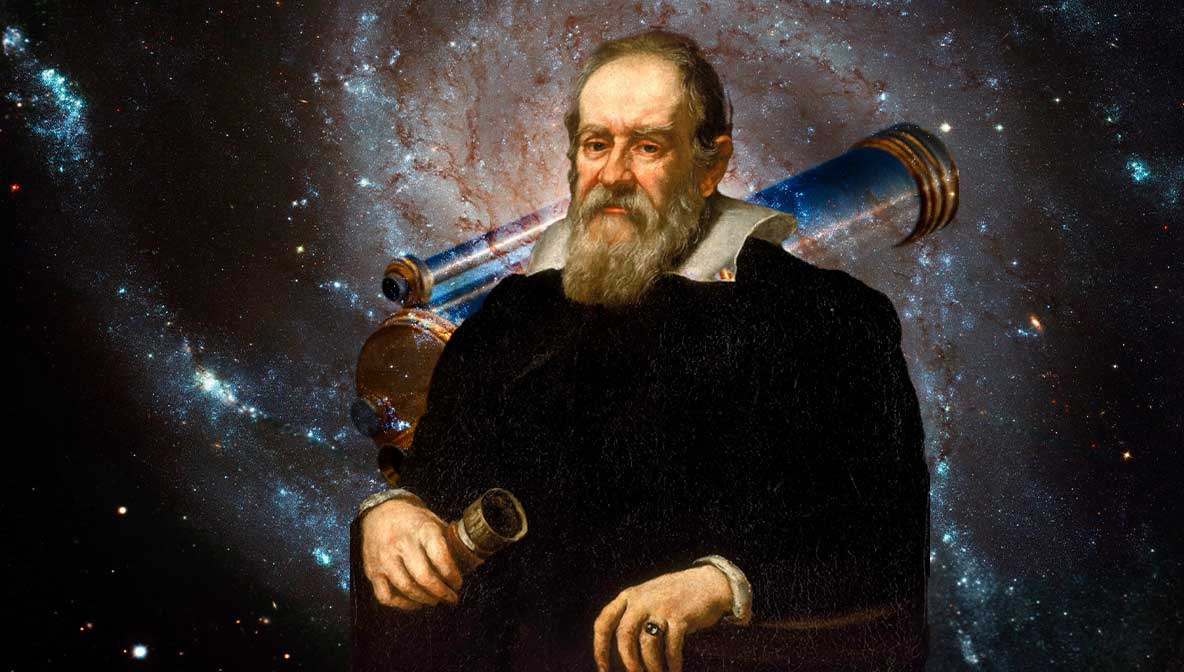
Galileo Galilei wasn’t just an astronomer—he was a rebel with a telescope. At a time when people believed Earth stood still at the center of the universe, Galileo dared to say otherwise. His discoveries shattered ancient myths, sparked a scientific revolution, and even got him in trouble with the Church. Yet, his courage to seek the truth made him the “Father of Modern Science.”
Early Life & Background
Born on February 15, 1564, in Pisa, Italy, Galileo was the son of a musician and scholar. Though his father wanted him to study medicine, young Galileo was more fascinated by math and physics. While studying at the University of Pisa, he made his first big discovery—the law of the pendulum—simply by watching a swinging chandelier in a cathedral.
He never finished his degree but became a professor instead, teaching mathematics and conducting experiments that would change science forever.
Career & Achievements
Revolutionizing Astronomy
Galileo didn’t invent the telescope, but he improved it—turning it toward the night sky. What he saw shocked the world:
-
Jupiter’s Moons (1610): He discovered four moons orbiting Jupiter, proving not everything revolved around Earth.
-
Moon’s Surface: Contrary to popular belief, the Moon wasn’t smooth—it had mountains and craters.
-
Sunspots: His observations showed the Sun had imperfections, challenging the idea of a “perfect” universe.
Physics Breakthroughs
-
Law of Falling Bodies: He proved that objects fall at the same speed, regardless of weight (contrary to Aristotle’s teachings).
-
Inertia Concept: His experiments laid the groundwork for Newton’s First Law of Motion.
Conflict with the Church
Galileo supported Copernicus’s idea that Earth revolved around the Sun—a dangerous belief in 17th-century Italy. The Catholic Church accused him of heresy, forced him to recant, and placed him under house arrest for the rest of his life. Yet, he kept working in secret, writing one of his greatest books, Two New Sciences, while imprisoned.
Personal Life
Galileo never married but had three children with Marina Gamba. His two daughters became nuns, and his closest confidante, Sister Maria Celeste, supported him during his darkest years. Despite fame and persecution, he remained curious, witty, and stubborn—traits that both helped and hurt him.
Legacy & Impact
Galileo’s work paved the way for modern astronomy and physics. Centuries later, the Vatican finally admitted it was wrong to condemn him. Today, his name lives on:
-
NASA’s Galileo spacecraft explored Jupiter.
-
The term “Galilean moons” honors his discovery.
-
His trial symbolizes the fight for scientific freedom.
Final Thoughts & What We Learn
Galileo’s life teaches us:
✔ Truth matters more than tradition.
✔ Even great minds face opposition—but persistence wins.
✔ Science isn’t about beliefs; it’s about evidence.
His story reminds us that progress often comes from questioning the impossible.
Why Remember Galileo?
-
🔭 Proved Earth wasn’t the center of the universe.
-
⚖️ Stood trial for his beliefs but never stopped exploring.
-
📜 His work inspired Newton, Einstein, and modern science.
Galileo didn’t just look through a telescope—he changed how we see the cosmos.